The Suit of Swords brings thought, words and decisions into focus. Its 14 cards include curiosity, clarity and rest as well as conflict and grief. A dramatic picture need not become a frightening prediction.
If tarot is part of your spiritual practice, the Swords can invite a more honest conversation with yourself: what am I noticing, what am I assuming and what needs care? Begin with the image. You do not have to force every keyword to fit your life.
Thought, conflict, clarity and truth
These four themes are useful starting points. Thought includes ideas, plans and the stories we tell ourselves. Conflict may involve a disagreement or competing priorities. Clarity can mean naming a question precisely, not suddenly knowing everything. Truth asks us to distinguish an interpretation from something we have actually checked.
Swords are commonly associated with air. The traditional Golden Dawn attribution text calls the Ace the root of the powers of air; its numbered Swords correspondences include Libra, Aquarius and Gemini. These are optional symbolic associations, not personality tests or current sky positions.
The illustrated scenes discussed here are those of Pamela Colman Smith’s Rider–Waite–Smith deck. Other decks may emphasize different details. For wider history, Britannica’s overview of tarot places the cards in the context of their earlier use as a game.
Read one Swords card in four steps
- 1Describe the picture Name one visible detail before choosing a meaning. A blindfold, a raised sword and a boat invite different questions.
- 2Name the possible theme Try a sentence such as “I feel caught between two options.” Leave room for the card not to fit your situation.
- 3Separate the known from the assumed Write the facts on one line and your interpretations on another. Check actual restrictions instead of blaming yourself for them.
- 4Choose a proportionate response Ask a question, gather information, rest, seek support or take a small step. Waiting can be a valid response too.
All 14 Swords cards, Ace to King
Use these as contemporary interpretive prompts, not universal definitions. Upright and reversed readings vary. The original Waite descriptions of the Swords record the scenes and much older divinatory language; the gentler vocabulary below is not a verbatim list of his meanings.
Ace of Swords
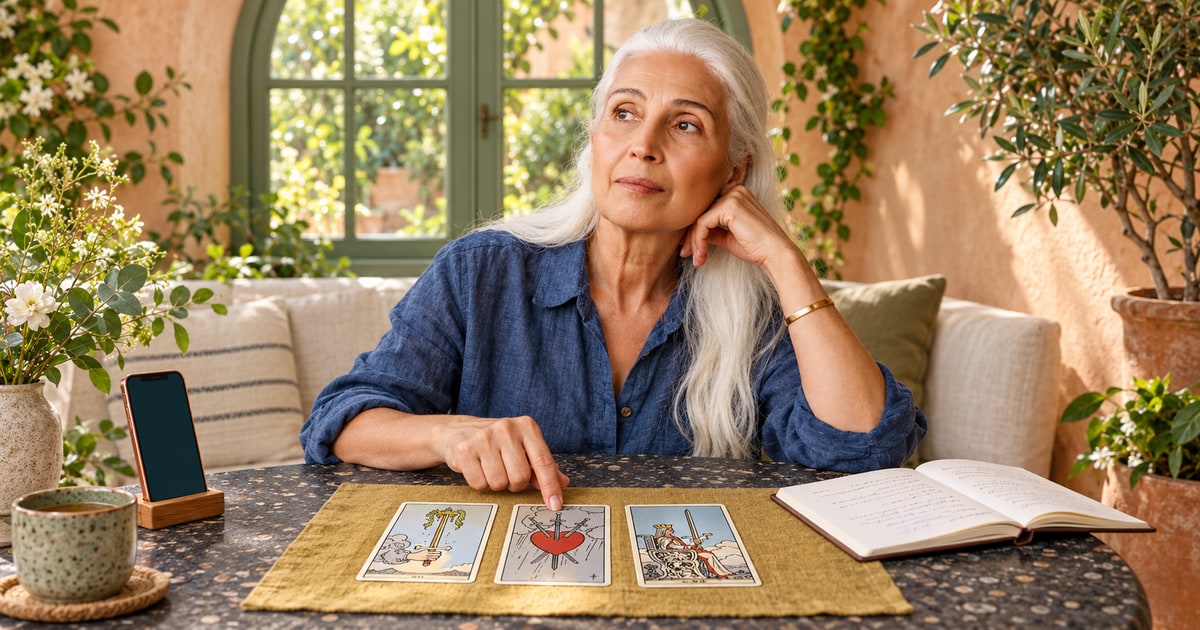
A hand from a cloud holds a sword through a crown.
- Upright
- Clarity, an idea, direct communication.
- Reversed possibilities
- A muddled plan, confusion or words needing care.
What needs a clearer definition before I act?
Two of Swords
A blindfolded figure balances crossed swords beside water.
- Upright
- A stalemate, a pause or competing considerations.
- Reversed possibilities
- A difficult choice becoming clearer, or pressure without enough information.
Which fact or preference have I not yet considered?
Three of Swords
Three blades cross a red heart beneath rain clouds.
- Upright
- Grief, separation or a painful realization.
- Reversed possibilities
- Making room for healing, or pain that still needs attention.
What hurt deserves to be acknowledged without adding a prediction?
Four of Swords
A knight’s effigy rests on a tomb; three swords hang above and one lies below.
- Upright
- Rest, a retreat, space to think.
- Reversed possibilities
- Restlessness, difficulty resting or a careful return to activity.
What could I pause, and what would make that pause possible?
Five of Swords
One figure gathers swords as two others turn away.
- Upright
- Conflict, a hollow win, the cost of an argument.
- Reversed possibilities
- Reconsidering a conflict, regret or an unresolved disagreement.
Is proving my point helping, or making the situation harder?
Six of Swords
A person poles a boat with passengers and six swords toward another shore.
- Upright
- Transition, support through change, carrying experience forward.
- Reversed possibilities
- A difficult transition, unfinished matters or reconsidering the route.
What would make this change more supported and practical?
Seven of Swords
A figure carries five swords away from a camp; two remain behind.
- Upright
- Strategy, privacy, an indirect approach or avoidance.
- Reversed possibilities
- Reviewing a strategy, seeking advice or reconsidering secrecy.
What am I keeping private, and is that serving a useful purpose?
Eight of Swords
A bound, blindfolded figure stands among swords near a distant building.
- Upright
- Restriction, limited options or feeling unable to move.
- Reversed possibilities
- Finding support, questioning a limit or recognizing a possible opening.
Which limits are factual, which are assumptions, and what support is available?
Nine of Swords
A seated figure covers their face in bed beneath nine horizontal swords.
- Upright
- Worry, distress, a thought that keeps returning.
- Reversed possibilities
- Sharing a worry, seeking help or exploring whether it is easing.
What am I experiencing, and who could help me address it?
Ten of Swords
A prone figure has ten swords in the back; a bright horizon appears beyond.
- Upright
- A painful ending, exhaustion with a situation or a limit reached.
- Reversed possibilities
- Considering recovery, reviewing an ending or difficulty letting go.
What has actually ended, and what care or practical task comes next?
Page of Swords
A standing figure holds a sword with both hands in a windy landscape.
- Upright
- Curiosity, observation, a new question.
- Reversed possibilities
- Hasty words, scattered attention or checking information poorly.
What do I need to learn before repeating a claim?
Knight of Swords
An armoured rider charges forward with a raised sword.
- Upright
- Direct action, urgency, determination.
- Reversed possibilities
- Rushing, inflexibility or acting before checking the consequences.
Is speed useful here, or do I need a pause?
Queen of Swords
A seated queen holds a sword upright and extends her other hand.
- Upright
- Discernment, honest speech, clear boundaries.
- Reversed possibilities
- Overly harsh judgment, defensiveness or difficulty expressing a boundary.
How can I be clear without being needlessly cutting?
King of Swords
A seated king faces forward with a sword held at an angle.
- Upright
- Reasoned judgment, responsibility, principled authority.
- Reversed possibilities
- Rigidity, unfair use of authority or a decision detached from its human cost.
What standard would make this decision fair and accountable?
The courts can represent people, roles or approaches. A Page’s curiosity, a Knight’s urgency, a Queen’s discernment and a King’s responsibility are not ranks of personal worth. Explore the guide to all 16 court cards for comparisons across suits.
One situation, four different angles
The common playing-card correspondences below are learning aids. They do not make tarot and cartomancy identical, or confine a subject to only one suit.
Wands
Fire · Clubs
Energy, initiative and creative effort. What do I want to put into this?
Cups
Water · Hearts
Feelings, relationships and intuition. What am I feeling or valuing?
Swords
Air · Spades
Thought, communication, choices and conflict. What am I thinking, and what supports it?
Pentacles
Earth · Diamonds
Resources, work, the body and practical needs. What time, care or resources does this need?
Example: considering a job offer
The Three of Wands could invite a look at your longer-term ambitions. The Two of Cups could prompt questions about collaboration. The Four of Pentacles could turn attention to resources and the wish to protect stability. The Two of Swords could focus on competing considerations.
Those are four ways to explore the same offer, not facts the cards have discovered about the employer. Check the actual pay, duties, conditions and deadline. For a Two of Swords question, you might write “Which missing detail would help me compare these options?” rather than assuming you already know the answer and are refusing it.
The 78-card deck map shows how the 14 Swords fit beside the other suits and the Major Arcana.
Five difficult images, handled with care
You can acknowledge an unsettling image without making it describe an event. If a card feels overwhelming, put it aside. There is no requirement to keep interpreting until it feels positive.
Three: acknowledge the hurt
The pierced heart can give a strong image to grief or separation. You do not need to search for a betrayal to justify drawing it. If hurt is already present, ask what acknowledgment or support would be useful; the rain does not promise that healing has begun.
Five: consider the cost of conflict
The gathered swords and departing figures can prompt a look at what an argument is costing. You might seek clarification, disengage or set a boundary. Do not assume the person holding the swords is always you, or that keeping a relationship at any cost is the right answer.
Eight: do not turn restriction into blame
The picture can feel like being stuck, but real constraints also exist: money, disability, coercion, responsibilities or lack of support. The card cannot decide that a barrier is imaginary or that leaving is easy. Ask what is changeable, what is not and who could help.
Nine: attend to the worry itself
This image can resonate with sleeplessness or distress. It does not diagnose anxiety or prove that a fear has no real cause. If worry persists or interferes with daily life, consider speaking with a health professional rather than using more draws to settle it.
Ten: an ending is not a promise that all danger is over
The bright horizon can be a hopeful symbol, but it cannot confirm that the worst has passed. Identify what has actually ended and what remains unresolved. The printed scene is not evidence of injury, death or an inevitable disaster.
NIMH’s information on anxiety distinguishes occasional worry from symptoms that persist and interfere with daily life. Seeking help does not depend on drawing a particular card. If you are struggling or having thoughts of suicide, call or text 988 in the US; call 911 in a life-threatening emergency. Elsewhere, use local crisis or emergency support.
When a spread contains several Swords
- 1. Notice the mood, not a forecast Weather, posture and movement can help you describe the image. They do not establish how serious your situation is.
- 2. Notice a repeated theme Several Swords can focus a reading on communication or decisions. A numerical majority does not prove you are overthinking or that trouble is coming.
- 3. Compare rest, movement and clarity The Four, Six and Ace offer contrasting themes. Explore them as possibilities, not automatic solutions supplied by neighbouring cards.
- 4. Give each court a different approach Try the Page’s question, the Knight’s urgency, the Queen’s boundary and the King’s judgment. These roles are not tied to age or gender.
- 5. Write a tentative sentence “I may be postponing this choice” is easier to test than “The Two means I must decide today.” Include anything that did not fit.
- 6. End when you have enough Choose an action, a pause or a question to take to someone else. Repeated draws are not necessary to earn certainty.
Habits worth keeping
- Explore the sequence without making it a timetable. Ace to Ten can be a memory story about ideas, choices, conflict, rest, change and endings. It is not a cycle everyone must experience in order.
- Compare matching numbers across suits. Three of Cups beside Three of Swords can invite a discussion of support alongside grief. It does not cancel the difficult card or guarantee comfort.
- Record a sentence you can check. “I have not asked about the lease deadline” is more useful to revisit than “Two of Swords means stalemate.” Note what did not fit as well.
- Keep the question within the reading’s limits. Cards cannot establish whether someone is lying, diagnose a health condition or determine a legal outcome. Use reliable evidence and appropriate professional help for those questions.
You may read reversals as blocked, inward, excessive or easing themes, or keep all cards upright. Choose your approach before the draw. The reversed-card guide explores that choice.
18 questions about the Suit of Swords
1. What does the Suit of Swords mean in tarot?
In many Rider–Waite–Smith-style readings it explores thought, communication, judgment, decisions and conflict. You may also find spiritual meaning in its search for clarity. Begin with the picture and the question rather than treating a keyword as a fact about your life.
2. How many Swords cards are in a tarot deck?
Fourteen: Ace through Ten, followed by Page, Knight, Queen and King. The four suits together contain 56 Minor Arcana cards. Some decks rename the courts or include extra artwork; check the guidebook if your count differs.
3. Which element is linked to the Swords?
Air is the common association in the Golden Dawn system and many modern readings. Elemental correspondences are symbolic conventions, and not every deck or tradition uses the same assignments.
4. Which playing-card suit matches the Swords?
Spades is the common cartomancy correspondence. Cups are usually paired with Hearts, Wands with Clubs and Pentacles with Diamonds. That comparison is useful for learning; it does not make all playing-card and tarot interpretations identical.
5. Are Swords cards always negative?
No. The suit includes curiosity, clear communication, rest and responsible judgment as well as conflict and distress. A difficult image can invite a useful question without becoming a verdict about what will happen.
6. What does it mean when a reading is mostly Swords?
It can give your reading a strong theme of thought, communication or decisions. It does not prove that you are overthinking or neglecting feelings. Compare the individual cards, their positions and the circumstances you actually know.
7. Does the Three of Swords mean someone will break my heart?
The pierced heart is often read through grief or painful separation, but drawing it is not evidence of an approaching betrayal or breakup. You can explore a feeling that is already present without searching for a future event to explain the card.
8. Does the Ten of Swords mean death or disaster?
It does not establish either. Many readers use it to explore an ending, a limit reached or the need to stop repeating a painful situation. The dawn in the picture is a symbol to consider, not proof that all danger or difficulty has passed.
9. What if I keep drawing the Nine of Swords?
You may choose to reflect on worry or distress, but repetition does not establish your mental state or confirm a feared event. If readings are increasing your worry, take a break. Persistent or disruptive symptoms deserve support independently of what you draw.
10. How are the Queen and King of Swords different?
A useful comparison is the Queen’s discernment and clear boundary beside the King’s reasoned authority and responsibility. Either can describe a role or approach, not only a person, and neither requires a particular age or gender.
11. How do reversed Swords cards work?
Some readers explore a theme as blocked, inward, excessive or easing. A reversed difficult card does not automatically mean relief. Choose a consistent method and use the question and surrounding cards; you can also read the full range with every card upright.
12. Which zodiac signs are linked to the Swords?
Gemini, Libra and Aquarius are the air-sign associations often used alongside the suit in Golden Dawn-derived systems. Use them as an optional symbolic layer, not a way to identify a person, judge a sign or establish a date.
13. Can the Swords tell me whether someone is lying?
No card establishes deception or another person’s private thoughts. The Seven may invite questions about privacy, strategy or avoidance, but it is not evidence against someone. Check observable behaviour and reliable information.
14. Is the Ace of Swords a good card?
It often suggests a fresh idea, clarity or direct communication. Its usefulness depends on the context: a clear idea still needs checking, and honesty need not be harsh. It does not guarantee that your interpretation is correct.
15. What does the Two of Swords say about a decision?
It can represent a pause, uncertainty or competing considerations. Ask what information is missing and whether there is a real deadline. You do not have to assume you are avoiding the answer or that the card requires a choice today.
16. What is the Seven of Swords warning me about?
Possible themes include strategy, acting privately, an indirect approach or avoidance. Consider whether a method fits your situation and values. Do not turn the card into proof of dishonesty, guilt or a secret that must be exposed.
17. Does the Six of Swords mean I should move or leave a relationship?
Not by itself. Its boat and passengers can invite reflection on a transition and the support needed for it. A card cannot establish that a move is underway, that conditions will improve or that leaving is safe and practical.
18. What do the Swords court cards represent?
They can be people, roles or ways of approaching a question. The Page can ask, the Knight can pursue, the Queen can discern and the King can judge responsibly. Treat those as flexible prompts rather than fixed personality labels.
Let clarity include kindness
The Swords can make a reading more precise without making it harsher. Notice the picture, name a possible theme, check the situation and choose a response you can actually use. Clarity can include “I do not know yet.”