

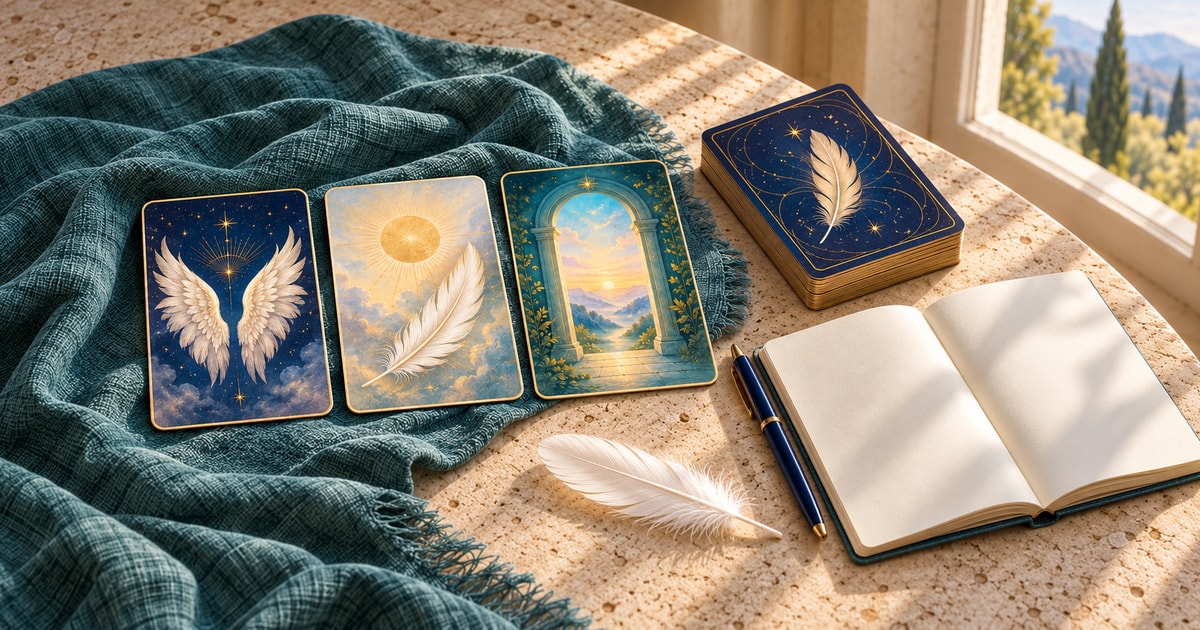
Angel oracle cards are oracle decks built around angels, archangels or qualities such as courage, compassion and trust. Their imagery and messages can offer a gentle starting point for spiritual reflection. Some readers understand the practice as connecting with angelic guidance; others use it for contemplation and journaling.
The deck’s creator sets its card meanings and reading method. There is no single angel-card system, and a moving or reassuring draw is not proof that an external being has delivered factual information. You can value the experience while leaving room for uncertainty.
A theme, not one fixed set of cards
Wings, light, open skies and messages of support are familiar motifs, but the category is wider than soft artwork and affirmations. A deck might focus on named archangels, guardian angels, virtues or a mixture of spiritual figures. Its tone may be devotional, practical, playful or more challenging.
Card counts vary too. For example, the publisher lists The Angel Guide Oracle as a 44-card deck, while The 22 Archangels Oracle contains 22. These are examples of different formats, not a ranking or a recommendation to buy either one.
“Angel” describes the theme, not necessarily the structure. An angel-themed tarot deck may retain tarot’s suits and Major Arcana; an angel oracle uses its own arrangement. Check the contents and guidebook rather than deciding from the cover alone. Our oracle-card guide explains the broader differences.
Read the image, the words and your response
The examples below are illustrative phrases, not quotations from one particular deck. Start with the meaning supplied by your own guidebook, then notice what the imagery brings to mind.
1. A named archangel
A card pairing Michael with courage might invite you to consider a difficult conversation. Ask “What would a calm, courageous response look like?” Different creators assign different themes; a modern deck’s associations are not a universal account of religious tradition.
2. A supportive affirmation
“You are supported” can become “Who could I ask for help, and what exactly do I need?” The card is an invitation to consider support, not confirmation that someone has already offered it.
3. A quality to practise
Patience, Forgiveness or Play can suggest a small action today. Patience might mean allowing time for a reply; forgiveness need not mean reconciliation, removing a boundary or excusing harm.
4. A reassuring message
If a card seems to say “All is well,” note the worry you brought to it. What can you check or address? Comfort does not require you to overlook a practical problem or a warning sign.
5. A symbolic detail
Describe a wing, doorway or dawn sky before assigning a meaning. A doorway might suggest an opportunity to you, but that association does not establish that an opportunity is coming. Keep your observation separate from your interpretation.
Try one card with one clear question
Begin with a question about your own choices, such as “How could I ask for support this week?” You may add a prayer or quiet intention if that fits your beliefs; elaborate preparation is not necessary for this exercise.
- Draw and observe. Shuffle in a comfortable way and draw one card. Write its name and one visible detail. Follow any special instructions your deck provides rather than assuming every oracle uses reversed meanings.
- Read and reflect. Check the guidebook. Write its main theme, then your own association. Ask where the theme fits, where it does not, and what information is still missing.
- Choose an ordinary next step. Name something you can actually do, ask or verify. Date the note, stop the reading and leave space to record what happens later.
Imagined example: you are nervous about requesting help with a busy week and draw a card you interpret as Support. Your note might be: “The image makes me think of sharing a load. I will ask a friend whether they can help with one errand, while making another plan if they cannot.”
The useful result is a specific request, not a promise about your friend’s response. If the card does not suggest anything helpful, “unclear today” is a valid note. You do not have to keep drawing until reassurance appears.
Once one card feels manageable, try our three short oracle spreads. If you also read tarot, an angel card can offer an opening theme or closing reflection; it does not have to cancel a difficult tarot card. See using oracle cards alongside tarot for ways to keep their roles distinct.
Choose the voice as carefully as the artwork
- Read a sample entry: does it invite reflection, or tell you what you must believe and do?
- Check spiritual language: are the names, prayers and traditions compatible with your practice? A commercial deck is not an authority on an entire faith.
- Check everyday usability: can you read the lettering and comfortably hold or shuffle the cards? Look for a guidebook in a language you can use.
- Notice the range: can the deck make space for doubt, limits and difficult feelings as well as hope? Gentle wording need not prevent honest reflection.
An angel deck need not replace tarot or be reserved only for easy questions. What matters is how you use it. A comforting message cannot establish another person’s feelings, guarantee an outcome or determine whether a situation is safe; use the relevant conversation or evidence for those questions.
If this is part of a wider change in your spiritual life, our guide to spiritual awakening offers further reflection. Keep the card practice small enough to support your day rather than repeatedly checking it for permission to act.