


The Hermit asks for room to hear yourself. Upright, it can invite purposeful solitude, patient study or wise guidance. Reversed, it can raise a different question: is this pause helping you, or have you become stuck inside it?
For a spiritual reader, the lantern can be an image of inner guidance without demanding a complete answer all at once. This is card IX of the Major Arcana, not a sentence of loneliness. Read it beside your question, the spread position and what is actually happening in your life.
Look closely at the Hermit
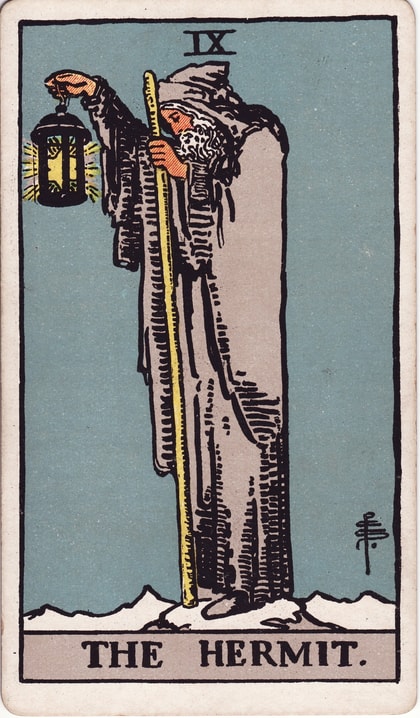
The lantern: a light to share
A six-pointed star shines inside the lantern. In Waite’s account of the card, the figure has reached a height and holds out a beacon for others. That is more than retreat: it also makes room for teaching, guidance and sharing what you have learned.
The staff: support for the journey
The long yellow staff reaches to the ground. As a reflection prompt, it can stand for the support you rely on: experience, a useful routine or someone willing to help. Wisdom does not have to mean doing everything alone.
The robe and high ground: less noise, more perspective
The gray cloak, lowered gaze and snowy setting give the scene its stillness. You might use them to ask what becomes clearer when distractions fall away. “One step at a time” is a useful way to work with this image, not a promise that a card will show the whole future.
The guide uses the Rider-Waite-Smith image. Modern themes of introspection and solitude are reading conventions, not the only meanings ever assigned to the card. Waite’s own writing emphasizes attainment; his separate divinatory list also includes caution and concealment. The history is broader still: tarot began as a card game before its later spiritual uses. Follow your deck’s guidebook when its imagery differs.
Upright and reversed: keep the question in view
Upright · choose a useful pause
Reflection, careful learning, personal space and guidance are useful starting points. You may need a quieter setting to sort your own priorities from other people’s expectations.
The mentor need not be older, male or spiritually impressive. Relevant experience, good boundaries and a willingness to listen matter more. You can also be the person offering thoughtful guidance.
Ask: What needs my undivided attention?
Reversed · reconsider the distance
Read this as a question about how solitude is working, rather than a label such as “antisocial.” Possible themes include avoiding a conversation, shutting out useful feedback or thinking in circles instead of taking a manageable step.
It may also describe the opposite problem: so little time alone that you cannot hear yourself. Choose the interpretation that fits the question and circumstances; a reversal does not automatically cancel the upright meaning.
Ask: Do I need more quiet, or more connection?
Restful solitude or an unhelpful retreat?
A pause with a purpose has something specific to explore, room for everyday responsibilities and a way back to people or action.
A pause worth reconsidering keeps moving the finish line, replaces every conversation with another reading or leaves you feeling less able to cope. These are reflection prompts, not a test or diagnosis.
If being alone feels distressing or is interfering with everyday life, reach out to someone you trust or a health professional. If you are thinking about suicide or need immediate emotional support in the US, call or text 988, available day and night. Our tarot and mental wellness guide explores how reflection and real-world support can sit together.
The Hermit in love, career and money readings
Love · space that can be communicated
If you are single, the card can invite you to notice what companionship means to you rather than treating dating as a deadline. You do not have to withdraw from a relationship you want simply because this card appears.
In a partnership, consider how each of you asks for time alone and how you reconnect afterward. Reversed, explore whether an important conversation is being avoided. A card cannot establish another person’s private feelings or whether an ex will return; listen to what they say and respect their boundaries.
A practical conversation: “I would like a quiet evening to sort my thoughts. Could we check in tomorrow after dinner?” This states a need and offers a return point without asking the other person to guess.
If distance involves threats, fear or control, prioritize safety rather than a symbolic interpretation. In the US, the National Domestic Violence Hotline is 1-800-799-7233; text START to 88788. Call 911 in an immediate emergency.
Career · study, then seek useful feedback
The Hermit can suit research, writing, careful craft or a period of learning. For a job change, use it to clarify what matters in the next role and which information you still need. It is not an instruction to quit, refuse an offer or wait indefinitely.
Reversed, ask whether working alone has become a barrier to feedback or whether constant interruptions are preventing focused work. A concrete response could be one protected work block followed by a conversation with an experienced colleague.
Money · bring the details into the light
Try a quiet review of statements, upcoming bills and questions you have been avoiding. Separate the facts you can verify from the feelings the card brings up. The Hermit does not forecast markets or establish whether an investment is suitable; decisions about debt, tax or investments may need qualified advice.
What the spread position changes
The same image can answer different questions. Use the position you chose before drawing, rather than changing it to make the card more reassuring.
- PastWhat has a period of study, distance or reflection taught me?
- Present or adviceWhere would a pause, a clearer question or trusted guidance help now?
- Future possibilityWhat space for reflection might I choose to protect, and how will I stay connected?
In an advice position in a Celtic Cross, you might explore careful thought or asking for guidance. In a future position, avoid turning the card into “you will be alone.” A useful interpretation leaves room for choices and changing circumstances.
A Hermit practice: pause, listen, ask, return
Choose a manageable topic and place the Hermit in front of you deliberately. You do not need another draw to do this exercise. Five or ten minutes can be enough to begin; adapt the timing to your needs, and keep any accessibility tools or contact you rely on available.
- Pause with a purposeWrite one question: “What needs a little more attention before I respond?” Reduce a distraction if that helps. Darkness, total silence and a full hour alone are not requirements.
- Listen, then separateWrite three short lines: what I know, what I feel, and what I still need to find out. Treat a strong feeling as something to explore, not proof that an assumption is true.
- Ask one useful questionName a trusted person or a reliable source that could help with the missing information. Write the specific question you would ask. You can value intuition and still seek another perspective.
- Return with one stepChoose a small action you can take and a realistic time to review it. Record what actually happened, including anything that did not fit your first interpretation.
Example · an unanswered invitation
You feel unsure about joining a weekend class. Your notes might read: I know the date and price; I feel nervous about arriving alone; I need to find out whether newcomers work in pairs. Your next step is to ask the organizer that question before deciding. The card supports the pause; it does not promise how the class will go.
For a fuller way to record a session, use the three-step self-reading routine. If your question is still vague, the tarot-question guide can help you make it more specific.
Read the Hermit beside other cards
These are possible conversations between images, not fixed formulas or claims that these cards appear together more often.
Eight of Cups
The walking figure can bring a theme of leaving something behind; the Hermit can add reflection about why. Ask what you are moving toward, what needs an honest ending and what practical support a change would require.
Three of Cups
A private pause sits beside shared enjoyment. Ask whether you need a break from social demands or a gentle way to reconnect. Neither card automatically makes solitude or company the “right” answer.
The Hierophant
Compare a structured source of teaching with a more personal inquiry. A course, community or teacher and independent study can complement each other; check whether the guidance welcomes questions and respects your choices.
For another contrast, the High Priestess can emphasize listening to what is not yet clear, while the Hermit can emphasize a deliberate search and guidance. The Chariot can bring the discussion toward direction and sustained action. These distinctions are starting points, not rigid definitions.
15 questions about the Hermit
1. What does the Hermit card mean in tarot?
In the reading approach used here, the Hermit can represent purposeful solitude, reflection, careful learning and guidance. Read it in relation to your question and spread position rather than assuming one fixed message.
2. What number is the Hermit card?
The Hermit is IX, or 9, in the Major Arcana. In the Rider-Waite-Smith sequence it follows Strength VIII and comes before the Wheel of Fortune X. It is not part of a suit.
3. What does the lantern on the Hermit card mean?
The star-lit lantern can suggest guidance or understanding that can be shared. Waite describes the figure as holding a beacon from a height. For a personal exercise, you can use it as an image of attending to one next step.
4. What does the Hermit mean reversed?
Possible readings include an unhelpful retreat, avoiding a decision, refusing useful guidance or having too little room for reflection. Choose an interpretation that fits the circumstances. Reversed does not automatically mean bad.
5. Is the Hermit a yes or no card?
There is no universal yes-or-no assignment. Some readers use it for a pause or not yet, but that is a chosen convention. A more useful question may be what information or reflection is needed before deciding.
6. What does the Hermit mean in a love reading?
It can invite reflection about your needs, time alone and how you reconnect. In a relationship, discuss space clearly. The card does not establish another person’s feelings or say that a partnership must end.
7. Does the Hermit mean I will be alone?
No card can establish that you are destined for lifelong loneliness. The Hermit can be used to explore the difference between chosen quiet and a distance you would like to change, while leaving room for your choices.
8. Which zodiac sign is linked to the Hermit?
The Golden Dawn correspondence links the Hermit to Virgo, an Earth sign. This is a symbolic reading system, not a statement about every Virgo or a requirement that the card represent a Virgo person.
9. What does the Hermit mean in a career reading?
It can suggest focused study, careful work or seeking relevant guidance. Reversed, consider whether isolation or constant interruption is getting in the way. It does not by itself tell you to leave a job or reject an offer.
10. What does the Hermit mean as a daily card?
Try a short, purposeful pause. Write what you know, what you feel and what you need to find out, then choose one manageable step. You do not need to withdraw from everyone or delay an urgent responsibility.
11. What is the difference between the Hermit and the High Priestess?
One useful distinction is deliberate inquiry and guidance for the Hermit, compared with listening to what remains partly hidden for the High Priestess. Both can involve intuition; deck imagery and your question still matter.
12. Is the Hermit a bad card to pull?
It is not a verdict about your character or future. Consider whether its themes help you notice a real need. If isolation feels distressing, seek support from a trusted person or health professional rather than treating a card as a diagnosis.
13. How long should I spend on a Hermit practice?
There is no required duration. Begin with a brief period that feels manageable, such as five or ten minutes, and choose a return point. Keep everyday responsibilities, support and accessibility needs in view.
14. Do I have to read the Hermit reversed?
No. Decide before the reading whether you will use reversals. You can explore supportive and difficult sides of solitude with upright cards too. Staying consistent is more helpful than changing the rule after a draw.
15. What if the Hermit keeps appearing?
Record the question, deck, card position and actual circumstances. Notice whether one theme remains relevant, but do not assume repetition proves an external message. Take a break if repeated draws are replacing a needed conversation or action.
Carry something back from the quiet
The Hermit’s pause is most useful when it makes room for a clearer question, a kind boundary or a next step. Let reflection support your life and relationships, rather than asking it to replace them.