

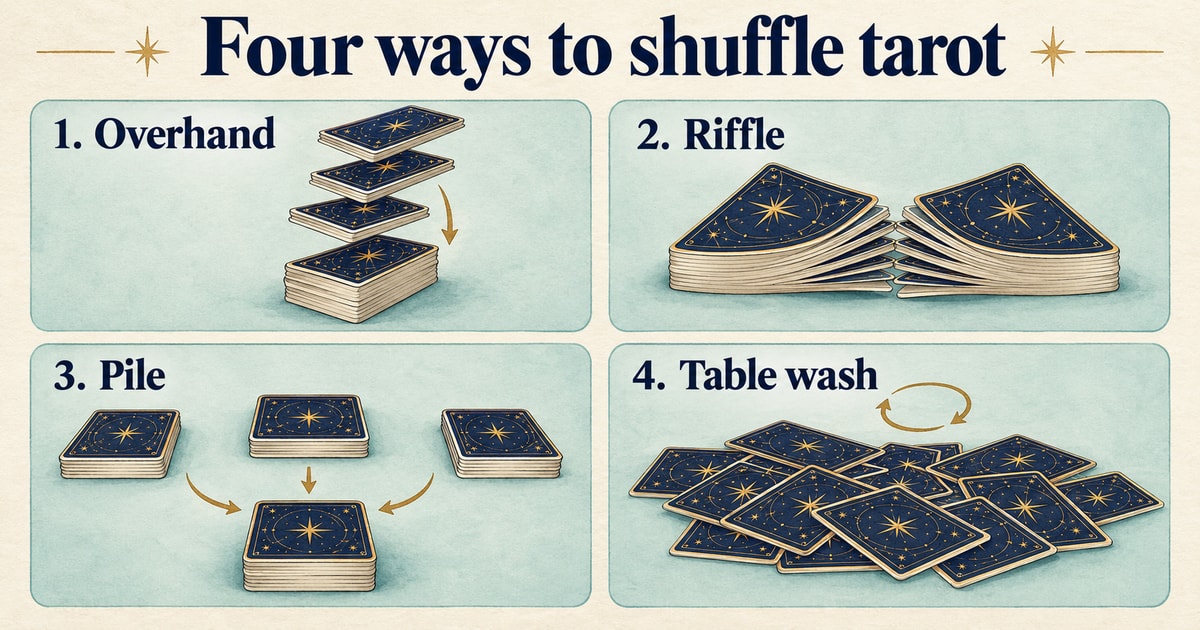
To shuffle tarot cards, choose a method you can use comfortably without forcing the deck: overhand, a gentle riffle, dealing into piles, or a table wash. Mix, square the edges, cut if you wish, and draw for a question and spread you have chosen in advance.
The methods have different handling and mixing properties. This guide explains the movements, their limits, reversals, one-card and larger layouts, journaling and deck care. You can make room for spiritual practice without treating a particular shuffle as a guarantee of an accurate prediction.
Before you shuffle: make the deck manageable
Clear a clean, dry surface and keep drinks away. A smooth cloth is optional; check that it does not snag the corners. Try holding the deck lightly. If the cards are too large or heavy, use smaller portions or a table method rather than stretching your grip. There is no need to continue through pain.
Write your question before drawing. Instead of asking cards to establish whether someone will text, try “What do I want to communicate, and what boundary would help me?” Our guide to a useful tarot reading explores preparation and questions. You can pause, breathe or set an intention if that belongs to your practice.
A standard deck has 78 cards, although size, stock and artwork vary. Tarot developed as a card game before its later divinatory use; the V&A’s history of tarot traces that distinction. For the card structure itself, start with our tarot beginners’ guide.
Four ways to shuffle tarot cards
1. Overhand: move small packets
Try this if you can hold the deck without squeezing or stretching your fingers. A large or slippery deck may be easier to handle in smaller portions.
- Support the face-down deck in one hand. Lift a larger portion with the other hand.
- Let small packets fall from the lifted portion into the supporting hand, one packet onto the next. Keep the grip light.
- Repeat with different packet sizes, then gently square the edges. If cards slip, work lower over a clean table.
Trade-off: Compact and avoids a deep bend. It can leave groups together; repeating the same packet movement is not a guarantee of a random order.
2. Riffle: interleave two halves
Use this only if the stock flexes comfortably and you can release the edges without forcing them. Test gently; thick, gilded, old or fragile cards may suit another method.
- Split the deck into two roughly similar portions, keeping both face down.
- Bring their inner edges close and release small groups so the two portions interleave. Use as little bend as you can.
- Ease the interleaved cards together and square them. Skip the springing bridge finish if it strains the cards.
Trade-off: Can mix two portions effectively with practice. It demands more grip and edge control; do not assume a fixed number of passes produces randomness.
3. Pile: deal and regather
Use this when holding the whole deck is awkward or when you want to handle the cards one at a time on a table.
- Deal face-down cards into several piles. Three is a convenient option, not a required number.
- Gather the piles into one deck in an order you choose.
- If mixing is your aim, vary the dealing and gathering and consider combining this with an overhand or table wash.
Trade-off: Little bending and easy to pause. A fixed deal-and-gather cycle is a predictable rearrangement, not randomisation; uneven piles alone do not prove the result is random.
4. Table wash: mix on a surface
Also called a swirl, this lets you move cards without holding the whole deck. Use a clean, dry, roomy surface; a smooth cloth may help protect the finish.
- Spread the deck face down in a loose overlapping layer.
- Gently move cards around in different directions, allowing them to change places. Avoid grinding the edges into the surface.
- Gather small groups and square them without forcing corners. Check orientation if you want upright-only cards.
Trade-off: Accommodates different grips and can introduce reversals. It needs space and can scuff cards on a rough surface; it is not universally the gentlest method.
A hand-to-hand packet transfer, sometimes called a push shuffle, is another option: slide small groups between your hands while keeping the deck supported. It needs grip control and may leave groups together. Fanning and picking is different—it is a way to select cards after mixing, not a shuffle by itself.
How long should you shuffle?
There is no universal thirty-second rule, number of passes or feeling that proves a deck is random. Varying the movements can change the order, but comfort and care matter too. A fixed pile cycle and an exactly alternating “perfect” riffle are structured procedures; do not confuse either with a guarantee of randomness.
The often-quoted seven-riffle figure comes from mathematical work on a particular model of riffle shuffling, famously discussed for 52 cards. It is not an instruction for every tarot deck, technique or purpose. Bayer and Diaconis’s original paper explains the model and also examines other deck sizes.
If a card falls out, you can return it or record it as a jumper according to a rule chosen beforehand. Some readers give jumpers spiritual significance; the fall itself does not establish that a message is true. If cards keep slipping, adjust your grip or work on the table rather than interpreting every spill.
Cutting the deck and drawing cards
A simple cut lifts one portion off the top and puts it underneath. You may instead divide the deck into three piles and regather them. The direction, hand and number of piles can be part of a custom, but are not universal requirements. Cutting moves the starting point; it keeps the deck’s cyclic order and does not replace mixing.
After squaring the deck, draw from the top or fan the cards and select from the fan. Decide before looking at the faces. Drawing by feel is a selection practice, not proof that every card had an equal chance of being chosen.
You can lay all cards face down and reveal them one at a time, or turn them as you draw. The first option gives a clear sequence for describing each picture, but it does not prevent earlier cards influencing later interpretations. Keep the position labels fixed rather than changing them to fit what appears.
Choosing whether to read reversals
A reversal means a card appears upside down from the reader’s viewpoint. It is not a face-up card accidentally mixed into a face-down deck. Some readers interpret a reversal as inward, blocked, excessive or otherwise altered expression; others read upright-only. It need not mean “bad” or the simple opposite.
To introduce reversals, rotate a face-down portion 180 degrees before mixing it back, or let cards rotate during a table wash. For upright-only reading, realign them. Choose before drawing and follow your deck’s approach rather than switching after seeing an uncomfortable card. There is no required beginner waiting period. Our reversed tarot guide explains interpretation options.
Lay out one, three or ten cards
One card: choose a focus such as “What could I pay attention to today?” Write an observation and a possible response, then revisit the note later. You do not have to draw more cards when one offers enough to consider.
Three cards: name the positions before drawing. Situation, obstacle and a next step is one option; what to keep, change and let go is another. Past, present and future is a traditional alternative, but a future position remains an interpretation, not verified knowledge of an event. A three-card line is not automatically right for every question.
Celtic Cross: ten positions provide a longer study exercise. Books use different numbering and labels; the version below preserves one complete layout so you can practise consistently. It is an adaptation, not a claim that every reader or Waite’s original instructions use this order.
- The situation — centre: What aspect of the question needs attention now?
- The crossing — across card 1: What help, tension or obstacle might be worth considering?
- The foundation — below the centre: What history or assumption could be shaping my view?
- The recent past — left of the centre: What experience am I bringing into this?
- The possible — above the centre: What am I aiming for, and what would improvement look like?
- The near future — right of the centre: What theme or preparation could I consider next?
- You — bottom of a separate right-hand column: How am I approaching this?
- Your surroundings — next card up in that column: What circumstances should I check rather than assume?
- Hopes and fears — next card up: What do I want, and what am I worried about?
- The outcome — top of the column: What possible direction does this image prompt me to examine?
The near-future and outcome positions can help you consider possibilities and preparation. They do not reveal where events must lead, even if nothing changes. Read cards 1–6 first, then the right-hand column 7–10, recording a sentence for each before linking them. You may prefer a smaller layout; our guide to simple card spreads gives other options.
A complete reading routine, from question to record
- Set the question and spread. Write the question, position meanings and your reversal choice before drawing. “What could help me prepare for this week?” leaves room for action.
- Shuffle, then cut if you wish. Use a comfortable method, square the deck and make your chosen cut. Stop or change methods if your hands hurt or the cards resist.
- Draw into the named positions. Use the top of the deck or your prechosen fan-and-pick method. Face down first is an option, not a requirement.
- Describe before concluding. Note what is actually pictured, then compare it with the guidebook. In many Rider-Waite-Smith images, the Eight of Pentacles shows a craftsperson working on pentacles; the Three of Swords shows a pierced heart. Other decks may differ.
- Connect and choose a response. Write one sentence per position and a possible next step. An unclear card can remain unclear. For factual or safety decisions, use the relevant evidence, conversation or qualified help.
- Record and revisit. Date the reading and choose a review date. Add what happened and what you changed without rewriting the original interpretation.
A small worked example: imagine asking “How can I approach this unfinished project?” and drawing the Eight of Pentacles. You notice the repeated craftwork and consider practising one manageable part rather than waiting to feel expert. A possible note is “I will spend twenty minutes on the next section.” This is an imagined reflection, not a documented reading or a guarantee of success.
Keep a journal you can actually revisit
A notebook or notes app can preserve what you thought at the time. Record the question, positions and cards even for a small reading. Later, add a dated follow-up without changing the original. Include unclear results and mismatches as well as memorable connections.
This makes it easier to examine assumptions rather than favour only information that fits them—a pattern discussed in Nickerson’s review of confirmation bias. A journal is a learning aid, not a guarantee against bias or evidence that the cards predicted an event.
- Date and exact question: include the circumstances you already knew.
- Spread and position labels: record them before interpretation, even for three cards.
- Cards and orientation: list them in order; mark reversals if used.
- Image observations: separate what is pictured from guidebook meanings and your associations.
- Interpretation: write a few clear sentences, including uncertainty.
- Decision or next step: note what you chose, or that no action followed.
- Follow-up: record what happened, what did not fit and whether the exercise helped.
Care for the cards without experimenting on the finish
Store the deck in its box or a protective case, somewhere cool and dry, away from direct sun, spills and crushing. These basics align with Bicycle’s card-storage guidance; follow your own maker’s instructions for unusual stock or finishes.
- Handle gently: use clean, dry hands and keep food, drinks and fresh hand cream away.
- Avoid pressure: do not force a stiff riffle, bridge or tight rubber band around delicate edges.
- If cards stick: stop forcing them apart, move them away from damp or heat and ask the maker about care. Do not add water, cleaners or fanning powder unless specifically recommended for that finish.
- If a card is damaged or missing: ask the publisher whether replacements are available; do not assume a single-card service exists.
- When retiring a deck: check local disposal or recycling rules. Coatings, foil and mixed materials can affect what is accepted.
Wear depends on use, stock and storage, not a fixed one- or two-year lifespan. Card size and finish also affect handling; our guide to choosing a tarot deck considers those practical details.
Gifting, touching and cleansing: customs you can choose
A gifted deck can be meaningful, and so can one you choose yourself. There is no universal rule requiring a gift. Claims about exactly where that custom began need evidence; you do not need an origin story to decide what suits your practice.
Ask before touching another person’s deck and explain your own boundary. If reading for someone else, agree who shuffles and draws; the reader can handle every card if preferred. A cloth, bag or box can mark a valued ritual and offer physical protection, provided it keeps the deck dry and uncrushed.
Some readers use cleansing or an intention to mark a new beginning. You can choose a quiet, non-contact ritual without exposing the cards to smoke, salt, moisture or heat. Moonlight outdoors can also mean dew or weather; a pillow can bend cards. Spiritual meanings belong to traditions and personal beliefs, not established changes in the cards’ physical energy.
For ongoing self-readings, see reading your own tarot cards. The introduction to how tarot works explains the structure and interpretive practice.
Key takeaways
- Choose handling you can manage comfortably; card size and finish matter.
- Mixing, cutting and selecting are different actions. A cut or a fixed pile cycle does not establish randomness.
- Choose reversals and spread labels before drawing, and leave uncertain interpretations uncertain.
- Use dated notes to review your thinking, including mismatches and decisions.
- Protect the deck and respect personal customs without treating a ritual as proof of predictive accuracy.
Frequently asked questions
1. Is there a right way to shuffle tarot cards?
There is no single required technique for a personal reading. Choose a method that suits your grip, the deck and the space available. The methods do not mix in identical ways, and none guarantees a meaningful interpretation.
2. How many times should I shuffle tarot cards?
There is no universal count or duration. Repeat a comfortable mixing process rather than relying on a feeling as proof of randomness. The familiar seven-riffle claim concerns a particular mathematical model, not every method or tarot deck.
3. Does shuffling affect reading accuracy?
Shuffling changes card order and the cards you encounter. That is different from demonstrating predictive accuracy. A familiar routine may help you focus, but no shuffle establishes that a reading reveals future events or another person’s thoughts.
4. Can I riffle shuffle tarot cards?
Only if the stock and your hands tolerate it comfortably. Release the edges gently, avoid forcing the halves together and skip a bridge finish that strains them. Switch methods for fragile, stiff or easily damaged cards.
5. What is the gentlest way to shuffle a tarot deck?
It depends on the cards and surface. Pile handling avoids much bending; a light table wash avoids holding the whole deck but can scuff rough finishes. Try a small movement first and stop if edges catch or strain.
6. Do I have to cut the deck?
No. Cutting is an optional way to move a portion from top to bottom before drawing. It changes the starting point but preserves the cyclic order; it does not replace mixing.
7. What if a card falls out while shuffling?
Decide beforehand whether to return it or record it as an extra prompt. A fallen card is not proof that a message must be followed. If several fall, gather them and adjust your grip or use a table method.
8. How do I introduce reversed cards?
Rotate one face-down portion by 180 degrees before mixing it back, or allow cards to rotate during a table wash. Keep faces down; reversed means upside down in the final reading, not face up in the deck.
9. Should beginners read reversals?
You may begin upright-only or learn reversals from the start. There is no required waiting period. Follow your deck’s instructions and choose before drawing; a reversed card need not mean something bad or simply opposite.
10. Which spread should I start with?
Try one card with a clear focus, then a three-card line such as situation, obstacle and a next step. Use a larger layout only when the extra positions help, not because you must progress to ten cards.
11. Are Celtic Cross positions always the same?
No. Books and readers use variations. This guide names a complete ten-position version so the numbering stays clear. Follow one set of labels for a reading rather than switching meanings after seeing the cards.
12. Should I turn cards over one at a time?
You can draw them face down and turn them individually, or reveal the whole spread. The first option gives you time to describe each image; neither method removes interpretation bias or guarantees a better reading.
13. What belongs in a tarot journal?
Record the date, exact question, spread labels, cards and orientations, first impressions, interpretation and any decision. Leave room for a dated follow-up and include uncertainty or no useful connection when that is your honest conclusion.
14. Why keep a tarot journal?
It gives you a record to compare with later impressions and can help you notice repeated assumptions. Include misses and changed interpretations as well as striking matches. Journaling does not by itself validate predictive claims.
15. How should I store a tarot deck?
Keep it in its box or a protective case in a cool, dry place, away from direct sunlight, spills and crushing. Avoid tight bands that press into the edges, and follow any specific care instructions from its maker.
16. What if my tarot cards stick together?
Stop pulling them apart forcefully. Move the deck away from heat or damp and check the maker’s guidance for that stock and finish. Do not add water, cleaners or powders unless the maker specifically recommends them.
17. Does a tarot deck have to be a gift?
No universal rule requires that. You can choose your own deck or enjoy a gifted one. Treat gifting as a custom that may be meaningful, not a condition for learning or reading.
18. Can other people touch my cards?
That is your boundary to set. Ask before touching someone else’s deck, and decide together who shuffles and draws. Shared handling is optional; clean, dry hands and gentle use help protect the cards.
19. Do I need to cleanse a new deck?
Some readers choose a ritual to mark a beginning; others start by studying and shuffling. A quiet intention or a protective cloth avoids exposing the cards to smoke, salt, moisture or heat. Spiritual cleansing is a belief-based practice, not a proven physical energy change.
20. Does shuffling charge cards with energy?
Some traditions describe it that way. The observable change is in card order, and any orientation changes you introduce. A belief about energy is not an established scientific effect; you may still value the ritual without treating it as proof of accuracy.