
The High Priestess is the tarot card of quiet attention: intuition, privacy, study and the part of a situation you cannot yet see clearly. When she appears, you do not have to force an answer. You can listen inwardly while leaving room for new information.
Whether you experience intuition as spiritual guidance, a familiar pattern or a feeling you cannot explain, this card offers a useful question: What am I noticing, and what do I still need to understand? A meaningful impression deserves attention without automatically becoming a fact about someone else.
- Card and number
- Major Arcana II; not a numbered suit card.
- Upright themes
- Intuition, patience, discretion, inner listening and learning.
- Reversed themes
- Outside noise, overlooked feelings, withdrawal or something difficult to discuss.
- Astrological correspondence
- The Moon in the Golden Dawn system; a symbolic association, not a prediction.
The High Priestess image: look before you interpret
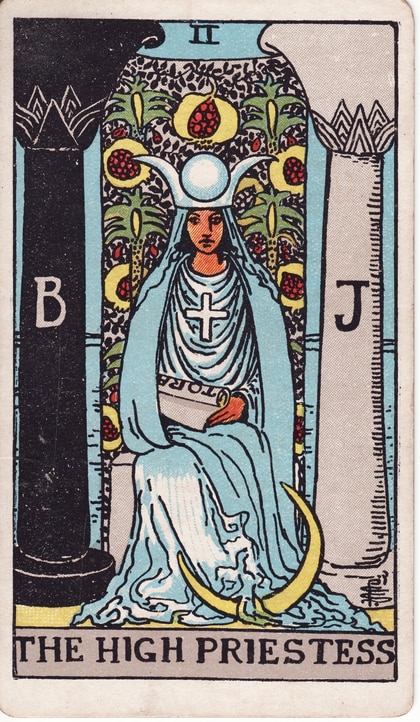
Pamela Colman Smith’s Rider–Waite–Smith image gives you concrete details to explore before reaching for a keyword. Compare the card below with your own deck; another artist may emphasize different features.
The pillars and veil
A black B pillar and a white J pillar frame the seated figure, recalling Boaz and Jachin, the temple pillars named in 1 Kings 7:21. The palm-and-pomegranate veil can invite reflection on boundaries and what remains out of view.
The partly covered scroll
The visible letters read TORA. In Waite’s description, the covered portion distinguishes what is expressed from what is implied. For a reading, ask what you know directly and what you are filling in yourself.
The crown, cross and crescent
The horned crown holds a central globe; a cross rests on her chest and a crescent sits beside her feet. Readers often connect the lunar imagery with cycles and inward attention. That symbolism does not assign a deadline to your question.
The Golden Dawn correspondence table links the High Priestess with Gimel and the Moon. Water is sometimes used as a broader intuitive association, but it is not her formal attribution in that table; the separate Water attribution belongs to the Hanged Man. For the wider development of the deck, see Britannica’s tarot history.
Upright and reversed meanings
Upright: make room to notice
The upright High Priestess often invites stillness, discretion and a closer relationship with your inner life. You may recognize a preference you have been dismissing, want more time with a decision or feel drawn to private study.
Listening is not the same as doing nothing. Name what you noticed, check what supports it and choose what deserves your attention. You can keep an unfinished plan private without withdrawing from everyone who could help.
Ask: What becomes clearer when I stop trying to produce an immediate answer?
Reversed: check what interrupts the connection
A reversed card can suggest too many outside opinions, reluctance to acknowledge a feeling or silence that has become uncomfortable. Some readers see an inward or blocked expression of the upright theme rather than its opposite.
It can also raise questions about discretion: am I protecting a healthy boundary, avoiding an important conversation or repeating something I do not actually know? A reversal is not proof of dishonesty or a warning that your intuition is broken.
Ask: What needs less noise, more information or a clearer boundary?
There is no reliable rule that a calm feeling must be intuition and an anxious feeling must be false. Experience, hope, fear and spiritual meaning can overlap. You can respect the feeling while remaining curious about its explanation.
Let the spread position shape the question
- Past: What did I keep private or sense at the time, and how do I understand that choice now?
- Present: Which observations, feelings and missing facts need separating before I decide?
- Future: How could I remain receptive and prepared without assuming a secret will be revealed?
- Advice: What can I listen to, investigate or keep confidential—and what real deadline still needs action?
For the broader sequence, explore the Fool’s Journey through the Major Arcana. The High Priestess follows the Magician’s outward use of skill with a more inward kind of attention.
Love, career and money: bring the meaning into context
Love and relationships
For someone single, the card can invite you to notice what kind of connection you want and let a new relationship develop at a pace you can assess. Attraction may feel mysterious without making the other person a destined partner.
Within a relationship, it can open a conversation about privacy, emotional depth or needs that have not been put into words. Try “I have noticed we have had less time together; how are you feeling about that?” rather than “The card says you are hiding something.” Privacy is not automatically secrecy, and quietness is not proof of infidelity.
If a relationship involves fear, control or threats, do not treat direct confrontation as a required tarot exercise. In the US, the National Domestic Violence Hotline offers support at 1-800-799-7233 or by texting START to 88788.
Career, study and creative work
The High Priestess can be a helpful symbol for listening, research, reflective writing or learning something before presenting it. Those themes may resonate with counselling or other attentive work, but the card does not select a profession or establish a qualification.
At an interview or meeting, turn an impression into a question you can ask. If a role sounds appealing but the responsibilities are vague, request examples of a typical week. Protect confidential information; do not confuse keeping your own plans private with withholding details that colleagues need.
Money and practical commitments
For a financial question, use the card to identify what you do not understand: fees, terms, repayment obligations or who is responsible for a decision. Neither an upright card nor a reversal establishes that an offer is safe, unsuitable or dishonest. Check the documents and seek appropriately qualified advice for a consequential decision.
A “pause” interpretation should not mean ignoring bills, contractual dates or urgent needs. Choose a next step that fits the actual situation. The tarot and finances guide explores reflective questions without turning a reading into a financial forecast.
A five-step High Priestess journal exercise
Use one ordinary, manageable question. Leave the card visible and write a few sentences for each step. You do not need to meditate perfectly, receive a message or draw more cards to finish.
- Notice. Complete “I keep noticing…” Describe the feeling or impression without calling it a certainty.
- Know. List what you directly observed, were told or can check. A feeling can matter even when you cannot yet explain it; keep it separate from confirmed information.
- Assume. Write the story you are adding and at least one other possible explanation. Ask what would change your mind.
- Ask and protect. Choose one useful question, a safe small action or a boundary to maintain. Decide what to keep private and what needs discussion with the right person.
- Review. Set a suitable check-in date, perhaps a week for a low-stakes question. Record what changed, including anything that did not fit your first impression. Do not let the exercise override a real deadline.
Worked example: an invitation you feel unsure about
Notice: “I feel hesitant about joining a monthly writing group.” Know: “It meets on Tuesday evenings, and I am often tired after work.” Assume: “I am telling myself that hesitation means I would not belong; it might instead be the timing.”
Ask and protect: “I will ask whether I can visit once before committing, without sharing my unfinished manuscript.” Review: “After the visit, I will note how the group actually felt and whether the schedule is workable.” The card gives the reflection a theme; it does not decide whether the invitation is good or bad.
If card checking starts making you more distressed, step away rather than searching for a perfectly reassuring answer. Our tarot and mental wellness guide and the NIMH mental-health resource offer further support. In the US, call or text 988 for crisis support or thoughts of suicide.
Three card pairings to read as questions
Consider the question, positions and your deck’s imagery together. These are possible conversations between cards, not fixed messages about another person.
High Priestess and the Moon
Both can invite attention to what is uncertain or emotionally charged. Ask: “What am I sensing, what am I imagining, and what could help me tell the difference?” The pair does not certify a hidden insight or danger.
High Priestess and the Hierophant
Explore private understanding alongside shared teaching or tradition. Ask: “Which guidance fits my values, and where do I need to question the rule?” Read more about the Hierophant’s meanings without assuming that inward and outward guidance must conflict.
High Priestess and the Seven of Swords
Consider discretion, strategy and incomplete information. Ask: “What am I choosing not to say, and what would I need to verify before reaching a conclusion?” Do not use the pair to accuse someone of deceit.
Frequently asked questions
1. What does the High Priestess card mean in tarot?
The High Priestess commonly represents intuition, inward attention, discretion and learning that is still unfolding. Begin with your question and the card’s position. It can invite you to listen more closely without assuming that an impression reveals a hidden fact.
2. Is the High Priestess a good card?
It can be encouraging when you need patience, reflection or a healthy boundary. Its quieter themes can also challenge you to notice avoidance or missing information. Rather than labelling it good or bad, ask what kind of attention the situation needs.
3. What does the High Priestess mean reversed?
Possible reversed themes include outside noise, overlooked feelings, withdrawal or difficulty speaking about something important. Some readers interpret it as an inward or blocked expression of the upright meaning. It does not prove deception or mean that your intuition has failed.
4. What does the High Priestess mean in a love reading?
It can invite patience, emotional honesty and respect for privacy. For a new relationship, notice your own needs while getting to know the person. For an existing relationship, consider what needs a safe conversation. The card cannot establish love, compatibility or infidelity.
5. What does the High Priestess mean for career and money?
Use it to explore listening, research, discretion and unanswered practical questions. At work, ask for clarity about responsibilities. With money, check the actual terms and obligations. A card does not determine a suitable career, confirm an offer’s safety or replace qualified advice.
6. Does the High Priestess mean yes or no?
Some readers use it for not yet or unclear, but there is no universal yes-or-no assignment. A more useful follow-up is: what information or reflection would help me decide? Do not postpone a necessary action solely because this card appeared.
7. What do the B and J pillars mean?
The letters recall Boaz and Jachin, temple pillars named in 1 Kings 7:21. In a practical reading, the contrasting pillars can prompt questions about opposites and boundaries. Their symbolic role is not evidence that you must choose one side or uncover someone’s secret.
8. What does the scroll marked TORA mean?
The scroll is partly covered. Waite connected it with sacred law and with meanings that are expressed or implied. For reflection, you might ask which information is visible, which remains incomplete and what you are assuming about the missing part.
9. What does the High Priestess mean as a person?
It may describe qualities such as attentiveness, reserve, curiosity or discretion, or qualities you want to practise. It is not a diagnosis or proof that someone has psychic abilities. The figure can be meaningful to a reader of any gender.
10. Does the High Priestess mean someone is keeping a secret?
Secrecy is one possible theme, not a finding about another person. Consider healthy privacy, your own unspoken concerns and ordinary missing information before assuming concealment. Where it is safe and appropriate, ask a clear question rather than treating the card as an accusation.
11. Which planet or element is linked with the High Priestess?
The Golden Dawn table gives the High Priestess the Moon and the Hebrew letter Gimel. Water is sometimes used as a broader intuitive association, but that table’s separate Water attribution belongs to the Hanged Man. Follow your chosen deck’s system consistently.
12. What does it mean in a past, present or future position?
For the past, reflect on earlier privacy or impressions. For the present, separate observations from assumptions. For the future, consider how to stay receptive and prepared. None of these positions guarantees that information will arrive or that a particular event will happen.
13. What if I keep drawing the High Priestess?
You can revisit the theme once in a journal: what needs quieter attention or a clearer boundary? Repeated cards do not require repeated readings until you find certainty. If checking becomes stressful, put the deck away and return to the practical question later.
14. How is the High Priestess different from the Magician?
The Magician often emphasizes using skills and resources outwardly; the High Priestess emphasizes listening, receptivity and what remains unexpressed. They can complement each other: pause to understand what matters, then decide whether a concrete action is useful.
15. What is a simple High Priestess journaling prompt?
Try five headings: Notice, Know, Assume, Ask and protect, Review. Record your impression, the facts you can check, another possible explanation, one useful action or boundary and a time to revisit. You can value the card’s spiritual meaning while keeping those categories distinct.
Keep the question open, not your life on hold
The High Priestess can make space for spiritual meaning, quiet observation and healthy privacy. Listen to what matters, distinguish impressions from facts and choose a next step you can revisit. If you are learning the deck, begin with our tarot guide for beginners.