

Quick guide
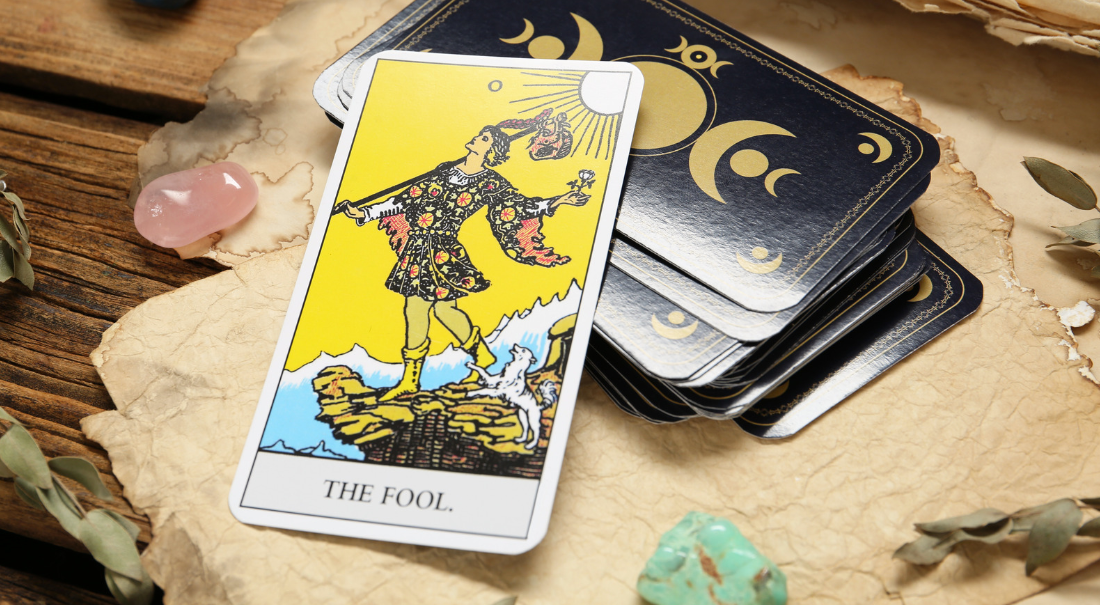
The Fool is card 0 of the Major Arcana. In the Rider-Waite-Smith deck it shows a young traveller at the edge of a cliff, face turned to the sky, holding a white rose in one hand and a small bundle on a stick over the shoulder, while a white dog leaps at the heels under a bright sun. Upright, its traditional keywords are new beginnings, openness, trust and a step into the unknown. Reversed, readers speak of hesitation, recklessness or a start that has not been thought through. The one question it usually raises is this: what would you begin if you stopped waiting to feel ready?
| At a glance | |
|---|---|
| Arcana / number / suit | Major Arcana, number 0 (placed first in most modern decks, unnumbered in older ones) |
| Upright keywords | New beginnings, innocence, spontaneity, trust, freedom, a leap of faith |
| Reversed keywords | Hesitation, recklessness, naivety, a false start, fear of the unknown |
| Element / astrological association (tradition) | Air; the planet Uranus in modern astrological tarot (the Golden Dawn system gave the card the element Air) |
| Yes/no reading (convention) | Usually read as a yes, especially when the question is about starting something |
The image and its symbols
Pamela Colman Smith drew the Fool in 1909 for the deck that most modern guidebooks follow. The figure is young and dressed for a journey in a patterned tunic, with a feather in the cap. One more step and the ground runs out, yet the Fool is not looking down. The gaze goes up and out, toward whatever comes next.
Each detail has a traditional reading. The cliff edge marks the limit of what is already known. The white rose held loosely in one hand stands for innocence and a clean intention. The bundle on the stick is small on purpose: it suggests that what you truly need to begin is less than you think, and that the past can be carried lightly. The white dog at the heels is usually read as instinct and loyalty, the companion that either cheers you on or barks a warning. The sun in the top corner is the light of a day that has only just started, and the snowy mountains behind are the work still ahead. The number 0 is a circle with nothing fixed inside it: not a failure, just a beginning before anything has been decided.
Older decks draw the card differently. In the Marseille pattern the Fool, called Le Mat, walks across open ground with a dog tugging at his clothes, and the card carries no number at all. The playful name comes from the game of trionfi, where the Fool was a special card that could be played at any time. Reading it as a symbol of beginnings is a later tradition, not an original rule.
Upright meaning
Upright, the Fool is traditionally the card of a fresh page. Readers take it to mean a beginning made with little evidence and a lot of trust: a first day, a first attempt, a first conversation. The mood is light rather than heroic. The card does not say the journey will go well; it says you are at the start of one and that your attitude matters more than your preparation right now.
Where the card falls changes how it is read. In a position about the present, it reflects an open situation with no commitments yet. In a position about advice, many readers take it as “go, but go lightly, and keep your eyes open.” In a position about an obstacle, it can point to inexperience, or to a wish to keep every option open rather than choosing one. A useful habit is to say out loud what the new thing actually is. If you cannot name it, the card is asking you to look for it.
Reversed meaning
Reversed, the Fool pulls in one of two directions, and the question usually tells you which. The first is too much caution: standing at the cliff edge for months, researching, asking everyone, and never taking the step. The second is too little: leaping without a glance at the dog, ignoring every warning because the leap itself feels good. Both are versions of the same card with the trust taken out and replaced by fear or by bravado.
A third reading appears in practical questions. The reversed Fool can describe a start that keeps being restarted, such as a course begun three times or a plan that is always “from Monday.” Readers treat this as a prompt to find what is missing, which is often a first step small enough to finish. None of this is a verdict on your character. A reversed card describes a pattern you can change, not a fixed trait.
In a love reading
For someone single, the upright Fool is traditionally read as openness: meeting people without a checklist, saying yes to a coffee, treating a first date as a first date rather than an audition for marriage. For a couple, it points to playfulness and to trying something new together, a trip, a hobby or a conversation you have been putting off. The card favours curiosity over strategy.
Reversed, readers often see one person who is not ready to commit, or a relationship that keeps going back to the beginning without moving forward. That is a prompt for a direct conversation, not evidence about the other person. Tarot cannot tell you how someone else feels, whether they will text, or whether a relationship is “meant to be.” It can only help you notice what you want and what you are avoiding. If the relationship involves fear, control or threats, the right next step is a person, not a card: the National Domestic Violence Hotline is 1-800-799-7233, or text START to 88788.
In a career or money reading
At work, the Fool is the beginner’s card. It appears in readings about a new role, a first business, a change of field, or the early days of training when everything is unfamiliar. The traditional advice is to accept that you do not know yet, ask questions freely and let enthusiasm carry you through the awkward phase. Readers also see it as a nudge to try an idea before it is polished.
With money, the upright card suggests a new venture or a willingness to invest in yourself. Reversed, it can describe spending on impulse or taking a risk without any cushion underneath it. The card is a reflection tool, not financial advice. Before quitting a job, borrowing or investing, run the numbers and talk to someone qualified, because a card cannot see your bank balance or your obligations.
How to work with this card
- Name the leap. Write down the one thing you would start this month if fear did not get a vote.
- Pack the bundle. List only the things you genuinely need to begin, and notice how short the list is.
- Listen to the dog. Ask what a loyal, honest friend would say about the plan, then decide whether that voice is a warning or a cheer.
- Take one step. Choose an action small enough to complete within two days, and do it before you draw another card.
- Keep a note. Record the question, the card and your decision, so you can see later whether the reflection helped.
Cards that often appear with it
With the Magician, the Fool is traditionally read as a new idea meeting the means to act on it: you have the impulse and the tools, so the question becomes what to build first. With the Tower, readers usually see an impulsive leap that upends a structure, or a sudden change that forces a fresh start; the pairing asks for care, not panic. With the Four of Pentacles, the pull is between freedom and security, the traveller’s bundle against the figure clutching coins. Readers treat that pair as an invitation to decide what you are willing to carry and what you can set down.
Key takeaways
- The Fool is card 0 of the Major Arcana and the traditional card of beginnings, trust and openness.
- Its Rider-Waite-Smith symbols, the cliff, rose, bundle, dog and sun, each describe a different side of starting something.
- Reversed, it points to either too much caution or too little, and the question decides which.
- In love and work it favours curiosity and first steps, but it cannot tell you how another person feels or whether a venture will pay off.
- Use the card as a prompt to name your leap, pack light and take one small, finishable step.
Related reading
- The Fool’s Journey: the 22 Major Arcana cards in order
- The Magician tarot card meaning
- The High Priestess tarot card meaning
- Tarot cards for beginners
- Tarot card reading for hard decisions
Frequently asked questions
1. What does the Fool card mean in tarot?
In the Rider-Waite-Smith tradition the Fool stands for new beginnings, openness, trust and a willingness to step into the unknown. It is a prompt about how you start things, not a prediction that something will happen.
2. Is the Fool a good card to pull?
Most readers see it as a hopeful card because it describes a fresh start and a light heart. Whether that is good news depends on the question, since a leap is welcome in some situations and risky in others.
3. What does the Fool mean reversed?
Reversed, the Fool traditionally points to hesitation, recklessness or a start that has not been thought through. Readers use the question and the nearby cards to decide whether the issue is too much caution or too little.
4. What does the Fool mean in a love reading?
Upright, it suggests openness, playfulness and taking a first step without over-planning. Reversed, it often describes someone who is not ready to commit, which is a prompt for an honest conversation rather than proof about the other person.
5. What does the Fool mean for career and money?
It is the beginner’s card: a new job, a first business, a change of field or the early days of learning a skill. In money questions it can mean a new venture upright or impulsive spending reversed, but it is never a substitute for financial advice.
6. Does the Fool mean yes or no?
By convention the Fool is usually read as a yes, particularly when the question is about starting something new. Yes/no readings are a simplified way of using the cards and carry no predictive power.
7. Why is the Fool numbered 0?
The 0 marks the Fool as the card before the sequence begins, a circle with nothing fixed inside it. Older decks such as the Marseille pattern left the card unnumbered, and some place it at the end of the Major Arcana instead.
8. What does the white dog on the Fool card mean?
The dog is traditionally read as instinct and loyalty, the companion who either cheers the traveller on or barks a warning near the cliff edge. Readers use it as a prompt to listen to honest feedback before taking a leap.
9. What does the Fool card mean as a person?
As a person, the Fool describes someone curious, spontaneous and new to a situation, or sometimes someone naive about its risks. It can also represent your own beginner’s mind rather than another person.
10. Can the Fool card predict a new relationship or job?
No. Tarot has not been shown to predict events, and the Fool cannot tell you that a relationship or job is coming. It can help you notice whether you are ready to begin and what is holding you back.
11. What does the Fool mean in a past, present or future position?
In a past position it points to a start you made, in the present to an open situation with no commitments yet, and in a future position to an opportunity or a decision about whether to begin. Readers treat the future position as a possibility to prepare for, not a forecast.
12. What is the Fool’s Journey?
The Fool’s Journey is a modern teaching story that reads the 22 Major Arcana in order as stages of one life, with the Fool as the traveller who meets the Magician, the High Priestess and the rest. It is a memory aid for learning the cards, not a historical doctrine.
Evidence note: The meanings on this page are conventions attached to the Rider-Waite-Smith deck (1909) and the guidebooks that follow it, not findings about how the world works. Tarot began as a card game in Italy in the 1430s, where the Fool was a special card in the game of trionfi, and divinatory use came centuries later (see Britannica on tarot). No reading predicts events, reads another person’s mind or sets a timeline. If your question is about health, legal matters or money, use the card to clarify your thinking and then take the question to a qualified professional. In the US, call or text 988 if you are struggling with low mood or thoughts of self-harm.