


Initiative, with room to reflect
The four cards associated with Aries
In the Golden Dawn correspondence system, Aries is paired with the Emperor and with the Two, Three and Four of Wands. Together, they offer a way to explore direction, initiative, follow-through and the satisfaction of completing something.
You do not need to be an Aries to work with these cards. If the symbolism feels spiritually meaningful to you, use it as a lens for a real question—not as a fixed description of your personality or a promise about your future.
One sign, one Major card and three decans
The Emperor is the sign-level association. The numbered Wands cards belong to Aries’s three decans: divisions of ten degrees within a thirty-degree zodiac sign. These are angular divisions, not three permanently fixed ten-day birthday windows.
This is an esoteric framework, not an astronomical measurement of a person’s character. The attributions appear in the historical Book T / Liber LXXVIII text. Aries and Wands share the fire association in this system.
Tarot’s card-game history is older than this correspondence framework. The V&A’s history of tarot explains the later Golden Dawn context and the creation of the Rider–Waite–Smith deck, first published in 1909. Britannica’s tarot overview offers further historical context. There is no need to treat one later mapping as the origin of every tarot image.
The Emperor: give your energy a structure
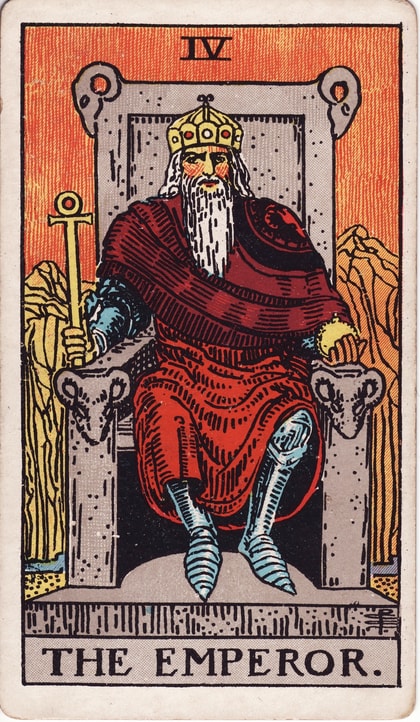
The Rider–Waite–Smith Emperor is a crowned figure on a stone throne. Notice the ram-head carvings, sceptre, globe and armour beneath the robe. These details make an especially clear visual partner for themes of authority, responsibility and purposeful action.
- Ram heads: a visible connection you can place beside the Aries correspondence.
- Throne and armour: prompts to consider structure, protection and the limits of control.
- Sceptre and globe: prompts about the responsibility that comes with influence.
Waite describes the ram-fronted throne and the figure’s executive quality in The Pictorial Key to the Tarot. You can read leadership here without assuming that the card means a man, a father or a particular kind of person.
Reflection: What boundary, plan or support would help me act with more clarity?
Read the Wands as plan, act and acknowledge
The following sequence is a practical way to work with the pictures. It is not a rule that events must unfold in this order. Your deck may depict these cards differently; use its guidebook alongside the correspondence map.
Plan
Two of Wands
In the Rider–Waite–Smith scene, a figure surveys land and sea from a battlement while holding a globe. Use that wider view to give an idea a workable scope before acting.
Ask: Which idea am I ready to explore, and what information would help me begin?
Act and review
Three of Wands
A figure looks toward ships at sea. You can reflect on what is already in motion, cooperation and the next stage. Some outcomes depend on others, but you may still be able to follow up or adjust.
Ask: What is already underway, and where would patience or a useful follow-up help?
Acknowledge
Four of Wands
Four staves support a garland, with figures and a house beyond. Use the image to notice a milestone, shared support or a place where you can pause and enjoy what has been built.
Ask: What small finish deserves recognition before I rush to the next thing?
For another way to explore the shift from two to three to four, see Understanding Tarot Card Numerology. The numbers add a layer to the pictures; they do not replace them.
A short four-card reflection
- Choose a real, manageable topic. A project, conversation or new habit is enough. Deliberately take the Emperor and the Two, Three and Four of Wands out of the deck; this is a study exercise, not a random forecast.
- Write one line for each card. Emperor: a helpful structure. Two: a plan to explore. Three: something to follow up or allow time. Four: a milestone or source of support.
- Choose one action you can own. Keep it small enough to attempt, and include any information, permission or support you need first. You do not have to control anyone else’s response.
- Review what actually happened. Record the action, the result and whether the imagery helped you think. Do not turn a setback into proof that you failed to embody your sign.
If you would rather shuffle and draw around your own question, the self-reading routine explains how to set positions and record an interpretation.
Example: planning a small community book swap
This invented example shows how the four selected cards can organize a plan without predicting turnout.
- The Emperor · Structure
- “I will agree the date, venue permission and how leftover books will be handled before announcing it.”
- Two of Wands · Plan
- “I will compare two possible spaces and ask which one is accessible and available.”
- Three of Wands · Follow-through
- “The venue request is sent. I can follow up on the agreed date while preparing a simple invitation.”
- Four of Wands · Milestone
- “Confirming the space is worth acknowledging, even before I know how many people will come.”
Why other Aries lists may look different
Keep a direct zodiac-sign association separate from a planetary association. In the Golden Dawn scheme, the Emperor is paired with Aries, while the Tower is paired with Mars. A reader discussing Mars in relation to Aries may therefore mention the Tower without making it the same correspondence.
Court-card systems add another layer: they can use elemental combinations and spans across more than one sign. A list naming the King of Wands or Queen of Swords needs to identify its method; those names are not interchangeable additions to the four-card map above. Personal symbolic associations are also possible, but label them as personal rather than universal.
There is no requirement to identify with every Aries stereotype. You can use initiative, structure, patience and celebration as questions, not judgments. For health, legal, financial or safety matters, check the real-world information and appropriate qualified support rather than treating a sign-card pairing as an answer.
Let the symbols help you choose a next step
The Emperor can hold the plan steady while the Wands invite movement and reflection. You decide which theme fits—and which practical action is worth taking.
For the wider zodiac map and ways to combine placements with a reading, continue to Astrology and Tarot Tools.