
A bright patch of yellow, a red cloak or a dark sky can draw you into a tarot card before you have named a single symbol. Color gives your intuition something concrete to notice. The useful next step is asking what it contributes to this particular scene.
This guide focuses on the Rider-Waite-Smith deck, illustrated by Pamela Colman Smith and first published in 1909. Its color associations can enrich a spiritual reading, but they are starting points rather than a universal code. Your deck’s edition, your experience and the question all matter.
- Scene before shade
- Name the figure, action and setting first.
- Association, not command
- A hue can support more than one interpretation.
- Check your edition
- Printing and recoloring can change what stands out.
Know the palette in your hands
Rider-Waite-Smith images use recurring colors, but that does not make every red garment or blue background interchangeable. A garment, a body of water and a patch of sky play different roles. Begin with your actual card rather than a remembered list.
Color can also change between versions. Mary Hanson-Roberts recolored the drawings for Universal Waite. The publisher describes Radiant Rider-Waite as a vibrant recoloring by Virginijus Poshkus that also alters the treatment of outlines and shading. Its Centennial and later RWS booklet describes further palette choices. These are not all identical scenes printed with a single brightness slider.
Paper aging, a screen’s settings and room lighting can change what you see too. If a detail matters to your interpretation, compare another reproduction and record the edition. You do not have to buy a new deck to make that check.
Waite’s Golden Dawn background is relevant to the deck’s esoteric history, but it does not justify claiming that every color was either a secret code or merely a printing compromise. For that larger context, see Kabbalah, Hermeticism and tarot. The practical reference below offers possible associations, not a reconstruction of Smith’s private intentions.
Seven colors, with context
Use these prompts alongside the image and your deck’s guidebook. The sample swatches help you scan the reference; they are not exact ink specifications for any edition.
Yellow
Possible associations: Daylight, visibility, enthusiasm or conscious attention.
Examples: Look at the Fool’s sky, the Magician’s background and the Sun’s disc.
Ask: What is becoming easier to see? Brightness can emphasize exposure as well as optimism.
Red
Possible associations: Will, desire, movement, urgency or embodied energy.
Examples: The Magician’s outer mantle, the Emperor’s robe and the Sun’s banner are useful examples. The Emperor’s stone throne is not the same red as his clothing.
Ask: Where might energy become action, and where could it become pressure?
Blue
Possible associations: Reflection, feeling, receptivity or distance.
Examples: Compare the High Priestess’s robe with the blue blades and patterned quilt of the Nine of Swords. Blue does not make every scene peaceful.
Ask: Does this scene invite listening, emotional space or a clearer conversation?
White
Possible associations: Openness, simplicity, a beginning or a strong visual contrast.
Examples: The Fool’s flower, the Magician’s inner robe, Temperance’s robe and the Sun’s horse show different uses.
Ask: What is unburdened, newly available or standing out? White is not a verdict on anyone’s moral worth.
Black
Possible associations: Mystery, uncertainty, a boundary, night or an ending.
Examples: Death’s armor and banner, the Devil’s background and the dark field of the Nine of Swords are familiar examples.
Ask: What is difficult to see or name? A dark background is not evidence of evil, danger or a curse.
Grey
Possible associations: Reserve, waiting, weather, stone or a quieter atmosphere.
Examples: The Hermit’s cloak, the Hierophant’s pillars and the Three of Swords’ clouds have different functions in their scenes.
Ask: Is this a pause, a practical structure or simply the material being pictured?
Green
Possible associations: Growth, cultivation, renewal or the living environment.
Examples: Look at the Empress’s landscape, the World’s wreath and the plants in the Seven and Nine of Pentacles.
Ask: What needs patient care? A green garden can suggest tending a project; it cannot establish someone’s health or fertility.
Try following one color through several cards. The white flower in the Fool, the blue clothing of the High Priestess and the grey cloak of the Hermit can each become an entry point. Let the rest of the picture refine your first association.
Compare two cards: the Sun and the Nine of Swords
These two images show why a color word alone cannot carry the reading. Notice both the large areas and the smaller details before deciding what the contrast suggests.
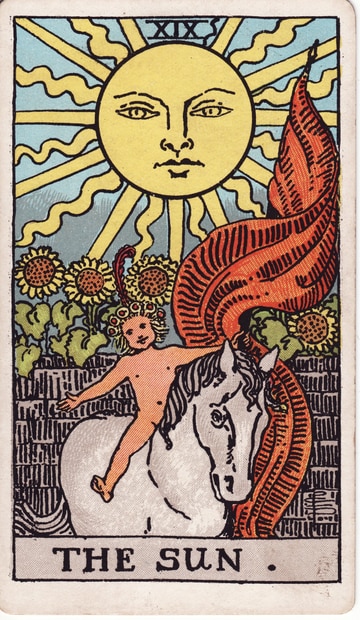
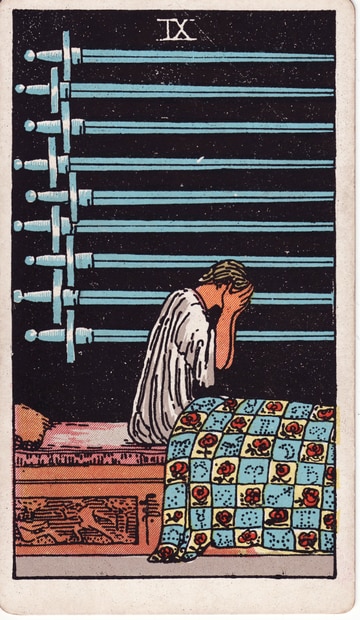
In the Sun, the large disc and rays may draw attention to visibility and vitality, but the open posture and setting contribute too. In the Nine of Swords, the face-covering gesture shapes the scene; blue details do not make it calm. Neither image is monochrome, and neither tells you what your next week must be like.
Now compare within a single image. The Magician’s red outer mantle and white inner robe can invite a reflection on intention and action. Death’s black banner and white flower may bring endings and continuity into the same conversation. Temperance combines pale clothing, colored wings and water within an act of pouring and adjustment. These are readings you can explore, not meanings forced by paint alone.
Small accents can matter, but “there is no black anywhere” is rarely a safe conclusion about a printed illustration with dark outlines. Look for placement, contrast and repetition rather than trying to prove that a difficult color has disappeared. For another layered scene, compare the sky, water and land in the Moon.
When another deck uses a different language
Marseille patterns
Flat printed or stenciled color can help separate clothing, objects and suit shapes. Do not assume those colors lack emotional effect, or that an RWS sky-color association transfers unchanged.
Thoth and formal correspondences
A deck may connect color to a wider esoteric system. Consult its own guide and distinguish a formal attribution from your personal response. Looking up a correspondence and feeling something about the image are not mutually exclusive.
Ink-led or limited palettes
Line, texture and isolated accents may carry more of the contrast. A predominantly black-and-white style can still include strong color across some cards; avoid describing an entire deck as colorless from one sample.
Pastel and watercolor palettes
Soft transitions can change the atmosphere without removing conflict or difficulty from a card. Check the figures and composition rather than assuming every pastel card is gentle.
Dark and neon palettes
A bright accent against darkness may direct attention differently from an RWS image. That design choice does not make the deck ominous or less spiritual. Learn its internal contrasts before importing a yellow-equals-happiness rule.
If you are choosing between styles, our guide to picking a tarot deck can help you consider readability and connection to the art.
A five-step color practice
Set two or three cards beside a notebook. Start with a manageable question such as how to approach a conversation or make space for a creative task.
- Describe the scene. Name the figure, gesture, objects and setting before assigning a meaning to the palette.
- Notice a large color area. Write an observation such as “blue water covers the lower half.” Keep that separate from an interpretation such as “I associate this with listening.”
- Find a contrast. Choose one smaller detail and ask how it changes your first impression. A yellow horizon or red flag can interrupt an otherwise quiet or dark scene.
- Compare the spread. Look for a repeated color or a card that stands apart. Ask whether the same hue serves the same function in each image; do not turn the pattern into a forecast.
- Make one useful question. Write a prompt connected to your situation and one small action you can assess. Stop if another layer of symbolism is making the reading harder rather than clearer.
Example: making room for a creative task
Suppose a bright scene suggests openness while a darker card shows someone folded inward. You might associate the contrast with wanting to share your work and needing privacy to finish it.
Rather than deciding that bright means success and dark means failure, ask, “What needs quiet development before I show it?” One small action could be setting aside a short drafting session and asking a trusted person for feedback afterward. Revisit whether that helped; the colors have shaped a reflection, not guaranteed a result.
Readers starting out can pair this exercise with tarot basics or use the narrative structure of the Fool’s Journey. You do not need to use every symbol in every reading.
Make the reading accessible and your own
Describe objects, not just hues
“A figure covers their face beneath nine horizontal swords” conveys more than “a black-and-blue card.” Name the location, shape, gesture and light-and-dark contrast, then add the color if useful. Ask what another person can comfortably distinguish.
The National Eye Institute explains that color vision deficiency can affect the differences people perceive between colors and shades. Color is therefore an optional layer, not a qualification for reading tarot. Suit symbols, numbers, composition and touch-friendly deck features may matter more for a particular reader.
Your associations may also be personal or cultural. Yellow might recall joy for one person and an uncomfortable experience for another. Record that response without insisting it must be the artist’s intention. Notice confirmation bias: a color that fits your expectation does not independently prove the expectation. You can keep a meaningful spiritual interpretation and still consider another explanation.
As with the cards themselves, a palette does not diagnose illness, settle a legal issue or establish an investment outcome. Those decisions need relevant information and qualified help, not a color association.
For historical context, Britannica’s tarot overview distinguishes the early card game from later occult uses. A practice can grow new symbolic layers without every layer having been present in the original deck.
Questions about color symbolism in tarot
1. What does yellow mean on a tarot card?
It can suggest daylight, visibility, enthusiasm or conscious attention in a Rider-Waite-Smith reading. Check where it appears: the Sun’s yellow disc, for example, is only one part of a picture that also contains blue, red, white and green.
2. What does red mean in tarot?
Red often provides a prompt about will, desire, urgency or action. The Magician’s mantle and the Emperor’s robe are examples. Read the surrounding gesture and scene before deciding whether that energy feels constructive, pressured or simply vivid.
3. What does blue mean in tarot?
Blue may suggest feeling, reflection, receptivity or distance. It is not automatically calm: the Nine of Swords has blue details within a distressed scene. Name what the figure is doing before assigning a mood to the color.
4. What do black and white mean on the Death card?
The dark armor and banner contrast with the pale horse and white flower on the banner. Readers may explore endings, change and continuity through that contrast. It is not a reason to predict a literal death or judge black as bad and white as good.
5. What does grey mean in tarot?
Grey can contribute reserve, waiting or a quieter atmosphere, but it also depicts ordinary stone, cloud and cloth. The Hermit’s cloak and a stone pillar do not have to carry an identical message merely because both look grey.
6. What does green mean in tarot?
Green often supports a theme of growth, cultivation or renewal. The plants in Pentacles scenes can invite questions about patient care and practical resources. They do not diagnose health, indicate fertility or guarantee that a project will prosper.
7. Is this a color key written by Pamela Colman Smith?
No. This guide offers practical interpretive associations and visible examples, not a reproduction of Smith’s personal color key. A useful reading can connect several possible meanings to a hue without claiming that the artist intended one fixed meaning everywhere.
8. Should I apply Golden Dawn color scales to every RWS card?
Not automatically. The Rider-Waite-Smith deck has important esoteric influences, but a modern color-association list is not the same as a formal Golden Dawn scale. Name the system you are studying and do not assume every printed shade is a one-to-one coded instruction.
9. Why do colors differ between editions?
Reproduction, paper, ink, lighting and deliberate recoloring can all change the appearance. Universal Waite and Radiant Rider-Waite are examples of recolored versions. Check your edition rather than assuming a different shade means your deck is incorrect.
10. How do modern decks change color symbolism?
Some use a restrained palette; others rely on bright accents, gradients or a detailed correspondence system. Learn the artwork and guidebook of the particular deck. A pastel or neon palette does not guarantee that every card has a softer or harsher meaning.
11. Can a card’s color predict what will happen?
A color by itself does not establish a future event, someone else’s thoughts or a deadline. It can help you notice a theme and form a reflective question. Evaluate any practical conclusion with information from the situation, not with hue alone.
12. What is a simple way to practise reading color?
Compare two cards from the same deck. Describe the scene, name one large color area, find a contrasting detail and write a possible connection to your question. Keep the observation and your interpretation separate, then choose a small action you can assess.
13. What if there is no dominant color?
Describe the balance or pattern instead, or leave color out. Repeated shapes, the figure’s posture and the card’s place in the spread may be more helpful. You do not need to force every available symbol into a reading.
14. How can I make a color discussion accessible?
Name the card, the object and its position before adding a color label. Include shapes, light-and-dark contrast, suit symbols and gestures. Ask what the other person can comfortably distinguish instead of correcting their perception or relying only on red-versus-green differences.
15. Are black cards bad and white cards good?
No. That shortcut ignores context and can introduce unfair moral associations. Darkness can frame mystery, night or a strong contrast; white can show cloth, light or empty space. Read the whole image and avoid turning a palette into a judgment about people.
Let color open a question
Notice the hue, locate it in the scene and explore what it brings to your question. You can trust the value of your response without turning one color into a fixed message for everyone.