

Quick guide
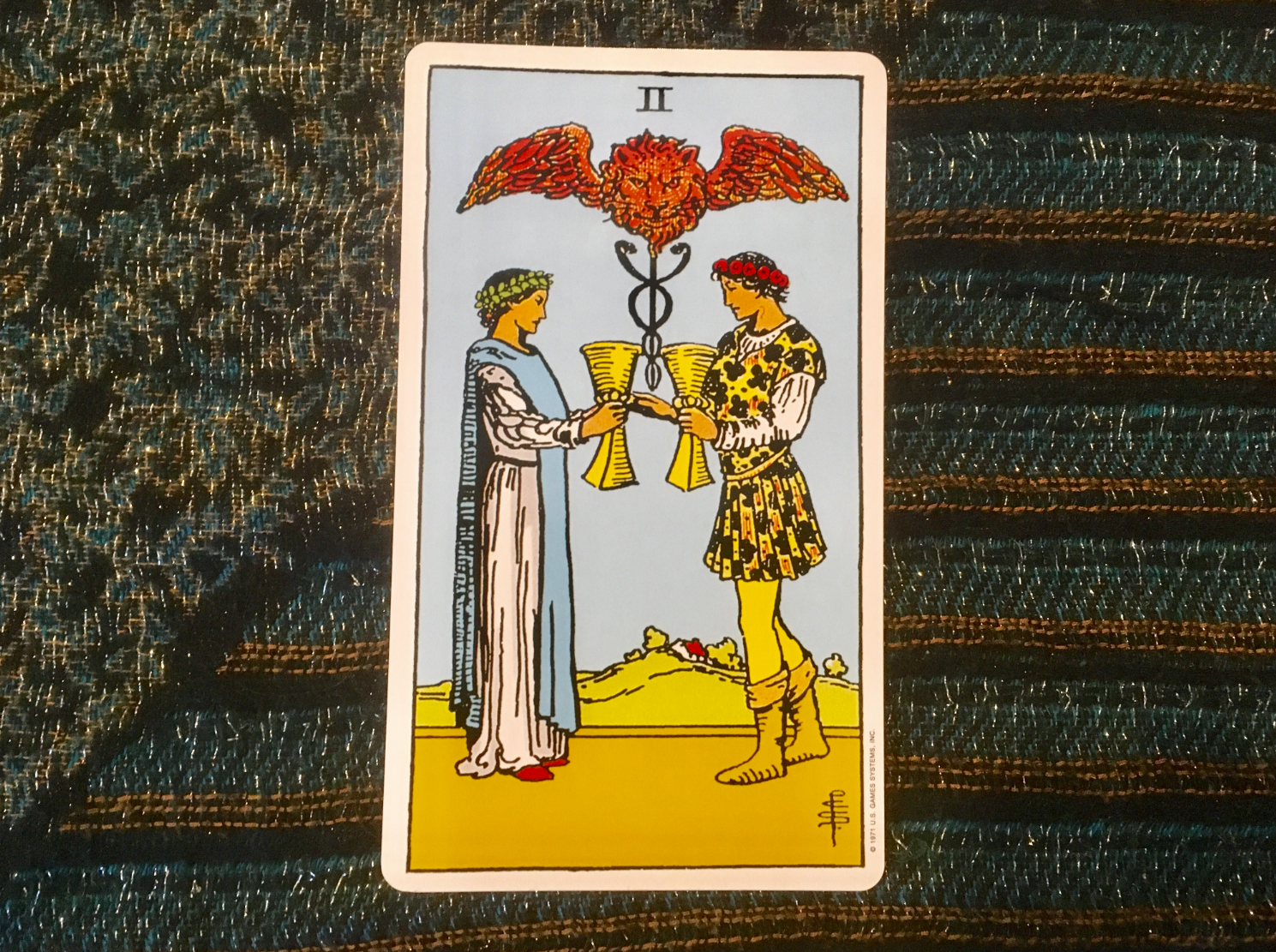
The Two of Cups is the partnership card of the Minor Arcana. In the Rider-Waite-Smith image a man and a woman stand face to face, each holding a cup, and he reaches toward hers as if to make a pledge. Above them floats the caduceus of Hermes, a winged staff with two snakes, topped by a red lion’s head with wings. Upright, the card’s traditional keywords are mutual attraction, partnership, trust, agreement and an exchange that leaves both people better off. Reversed, readers speak of imbalance, miscommunication, a bond that has gone one-sided and the need to repair or release it. The question it usually raises is this: is what passes between you and this person an even exchange, and if not, what would make it one?
| At a glance | |
|---|---|
| Arcana / number / suit | Minor Arcana, Two, suit of Cups |
| Upright keywords | Partnership, mutual attraction, trust, agreement, a fair exchange, reconciliation |
| Reversed keywords | Imbalance, mixed signals, a one-sided bond, broken trust, tension in a pair, self-care first |
| Element / astrological association (tradition) | Water; Venus in Cancer in the Golden Dawn decan system, where the card is titled the Lord of Love |
| Yes/no reading (convention) | Usually read as yes, especially for questions about two people; reversed, a cautious “not as things stand” |
The image and its symbols
Pamela Colman Smith drew a quiet scene. Two young people stand on level ground in front of a green hill with a house on it. The woman wears a white gown and a blue mantle with a laurel wreath in her hair; the man wears a patterned tunic and a wreath of red flowers. Each holds a golden cup at the same height, and he steps forward with his free hand out, so the cups are about to meet. There is no table between them and no crowd around them.
The strange part is the emblem above their heads. A caduceus, the winged staff with two serpents twined around it that belongs to Hermes in Greek myth, rises between the cups, and on top of it sits a lion’s head with red wings. Readers have offered many glosses. The caduceus is an old sign of negotiation and healing, which fits a card about two people reaching terms. The snakes twist in opposite directions yet form one shape, a picture of difference held in balance. The lion’s head is usually read as the passion that runs underneath a polite exchange, and the wings as the lift that a good partnership gives both people. The house on the hill suggests the bond has somewhere to go. Arthur Waite, who commissioned the deck, said only that the card stood for love, friendship and union; everything else is later tradition built on the picture.
Upright meaning
Upright, the Two of Cups describes a connection that works because it runs both ways. Two people meet, each offers something, each receives something, and neither keeps score. Readers see it in new romances, close friendships, strong business pairings and reconciliations after a quarrel. The card is small in scale: it is about one bond, not a crowd, and about the start or renewal of that bond rather than its long history.
Position matters. As a card for the present, it suggests a relationship in your life is in good balance right now and deserves attention. As advice, it asks you to meet the other person halfway, to say plainly what you offer and what you need, and to accept a fair deal rather than wait for a perfect one. As an outcome card, it points to agreement, whether that is a second date, a signed contract or an apology accepted. It never says who the person is or when they arrive.
Reversed meaning
Reversed, the cups tip and the exchange goes uneven. One person gives more than they get, one talks while the other withdraws, or a pair that used to pull together now pulls apart. Readers also use the reversed card for mixed signals, a promise made and quietly dropped, or a friendship that has become a one-way street. It is not a verdict that a relationship is over. It is a note that the balance needs looking at.
There is a second, kinder reading: the partnership that needs attention is the one with yourself. People sometimes draw the reversed Two of Cups when they are hoping someone else will supply what they have not given themselves, such as rest, respect or honest praise. The prompt then is to fill your own cup first, and to notice whether a bond that feels unequal is really unequal or simply unspoken.
In a love reading
This is the card most people hope to see in a love spread, so it helps to be precise about what it offers. Upright, it describes mutual regard: both people are drawn to each other and both are willing to show it. For a new connection, it suggests the attraction is not one-sided and that honesty early on will be well received. For an established couple, it points to a reset, a renewed agreement about how you treat each other, or the warmth of a plain “I still choose you.”
What the card cannot do is tell you how a specific person feels. No tarot card reads another person’s mind, confirms that an ex is thinking of you or decides whether someone is faithful. Those answers come from the person. If you draw the Two of Cups reversed in a relationship reading, it is worth asking which of you has stopped pouring. Research on couples by the Gottman Institute names criticism, contempt, defensiveness and stonewalling as the patterns most likely to wear a bond down (the four horsemen), and the reversed card is a good moment to check for them. If a relationship involves fear, control or threats, call the National Domestic Violence Hotline on 1-800-799-7233 or text START to 88788, and 911 in immediate danger.
In a career or money reading
At work, the Two of Cups is the card of the good pairing: a business partner whose skills match yours, a colleague you trust, a client relationship that feels like a conversation rather than a contest. It often appears when a collaboration is being proposed or a contract is close to agreement, and it suggests the terms are fair. Reversed, it can describe a partnership where one side carries the load, a handshake deal that was never written down, or a working relationship that has cooled and needs an honest conversation to warm up again.
With money, the card points to shared finances: a joint account, a split bill, a loan between friends, a business with two owners. Its advice is to keep the exchange even and visible, so that both people know what goes in and what comes out. The card cannot say whether a venture will pay or a partner can be trusted with money. For anything involving real sums, a written agreement and, where it matters, a solicitor or accountant protect both people better than any reading.
How to work with this card
- Name both cups. For the relationship you are asking about, write what you give and what you receive in two short columns. The card is about the match between them.
- Ask one direct question. If the card is reversed, choose a single thing you have been guessing about the other person and ask them instead of the deck.
- Draw a pair. Lay the Two of Cups between two cards, one for “what I bring” and one for “what I need”, and read the three as a sentence.
- Check the ground. The two figures stand on level earth. Ask whether you and the other person are meeting as equals or whether one of you is on a step.
Cards that often appear with it
The Two of Cups with The Lovers is usually read as a bond that has reached the point of choice: not just attraction but a decision to commit, and the Lovers adds the weight of values and consequences. With the Ten of Cups, the private exchange widens into family, home and a shared future, so readers take the pair as a relationship that is settling in rather than starting. With the Three of Swords, the partnership has been hurt, and the two cards together ask whether the exchange can be rebuilt after honesty about the wound. With The Hierophant, readers see a formal agreement, an engagement, a contract or a public promise.
Key takeaways
- The Two of Cups shows two people exchanging cups beneath a caduceus and a winged lion’s head; its traditional theme is a fair, mutual bond.
- Upright keywords are partnership, attraction, trust and agreement; reversed, imbalance, mixed signals and a bond gone one-sided.
- In love it describes mutual regard and reconciliation; it cannot report another person’s feelings or confirm that an ex will return.
- At work it points to good collaborations and fair contracts; with money, to shared finances that both people can see.
- The card is a prompt to look at the balance in a relationship, not a promise about how it ends.
Related reading
- Love tarot readings: questions, spreads and what the cards can and cannot say
- Nine of Cups tarot card meaning
- Six of Cups tarot card meaning, upright and reversed
- Reading reversed tarot cards
- Tarot cards for beginners
Frequently asked questions
1. What does the Two of Cups tarot card mean?
Traditionally it means a partnership built on a fair exchange: mutual attraction, trust and agreement between two people. The Rider-Waite-Smith image shows a man and a woman pledging with two cups beneath a caduceus, and readers take it as a bond that runs both ways.
2. What does the Two of Cups mean reversed?
Reversed, it is read as imbalance: one person giving more than they receive, mixed signals, or a pair that has fallen out of step. A gentler reading is a reminder to look after yourself before asking someone else to fill your cup.
3. What does the Two of Cups mean in a love reading?
Upright, it describes mutual regard, a promising new connection or a reconciliation on fair terms. Reversed, it asks which of you has stopped pouring. In either case it is a prompt for an honest conversation, not a prediction about the relationship.
4. Does the Two of Cups mean someone has feelings for me?
No card can report another person’s feelings. The Two of Cups describes what a balanced connection looks like so you can notice whether you have one. The only reliable way to learn how someone feels is to ask them.
5. Does the Two of Cups mean my ex will come back?
No. Tarot has not been shown to predict events or read minds, so it cannot say what an ex will do. The card can prompt you to think about whether a renewed bond would be an even exchange this time, which is a more useful question.
6. Is the Two of Cups a yes or no card?
By convention it is usually read as yes, particularly when the question involves two people agreeing. Reversed, it leans toward “not as things stand”. A yes/no draw is a way to reflect, not a forecast.
7. What does the Two of Cups mean for career and money?
At work it points to a good partnership, a fair contract or a colleague you can trust. With money it describes shared finances and advises keeping the exchange even and written down. It does not say whether a venture will succeed.
8. What is the lion’s head above the cups?
It sits on top of a caduceus, the winged staff of Hermes with two snakes. Readers usually take the caduceus as a sign of negotiation and healing, and the winged lion’s head as the passion and energy that a good partnership carries. These are interpretive traditions rather than anything the deck’s creators spelled out.
9. What is the difference between the Two of Cups and The Lovers?
The Two of Cups is a Minor Arcana card about one bond and the fairness of the exchange within it. The Lovers is a Major Arcana card about choice, values and the consequences of commitment. Readers often see the Two of Cups as the meeting and the Lovers as the decision.
10. Can the Two of Cups be about friendship or family rather than romance?
Yes. Readers apply it to any pair: close friends, siblings, a parent and adult child, business partners. The theme is the same in each case, a relationship that works because both people give and receive.
11. Which zodiac sign is linked to the Two of Cups?
In the Golden Dawn decan system the card is assigned to Venus in Cancer and titled the Lord of Love. This is a correspondence used in some reading traditions, not a fact about people born under Cancer.
12. Does the Two of Cups mean a soulmate or twin flame?
Those are modern terms, and no tarot card can identify a soulmate or confirm a twin flame. The Two of Cups describes a mutual, balanced connection. Whether a particular bond deserves a grand label is a judgement only the two people involved can make over time.
Evidence note: The meanings on this page are conventions attached to the Rider-Waite-Smith deck of 1909 and the guidebooks that follow it, not findings. Tarot began as a card game in fifteenth-century Italy, and its use for reflection came centuries later (Britannica). No reading has been shown to predict events, read another person’s mind, confirm love or infidelity or set a timeline. For questions about health, legal matters or money, speak to a qualified professional. If you are struggling with low mood or thoughts of self-harm, call or text 988 in the US.