
A familiar deck can become a thoughtful reading tool. With four suits, a simple rank key and a question you care about, you can begin exploring cartomancy without buying a new deck or memorising a wall of predictions.
Cartomancy is the broad practice of reading cards; here we focus on ordinary playing cards. You may approach a reading as spiritual guidance, intuitive conversation or symbolic reflection. This guide gives you one clearly labelled tarot-inspired framework, a three-card exercise and a way to keep your own interpretations separate from facts.
A short history, without the origin myths
Playing cards were in Europe in the fourteenth century. Tarot developed in fifteenth-century northern Italy as a card game with additional trumps and a Fool, rather than as a ready-made ancient divination system. The Metropolitan Museum’s history of tarot describes that early structure and its surviving decks.
Card-reading methods developed in different settings. One clear printed landmark is Etteilla’s 1770 manual in the Bibliothèque nationale de France catalogue. Its date does not establish the first ever reading. Later systems include Petit Lenormand and modern illustrated tarot; the influential Rider–Waite–Smith deck was published in 1909. These overlapping histories do not create one fixed set of meanings for every pack.
The four suits: a tarot-inspired bridge
If you already know tarot, these correspondences offer a convenient starting point. They are the framework used in this guide, not a rule that every cartomancer follows. A book from a different tradition may give a specific card a very different meaning.
Hearts
Cups · Water
Feelings, relationships, family and belonging.
What would care or connection look like here?
Diamonds
Pentacles · Earth
Resources, money, work and practical routines.
What can I actually afford, organise or maintain?
Clubs
Wands · Fire
Initiative, projects, study and creative effort.
Where could I direct my effort constructively?
Spades
Swords · Air
Thoughts, decisions, boundaries and tension.
What needs clearer thinking or a firmer boundary?
Red and black can be an extra layer in some traditions, but they are not a score for how good your life will be. A mostly black row does not diagnose trouble, and a mostly red row does not make a choice safe. Start with the actual suit, rank and assigned position.
The Joker sits outside the usual 52-card structure. Leave both Jokers out for the exercise below. You can later adopt one as a symbol of uncertainty, surprise or a Fool-like beginning if that suits your practice, but write the rule before drawing.
Ace to King: a starter rank reference
This key borrows familiar tarot-style themes. It is a learning aid, not an authoritative list of every traditional playing-card meaning. The Hearts and Spades examples show how one rank can lead to different questions. Read them as possibilities to explore, not events a card has confirmed.
Ace — A beginning or a seed
Hearts: A fresh conversation or affection.
Spades: A question needing clarity.
Two — A relationship, balance or choice
Hearts: Mutual attention and connection.
Spades: Two competing considerations.
Three — Growth, exchange or a group
Hearts: Celebration or belonging.
Spades: How hurt affects communication.
Four — Stability, rest or a familiar pattern
Hearts: Comfort at home, or a settled routine.
Spades: A pause after strain.
Five — Friction, change or an unmet need
Hearts: Disappointment to acknowledge.
Spades: The cost of an argument or conflict.
Six — Adjustment, support or continuity
Hearts: Kindness, shared memories or reconciliation.
Spades: Moving toward a calmer approach.
Seven — Assessment, possibilities or strategy
Hearts: Sorting hopes from available options.
Spades: Checking assumptions and plans.
Eight — Movement, effort or a changing pattern
Hearts: Considering what no longer fits.
Spades: Noticing a restriction that needs checking.
Nine — Intensity, fulfilment or reflection
Hearts: Appreciating what feels sufficient.
Spades: Worry that deserves attention, not a prediction.
Ten — Completion, culmination or excess
Hearts: Shared happiness or family expectations.
Spades: Reviewing an ending without assuming catastrophe.
Jack — Learning, curiosity or a message
Hearts: A tentative expression of feeling.
Spades: A question asked with care and curiosity.
Queen — Mature attention and discernment
Hearts: Care that includes your own needs.
Spades: Clear boundaries and independent judgement.
King — Responsibility, leadership or stewardship
Hearts: Kindness combined with responsibility.
Spades: Fair decisions and thoughtful use of authority.
For Diamonds or Clubs, combine the same rank with the practical or project theme. A Five of Diamonds might prompt “Where is a resource problem creating friction?” A Five of Hearts might prompt “Which disappointment needs an honest conversation?” Neither proves a money loss or an argument will occur.
Courts are roles, not a search for a secret person
A standard playing deck has Jack, Queen and King in each suit, while most tarot decks have Page, Knight, Queen and King. There is no exact one-to-one match for all four tarot courts. This guide uses the Jack for a learning or messenger role; another system may treat it differently.
You can explore Queen and King qualities without assigning them by gender, age, complexion or social status. A Queen of Spades could ask you to practise discernment yourself, rather than identify an unfriendly woman. For more ways to read roles and qualities, see the tarot court-card guide.
A simple three-card method
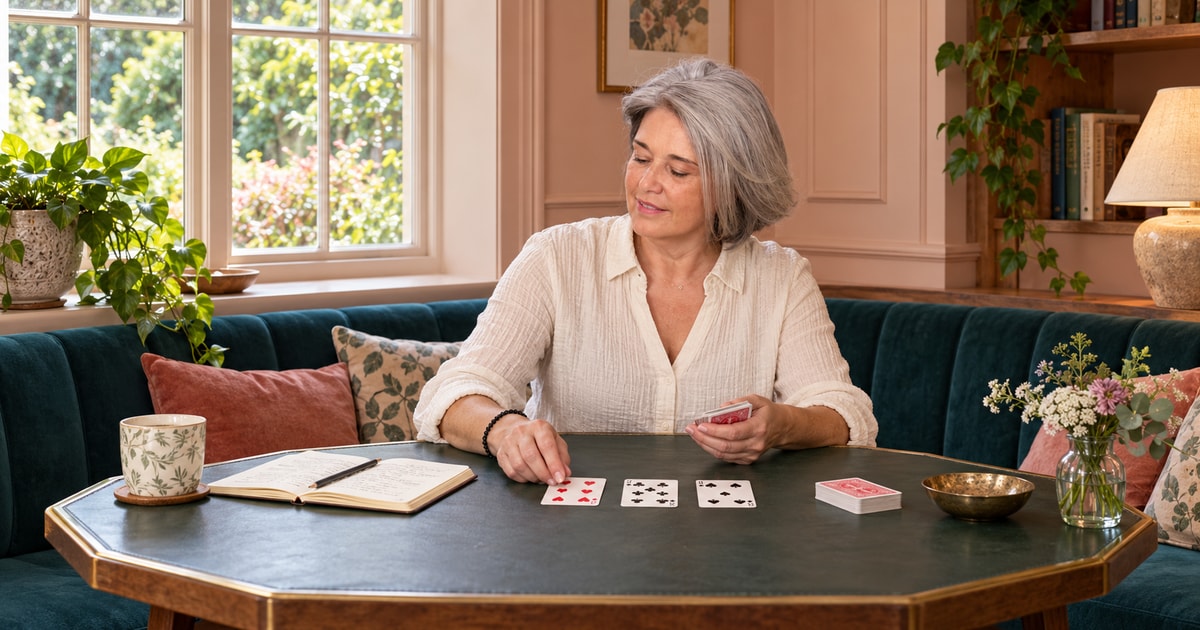
Use a complete ordinary deck, remove the Jokers and keep the chosen key nearby. Find enough unhurried time to write a few notes; there is no required ten-minute session or special number of shuffles. A single cut is optional.
- 1. AskWrite one question about your choices, needs or approach.
- 2. Deal threeShuffle and lay three cards left to right with the roles below.
- 3. CombineRead suit, rank and position together. Note what fits and what does not.
- 4. CloseWrite a short summary and one manageable action or fact to check.
- 1BackgroundWhat has shaped the question?
- 2Present focusWhat deserves attention now?
- 3Next approachWhat could I try or check?
This is a reflection-friendly variation on a past–present–direction row. If you prefer a future-position reading, treat it as a possibility within your spiritual practice, not an inevitable outcome. Choose the roles before you see the cards so you are not moving a difficult card into a more comfortable position afterwards.
For each card, make one sentence: “In this position, this suit and rank invite me to consider…” Then look for a connection across the row. Several cards of one suit can be an interpretive theme; they do not prove that area controls your situation. If a card makes no useful connection, leave it unresolved instead of drawing until a reassuring story appears.
A worked example: starting a weekly study group
Question: “How could I support a new weekly study group?” This imagined example uses the starter key above.
- 1. Background — Three of Hearts
- Hearts brings connection; Three brings a group. “Shared enthusiasm brought us together. What would help everyone feel included?”
- 2. Present focus — Eight of Clubs
- Clubs brings projects and study; Eight brings effort or movement. “We need a workable routine, not just a promising idea.”
- 3. Next approach — Queen of Spades
- Spades brings clear thinking and boundaries; the Queen brings discernment. “Suggest a clear meeting length and ask what each person can realistically commit to.”
A next action could be sending a proposed agenda and asking for feedback. The row does not establish that the group will succeed, that someone will object or that a particular woman is involved.
A one-card draw is another small starting point. Larger layouts can be adapted once their positions have clear jobs; see how to choose a tarot spread. The companion playing-card reading guide offers another route into working with an ordinary pack. If a source uses different meanings, keep its method distinct rather than blending it unconsciously with this key.
Playing cards, tarot and Petit Lenormand
All three can fall under the broad word cartomancy. The comparison below distinguishes their usual deck structures, not which one is more powerful or accurate.
Ordinary playing cards
52 cards. Four suits, Ace to Ten and three courts per suit. Most number cards show pips rather than narrative scenes. A suit-and-rank key or a named cartomancy tradition supplies the interpretive structure.
Tarot
Usually 78 cards. Twenty-two Major Arcana and 56 Minor Arcana, including four courts per suit. Rider–Waite–Smith-style illustrated scenes offer visual prompts; other tarot decks use different imagery or pip-style minors.
Petit Lenormand
36 cards. Named symbols such as Ship, Key and Dog, often read in combinations. A Grand Tableau uses the whole deck. Playing-card insets do not make its meanings interchangeable with this tarot-inspired key.
An ordinary deck has no separate Major Arcana, but it can still be used to explore a major life question. The size of a deck does not limit the importance of your experience. Nor are all tarot spreads or interpretive rules automatically part of every playing-card tradition.
The British Museum holds a 36-card Game of Hope pack with symbolic pictures and miniature French and German cards. It is a useful historical comparison for the small card insets you may see in later decks, not a reason to assume every inset should be read like a tarot card. For tarot’s structure, start with this introduction to tarot cards.
Keep a meaningful practice without handing over your judgement
You can value spiritual guidance while staying precise about what a reading can establish. A personal association is not verification of someone’s thoughts, a diagnosis, a pregnancy or a future event. Keep practical decisions tied to actual information and qualified help when appropriate.
- Choose one key for a reading. Record its source and your position meanings. Traditions differ; consistency makes your own notes easier to understand later.
- Write before hindsight fills the gaps. Keep the question, cards, first interpretation and action together. Later note what did not fit as well as what felt meaningful.
- Make general wording more specific. “A change is coming” could fit many lives. Ask what the image brought to your attention and what you can actually check.
- Respect other people’s boundaries. Do not turn a court card into an accusation or use a reading as evidence of someone’s private feelings, consent or honesty.
The Barnum effect is the tendency to experience broadly applicable descriptions as especially personal. Noting an interpretation in advance does not automatically remove that effect or prove predictive skill. The guide to tarot accuracy explores the difference between meaningful reflection and a checked claim.
When a frightening reading or money demand needs a pause
A black suit, the Nine of Spades or a difficult combination is not evidence of a curse, illness or approaching death. Do not pay someone who uses fear to insist that only they can remove a threat. If someone demands gift-card numbers or PINs as payment, stop: the FTC explains how gift-card scams work and how to report them. If you have already paid, contact the card issuer promptly and keep the card, receipts and messages.
If a reading leaves you distressed, put the deck aside and talk to someone you trust. You do not need to wait a fixed day or draw a better row before asking for help. For a crisis or thoughts of suicide in the US, call or text 988; outside the US, use local crisis services. Immediate danger needs emergency help, not another interpretation.
Related reading
Frequently asked questions
1. What is cartomancy?
Cartomancy is divination or interpretive reading with cards. The term can include tarot and other card systems, but it is often used more narrowly for reading ordinary playing cards. This guide focuses on a standard 52-card French-suited deck and clearly labels its tarot-inspired learning framework.
2. Can I really read with a normal deck of playing cards?
Yes. You can use a complete ordinary deck with Hearts, Diamonds, Clubs and Spades. For the exercise here, remove the Jokers and choose your meanings and positions before drawing. You do not need a special purchase, a particular brand or a deck claimed to have stronger powers.
3. Which playing-card suit matches which tarot suit?
In the framework used here, Hearts correspond to Cups and water, Diamonds to Pentacles and earth, Clubs to Wands and fire, and Spades to Swords and air. These are interpretive correspondences, not a universal historical rule. A different cartomancy book may assign different meanings to individual cards or suits.
4. How old is cartomancy?
Playing cards were present in Europe in the fourteenth century, and tarot developed as a card game in fifteenth-century Italy. Etteilla published a card-reading manual in 1770. That documented publication is not proof that nobody read cards earlier, or that all modern cartomancy systems come from one source.
5. Do playing cards have a Major Arcana?
A standard 52-card deck has no separate set of Major Arcana. It has four suits with Ace through Ten and Jack, Queen and King. That does not prevent you from exploring important life themes. A Joker can be given a Fool-like role by choice, but that does not turn the deck into a complete tarot pack.
6. What does the Jack mean in cartomancy?
In this starter framework, the Jack suggests learning, curiosity, a message or an active beginning. Other systems may use different meanings. There is no separate Knight in a standard playing deck, so decide whether your chosen system treats the Jack as Page-like, Knight-like or something else before a reading.
7. What do the Queen and King mean?
They can represent qualities, roles or ways of responding rather than particular people. Here, a Queen invites reflection on mature attention and discernment, and a King on responsibility and leadership. You do not have to assign them by gender, age, appearance or relationship status, and they do not identify a hidden person as fact.
8. Is there a difference between red and black cards?
Some traditions add a red-and-black interpretive layer, but it is optional and varies. Hearts and Diamonds are red; Clubs and Spades are black. Neither colour proves that a situation is easy, difficult, safe or dangerous. Read the specific suit, rank and position rather than making a verdict from the colour balance.
9. What is the simplest cartomancy spread?
One card for a reflection question is a small starting point. For more context, try a three-card row with positions agreed in advance. This guide uses background, present focus and a possible next approach. Write one interpretation for each card and finish with a practical question or action rather than a guaranteed forecast.
10. How is cartomancy different from Lenormand?
Cartomancy is the broader term. Ordinary playing-card reading commonly uses 52 cards, while Petit Lenormand uses 36 cards with named symbols such as the Ship, Key and Dog. Lenormand readers often combine neighbouring symbols; its playing-card insets do not mean you should automatically import tarot-style suit-and-number meanings.
11. Do I need to memorize all fifty-two meanings?
Not for the starter method here. Begin with four suit themes and a rank key, and keep notes nearby. That gives you a way to build interpretations, not mastery of every historical system. If you later follow a named tradition with individual card meanings or special combinations, learn those rules from that source.
12. Can playing cards predict the future?
Some readers use them for spiritual or divinatory guidance, but a reading is not established evidence that a future event will occur. Do not rely on cards to diagnose illness, confirm pregnancy, choose winning numbers or verify another person’s thoughts. A meaningful interpretation and a checked prediction are different things.
13. Does the Nine of Spades mean bad luck or death?
Some older systems attach alarming meanings to it, but drawing it does not establish death, illness, a curse or bad luck. In this guide it is a prompt about worry or mental strain, not a diagnosis. If a reader uses frightening claims to demand money for protection or curse removal, stop and seek independent support.
14. Can I use a Joker?
Yes, if you deliberately include it in your chosen method. For this 52-card exercise, leave both Jokers out. If you later use one for surprise, uncertainty or a Fool-like theme, write that meaning first. A Joker is not a missing Major Arcana or evidence that a special event must happen.
15. Should I read reversed playing cards?
Reversals are optional, not a requirement for an accurate or advanced reading. Many modern playing cards look the same both ways, so orientation may not be clear. You can read upright only and use the positions for nuance. If you adopt a reversal system, choose a consistent way to recognise orientation before drawing.
16. Are cartomancy meanings the same in every book?
No. Suit themes, individual meanings, court-card roles and combination rules vary across traditions. This guide offers one tarot-inspired learning key, not a universal dictionary. Keep the source or key beside your notes. If two books disagree, do not switch between them mid-reading just to get a more pleasing interpretation.
17. Can I mix playing cards and tarot in one reading?
You can use separate draws if you decide their roles first, such as a tarot card for a broad theme and playing cards for reflection questions. Keeping the decks separate preserves their different structures and avoids awkward shuffling. Explain the method if reading for someone else; more cards do not automatically add clarity.
18. What should I do if a reading upsets me?
Put the cards aside and name the interpretation that frightened you. A card is not proof that harm is coming, and you do not have to pay for protection. Talk with someone you trust if the fear persists. If you are in crisis or thinking about harming yourself, seek immediate human support rather than drawing another spread.
Start with three cards and one useful question
Keep your chosen key nearby, give each position a role and finish with something you can do or check. You can honour an intuitive or spiritual response without making the deck responsible for your decisions. A familiar pack and clear notes are enough to begin.