
Looking back without forcing an answer
Use tarot to put an experience into words
A tarot image can help you name a change, a loss, a beginning or a question you are still carrying. If you approach the cards spiritually, the reading may also feel like a conversation with your deeper values. You still decide which interpretation fits your lived experience.
This three-card lesson spread asks what happened, what it cost and what it taught. Those are invitations, not a demand to find a benefit in every difficult chapter. “I am not ready to make meaning of this” is a valid response.
Choose a chapter you feel able to revisit
Start with something manageable: a completed project, a move or a change in a friendship. You do not need to begin with the most painful event in your life. A chapter can be over while your feelings about it remain unfinished.
- Write the known facts first. List two or three things that happened without using the cards to establish missing facts or another person’s motives.
- Choose the deck and draw. You can use the 22 Major Arcana of a Rider-Waite-Smith deck for broad themes, or your full deck for a wider range of images. Decide before shuffling; use your deck’s own guidebook where needed.
- Set a limit. Choose a short session and a stopping point. Keep the three cards rather than replacing one because its message feels uncomfortable. You can leave an interpretation unresolved.
If the mechanics are new, the three-step self-reading routine explains how to keep your question, first impressions and guidebook meanings separate.
The three-card lesson spread
Lay three cards left to right in the order below, then write beneath each position. The first card is a way to reflect on what you experienced, not a way to rewrite the facts.
-
What happened
Which feature of the image connects with your experience? Name the connection, then compare it with the facts you wrote down.
Ask: “What part of this chapter am I noticing?”
-
What it cost
Consider time, energy, money, trust or a sense of belonging. You can also name what sustained you. Not every cost was your choice or your responsibility.
Ask: “What did this ask of me, and what support did I need?”
-
What it taught
Look for a value, boundary, skill or unanswered question you want to carry forward. A lesson can be tentative; it does not have to explain why the event happened.
Ask: “What might I do differently, or what do I still need to understand?”
You may feel that a card holds a spiritual message. Record that meaning as your interpretation, alongside other possible readings. A moving or timely image does not establish that a painful event was deserved, destined or sent to teach you something.
A worked example: looking back on a move
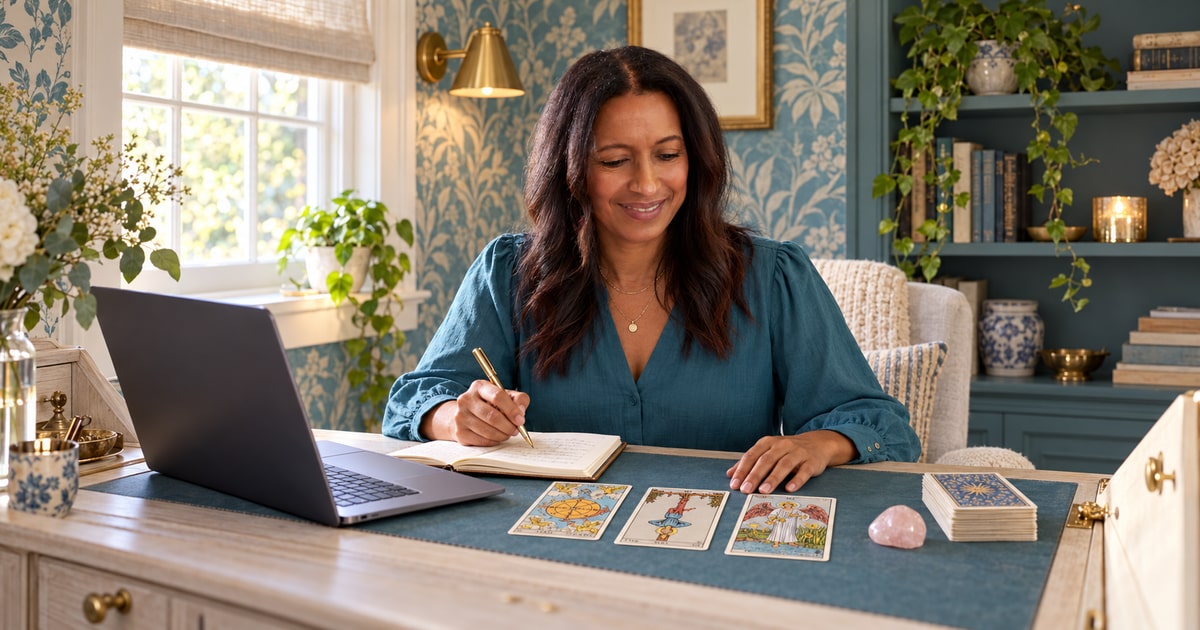
Imagine that a tenancy ended and you moved to another city. The facts are that you changed homes, left familiar routines and had fewer everyday contacts nearby. You draw Wheel of Fortune, The Hanged Man and Temperance, all upright.
Wheel of Fortune · What happened
The turning wheel might bring the unexpected change to mind. You could write, “I did not choose the tenancy ending, but I did choose between the places available afterward.”
Keep the distinction: a card about change does not prove the move was fate or reveal why the landlord acted.
The Hanged Man · What it cost
The suspended figure might connect with feeling in-between while you rebuilt a social life. You could write, “I missed easy companionship and needed more support than I asked for.”
Keep the distinction: noticing a pause is not an instruction to stay isolated or accept an unhealthy situation.
Temperance · What it taught
Pouring between cups might suggest combining old connections with new routines. You could write, “Familiar friendships and local activities can both have a place.”
A small next step: arrange a regular call with a friend and try one local activity that interests you.
Waite’s symbolic descriptions connect the Wheel of Fortune with the flux of life and describe The Hanged Man as life in suspension. The move and journal sentences above are an example of applying images, not a fixed rule for those cards.
Six card prompts for a life review
These are starting points you can adapt, not six compulsory lessons. Use the picture and your circumstances, and discard a prompt that does not fit.
The Fool
Beginning without complete certainty
What did I try, and what support would have made the first step easier?
Openness does not require ignoring a warning or blaming yourself for not knowing everything.
Wheel of Fortune
Change and the limits of control
Which parts were my choices, and which circumstances were outside my control?
A difficult turn is not proof that you attracted it or were meant to suffer.
The Hanged Man
A pause or a different viewpoint
What did the waiting reveal? What help, information or boundary did I need?
You do not have to remain stuck or endure harm to earn insight.
Death
An ending and what follows
What ended, what am I still grieving, and what do I need now?
In this exercise, use the card as a symbol of transition, not a prediction of physical death.
Temperance
Finding a workable combination
Which small habits, people or approaches helped me find a steadier pace?
Balance is not a demand to feel calm about something painful.
Judgement
Review, responsibility and a new response
What deserves repair, and what blame is not mine to carry?
Self-forgiveness and accountability can coexist; the card does not erase consequences.
Turn an insight into something usable
A lesson does not have to become a rule you follow forever. Choose one sentence that feels fair to your present self:
- “Next time I will…” Name an action within your control, such as asking about expectations before accepting a commitment.
- “I want to protect…” Name a value, limit or source of support.
- “I still need…” Leave room for information, help, time or an answer you do not yet have.
Keep the original note and add a dated follow-up after you have tried the step. Ask whether it helped, what was different and whether your first interpretation still fits. You do not have to make every event match the reading.
A fair next step has three qualities
- It is specific enough to try.
- It respects your resources and other people’s boundaries.
- It does not make you responsible for controlling someone else or preventing every future difficulty.
For example, “I will ask one person for help before the next move” is more workable than “I will never struggle with change again.” Keep useful sentences in your tarot notebook, but allow yourself to revise them as circumstances change.
When reflection needs a pause
If the exercise feels overwhelming, stop. Put the cards away and choose something supportive in the present: contact someone you trust, rest or seek professional support. You do not owe the reading a breakthrough, and a notebook is not a substitute for mental-health care.
If you are in the US and need support with emotional distress or thoughts of harming yourself, call or text 988. You do not need to finish this exercise before reaching out.
Let the meaning remain yours
A life review can hold both “this mattered” and “I wish it had not happened.” Tarot can offer language and spiritual perspective without deciding the meaning of your experience for you.
For related journaling practices and limits, see Tarot and Mental Wellness.