


Temperance is the tarot card of finding a workable mix. Its two cups invite patience, proportion and the careful blending of things that matter to you. Rather than asking you to give everything equal time, it asks: what needs adjusting so this can work in real life?
In a spiritual reading, the angel can feel like an image of harmony between your inner life and everyday choices. That meaning can be valuable without making the card a promise of healing, reconciliation or a calmer future.
Temperance is Major Arcana XIV (14), with no suit. It follows Death XIII and comes before the Devil XV. See the Fool’s Journey for the broader sequence.
- Upright
- Patience, proportion, cooperation and integration.
- Reversed
- Strain, clashing priorities, haste or overcorrection.
- Useful question
- What could I adjust without abandoning what matters?
The angel, cups and path: start with what you see
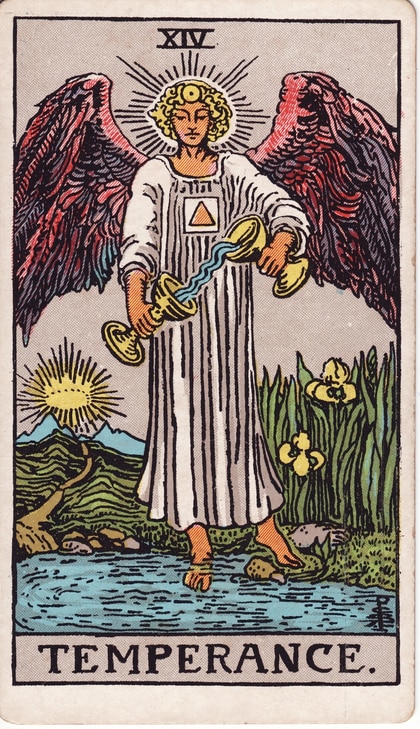
Look closely at Pamela Colman Smith’s Rider–Waite–Smith Temperance. The picture gives you several ways into the meaning; you do not have to settle on a single hidden message.
Two cups, one exchange
The stream connects the cups. You might use that movement to explore combining two skills, sharing responsibility or changing a proportion. A balanced exchange need not mean identical contributions.
Land and water
One foot meets the land and the other the pool. A practical reading can bring feelings and circumstances into the same conversation: what matters inwardly, and what is actually possible?
Wings, emblems and a distant light
Raised wings surround the figure; a sun emblem marks the forehead and a triangle sits within a square on the robe. The path leads toward a bright, crown-like form. Waite’s account describes harmonizing spiritual and material natures. You can explore that symbolism without treating the path as a forecast.
In the Golden Dawn correspondence table, Temperance is linked with Samekh and Sagittarius. This is a symbolic system, not a description of every Sagittarius person. Deck traditions differ; for wider background, see Britannica’s tarot overview.
Upright and reversed: adjustment is not a verdict
Upright: build a sustainable rhythm
Upright Temperance often invites patience, cooperation and a pace you can maintain. It may resonate when you are combining study with work, finding a shared routine or integrating a difficult experience.
Think of adjustment rather than a perfect midpoint. A short deadline may need more focus this week; rest may need more space next week. Blending skills or perspectives can mean creating something new, not simply splitting everything in half.
Ask: Which small change would make the whole arrangement more workable?
Reversed: examine the strain
Reversed Temperance can prompt reflection on a rushed process, competing demands or a swing from one extreme to another. It may also invite an honest look at two priorities that cannot both fit the current plan.
Do not turn that into a judgement about your character. Limited time, money, support or access can create a real imbalance. Sometimes the useful response is asking for help, reducing a commitment or setting a firm boundary—not trying harder to be moderate.
Ask: What is overextended, and what support or limit would actually help?
Balance does not require compromising safety or core values. Some arrangements need to change substantially or end. You do not have to keep a little of every option simply because the card depicts two cups.
Use the spread position to refine the reading
- Past: Which earlier compromise, pace or combination is still shaping the situation?
- Present: What proportion feels workable now, given the actual demands and resources?
- Future: What could support a steadier approach, without assuming that harmony is guaranteed?
- Advice: What is one adjustment I can try, and when will I review it?
Temperance is not only about waiting. The High Priestess emphasizes inward listening; Temperance can take what you have noticed and ask how different needs might work together.
Love, career and money: make balance specific
Love and relationships
For someone single, Temperance can invite a pace that leaves room to learn about a new person and notice your own needs. It does not mean you must wait indefinitely or accept a connection that does not suit you.
Within a relationship, consider the exchange of time, attention and responsibility. Instead of assuming the card confirms harmony, ask something concrete: “How can we divide the weekend tasks so neither of us feels left with everything?” A fair arrangement may be different for each person and may need revisiting.
A reversal can open questions about uneven effort, intensity followed by distance or incompatible expectations. It cannot establish faithfulness, compatibility or whether an ex will return. Reconciliation would depend on both people’s choices and the real relationship, not the card.
Where there is fear, control or threats, compromise is not the goal. In the US, contact the National Domestic Violence Hotline at 1-800-799-7233 or text START to 88788. Call 911 in immediate danger.
Career, study and teamwork
Temperance can be a useful image for coordinating different working styles, combining skills or giving a project enough time. It does not select a profession or promise that patient effort will prevent exhaustion.
If a team is strained, check the workload, handovers and decision process. A reversal might prompt “Which two tasks are competing for the same hour?” rather than “Who is the difficult person?” Blending approaches works only when responsibilities, limits and available resources are acknowledged.
Money and commitments
Use the card to explore your priorities, not to find an automatically correct spending-to-saving ratio. Essential costs, income, obligations and your goals affect what is possible. A feeling of balance does not verify an investment, contract or debt plan.
Write down the figures and questions that need checking, and seek qualified advice for consequential decisions. Our money and career tarot guide offers ways to keep the reflection tied to real circumstances.
When the question is about health or a habit
Some readers associate Temperance with healing or recovery in a spiritual sense. The card cannot assess health, identify dependence or show that treatment is working. Bring concerns about alcohol, drugs, medication or distress to a qualified professional rather than using a moderation exercise as treatment.
For example, the NHS warns that suddenly stopping alcohol can be dangerous if you are dependent. Get medical help rather than following an upright or reversed card as an instruction to cut down or stop.
A four-step Temperance adjustment exercise
Choose a manageable, non-medical situation such as planning a shared project or making space for a hobby. Keep the card nearby as a symbol of thoughtful adjustment; you do not need to draw clarifiers.
- Name the two cups. Write the two needs you want to accommodate. Be specific: “preparing for the craft fair” and “keeping a free Sunday,” rather than “everything” and “balance.”
- Check the container. List the time, help and resources actually available. Name any limit you cannot safely compromise. Notice whether the problem is the proportion or simply too much to fit.
- Change one proportion. Choose one small, reversible adjustment. Check whether it is a thoughtful change or an overcorrection. You may also need to remove a task rather than keep part of every demand.
- Review the mix. Choose a check-in that suits the situation, perhaps after a week. Note what helped, what did not and who carried the effort. Keep, revise or stop the experiment without treating the first plan as a promise.
Worked example: getting ready for a craft fair
The two cups: you want to prepare a small display while keeping Sunday free for family time. Your first plan puts all the preparation on Saturday evening, when you are usually tired.
The container: two short weekday sessions are available, and a friend can help with labels. You decide to make a smaller display instead of adding more tasks to every evening.
The adjustment: use Wednesday for choosing pieces and Friday for packing. After the fair, review whether that felt manageable and whether the help was fairly shared. Temperance supplies the theme; the actual trial tells you whether the plan fits.
If you need solitude before choosing your adjustment, compare the Hermit’s reflective approach. If worry is driving the plan, the Moon card guide offers another way to explore uncertainty.
If repeated readings increase distress, take a break. Our tarot and mental wellness guide and the NIMH mental-health resource provide further context. In the US, call or text 988 for crisis support.
Three card pairings: explore the exchange
Read each pairing in its spread positions and alongside your question. None of these combinations establishes a diagnosis, another person’s motives or a guaranteed outcome.
Temperance and the Devil
Explore pressure, attachment and the room available for change. Ask: “What keeps this pattern going, and what support or boundary would help?” Do not turn the pairing into blame or assume that every constraint can be solved through moderation.
Temperance and the Two of Cups
Consider cooperation and the quality of an exchange. Ask: “What does a fair contribution look like for each person?” The pair can inspire a conversation; it does not prove that a relationship is already balanced.
Temperance and the Five of Wands
Consider how competing ideas are handled. Ask: “Would clearer roles, a slower discussion or a different process help?” Making space for disagreement is not the same as accepting harmful behaviour or forcing agreement.
Frequently asked questions
1. What does the Temperance card mean in tarot?
Temperance commonly represents patience, proportion, cooperation and integration. It can invite you to combine needs or approaches in a way that fits the actual situation. Treat it as a theme to explore, not a promise that everything will settle into harmony.
2. What number is the Temperance card?
Temperance is Major Arcana XIV, or 14, in the Rider–Waite–Smith deck. It has no suit, follows Death XIII and comes before the Devil XV. Other decks may reinterpret its name or imagery, so check the guide that belongs with your deck.
3. What do the two cups on Temperance mean?
The exchange between the cups can suggest combining skills, sharing responsibility or adjusting a proportion. You might ask what you are trying to bring together and whether the exchange is workable. It does not require two people to give identical amounts.
4. Why does the angel have one foot in the water?
The figure stands between land and water. Readers often use that image to bring practical circumstances and inner experience into the same reflection. Waite described the card in terms of harmonizing spiritual and material natures; your deck may emphasize another aspect.
5. What does Temperance mean reversed?
Possible themes include strain, clashing priorities, haste or overcorrection. A reversal can prompt you to examine the plan, available support and limits. It is not a judgement that you lack self-control or proof that a relationship or project will fail.
6. Is Temperance a yes or no card?
Some readers assign it a conditional yes, but there is no universal rule. A more useful follow-up is: what would make this workable, and what still needs checking? Neither its orientation nor a yes-or-no convention establishes an outcome or a deadline.
7. What does Temperance mean in a love reading?
It can invite a pace, conversation or division of responsibility that suits the people involved. Reversed, it may prompt reflection on uneven effort or conflicting expectations. Use those themes to ask grounded questions rather than treating the card as proof of compatibility or faithfulness.
8. Does Temperance mean getting back together?
It does not establish that an ex will return or that reconciliation would be right for you. You could reflect on whether the relationship was workable, what would need to change and whether both people freely want that change. Safety and boundaries remain important.
9. Which zodiac sign is linked to Temperance?
The Golden Dawn correspondence table links Temperance with Sagittarius and the Hebrew letter Samekh. These are symbolic correspondences, not facts about the behaviour of Sagittarius people. A deck’s own tradition may use a different scheme, so be clear about which one you are following.
10. What does Temperance mean in a career reading?
It can highlight coordination, combined skills, workload and sustainable pacing. A reversal may invite questions about rushed handovers or competing demands. It does not select a profession or guarantee that patient effort alone will prevent exhaustion; resources and working conditions matter too.
11. How can I use Temperance as a daily card?
Choose one ordinary adjustment to notice, such as making a project smaller or sharing a task more clearly. Check what is realistically possible that day. You do not need a perfectly balanced schedule or a complete lifestyle overhaul to work thoughtfully with the card.
12. Does Temperance mean healing?
Healing can be a spiritual association for some readers, but the card is not a medical assessment or evidence that recovery is happening. Questions about symptoms, treatment, medication or dependence need qualified care. Keep the reading as reflection alongside that care, not a substitute for it.
13. Does Temperance require a 50/50 compromise?
No. A workable balance depends on needs, responsibilities, resources and consent, not an automatic equal split. Some boundaries are not negotiable, and some demands cannot fit together. You can use the card to consider a different arrangement rather than keeping part of every option.
14. How do I read Temperance in past, present and future positions?
For the past, explore an earlier compromise or pace. For the present, examine the current mix of needs and resources. For the future, consider what could support a steadier approach. A future position does not guarantee harmony or a particular time frame.
15. What is a simple Temperance exercise?
Name two needs, check the time and resources available, choose one small reversible adjustment and set a review point. Use a manageable non-medical situation, such as planning a shared project. Record what actually happens instead of pulling more cards until the plan feels certain.
A useful mix is one you can live with
Temperance can honour patience, spiritual integration and the care involved in making adjustments. Notice your actual limits, try a proportion that fits and remain willing to change it. For help learning the wider deck, start with our tarot guide for beginners.