

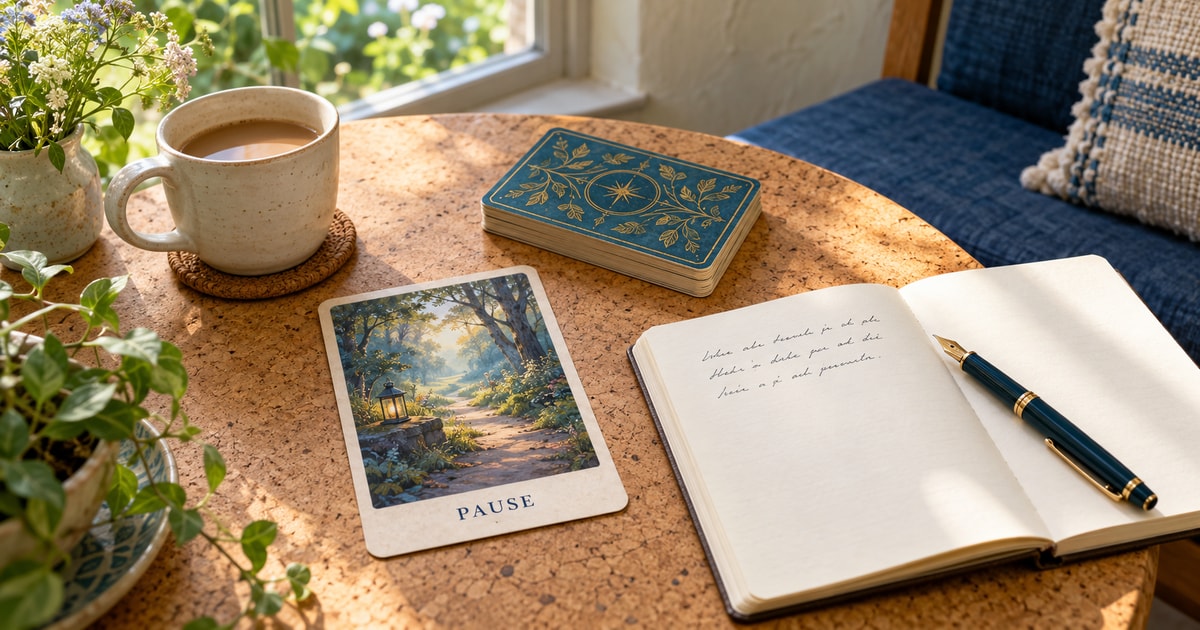
One oracle card, one question and a few lines in a notebook can make a simple daily check-in. Draw in the morning, consider the image and guidebook, then return to your note later to see what was useful.
Think of five minutes as a flexible starting point, not a target you must meet. You may approach the draw as a spiritual practice, a moment of reflection or both. This routine keeps the card connected to your day without asking it to make the day’s decisions for you.
Before your first draw
Have your deck, its guidebook if supplied, and somewhere to record a short note. Read the creator’s introduction: oracle decks can have different systems, suggested spreads and approaches to reversals. The routine below is an option to adapt, not a rule that replaces those instructions.
You do not need an elaborate setup. A clear surface and enough light to read the cards will do. If prayer or setting an intention is meaningful to you, leave space for it; if not, begin with the question. Keep drinks away from the cards and paper.
A five-step daily card routine
1. Set one question
Keep it close to something you can notice or do: “What deserves my attention today?” or “How could I approach this conversation more thoughtfully?” Write the question before drawing so you can return to what you actually asked.
A question about your response gives you room to act. “What would help me prepare?” is more workable than asking the card to guarantee that a plan will succeed.
2. Shuffle comfortably and draw one card
Use the deck’s instructions, or choose a simple method such as cutting the pack and taking the top card. If the cards are large or difficult to handle, mix them gently on a clean surface instead.
Decide beforehand how you will treat a card that falls out: return it or use it as the draw. You do not need to turn an accidental drop into a warning, and you need not pull extra cards to complete this routine.
3. Read the guidebook and notice the image
Read the entry for your card, then pick out one detail in the artwork. If you prefer looking first, that is also a reasonable way to begin. Record the creator’s explanation separately from your own association.
For example, a lantern might suggest taking a smaller next step to you, while the guidebook emphasises patience. Neither association needs to erase the other. Check the deck’s instructions before assigning a meaning to an upside-down card.
4. Write three short lines
Date the entry and note the card’s name. Write what it says, what it brings to mind and one manageable action. A sentence per line is enough; the journal does not need to become another large task.
Make the action specific and within your control: “Ask which task is most urgent” is clearer than “Be more balanced.” If action is not what you need, write a question to consider or a feeling you want to acknowledge.
5. Check back when it suits you
In the evening, or the next time you open the notebook, add a sentence about what actually happened. Did you take the action? Did the prompt fit only partly, or not at all? Keep the original morning note intact.
You can value comfort or a moment of prayer without treating a match as proof of prediction. An ordinary, uneventful day belongs in the journal too. Close the deck when you are finished rather than searching for a more impressive answer.
What three lines can look like
Here is an imagined entry for a card labelled “Pause”. The example shows a way to connect the word to a real task; it is not a fixed meaning for every deck’s Pause card.
Morning question: “What would help me handle today’s workload?”
- Card: Pause. A lantern lights a short stretch of path.
- Connection: I am trying to solve every task at once and have not checked which one matters first.
- Action: Before answering the next request, I will ask about its deadline and choose one task to begin.
Evening note: “I checked the deadline and changed the order of two tasks. I still felt rushed, but I did not need to finish everything at once.”
The last sentence need not be positive. “I forgot the card by lunchtime” or “I could not act on this today” is an honest record. That gives your later review something concrete to work with instead of an edited story in which every draw fits perfectly.
When the card or routine does not fit
- The message seems unrelated: write “No clear connection today.” You can revisit it later without inventing a link or making another draw compulsory.
- A theme repeats: note the repeat and your response to it. Ask whether circumstances have changed; repetition alone does not establish a prediction or an urgent instruction.
- You miss a day: pick up when you want to. There is no need to catch up, protect a streak or read a missed draw as a bad sign.
- Mornings are busy: choose another time, draw only on selected days or keep a single sentence. The practice should fit your available energy and access needs.
- You keep checking for reassurance: put the deck away and return to the facts of the situation. If readings leave you frightened or interfere with daily life, step back and seek support rather than more cards.
For a serious health, money, legal or safety concern, use the note to prepare questions for qualified help, not to decide whether help is needed. A card can carry personal spiritual meaning without establishing what another person thinks or what will happen next.
Keep the useful part, not the obligation
After a few entries, look back at the questions and actions. Which wording helped you notice something specific? Which prompts felt forced? You can change the question, shorten the routine or stop for a while. Comfort, curiosity and a practical next step are different kinds of value; you need not make every draw serve all three.
If you also use tarot, our guide to shuffling and journaling offers more ways to record a reading. When you want a different layout, try the short oracle card spreads. For deck types, choosing a deck and the differences from tarot, return to What Are Oracle Cards?