


The Nine of Cups in a sentence
The Nine of Cups invites you to recognize satisfaction, enjoy what you have, and ask whether your wish truly fits you. Upright, it is associated with contentment, pleasure and a wish fulfilled. Reversed, many readers explore disappointment, excess or happiness that looks better than it feels.
Its familiar nickname, the wish card, is encouraging symbolism—not a promise that a desired event or relationship will happen. A useful question to bring to this card is: “What would enough feel like, and what can I do to make room for it?”
- Card family
- Minor Arcana · 9 · Cups
- Element
- Water in the Golden Dawn correspondence system
- Upright themes
- Contentment, pleasure, gratitude, satisfaction, wishes fulfilled
- Common modern reversed themes
- Dissatisfaction, overindulgence, display, a wish that needs rethinking
- Astrological correspondence
- Jupiter in Pisces; the Golden Dawn title is Lord of Material Happiness
- Yes or no?
- Often read as a favorable yes, but neither a probability nor a guarantee
Read the picture before the nickname
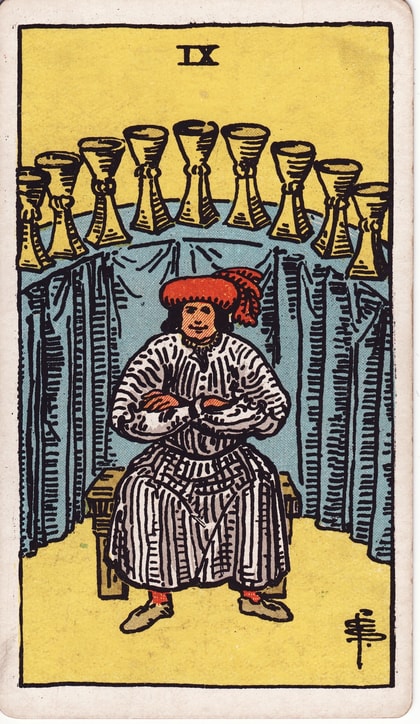
In Pamela Colman Smith’s Rider–Waite–Smith picture, a seated figure faces us with folded arms. Nine cups stand behind him on a curved counter covered with blue cloth. The scene is sparse, leaving his expression and the display of cups to carry the story.
- The seated figure: an image of enjoying the moment. Depending on the question, the same posture can suggest comfort or complacency.
- The nine cups: a visible collection of pleasures or achievements. Ask which “cup” actually matters to you rather than assuming more is always better.
- The folded arms: readers may see self-satisfaction or a guarded attitude. They do not establish a person’s intentions or character.
- The cloth-covered counter: a prompt to compare what is displayed with what is felt. Hospitality is one possible reading; hidden unhappiness is another, not a fact concealed in the drawing.
Waite’s original Nine of Cups commentary emphasizes satisfaction, harmony and success. His description is a useful starting point, while the questions you ask of the picture bring it into your own reading.
Upright and reversed: two ways to explore satisfaction
Upright: let a good moment count
This card can represent the pleasure of finishing something, receiving appreciation or having time to enjoy life. It does not have to mean a spectacular event. A relaxed meal, a project completed or an evening without rushing can fit its mood.
As advice, it may invite you to pause before inventing the next target. Name what is already good and decide how to enjoy it. Gratitude need not erase an unmet need or a difficult feeling.
Ask: “What am I allowed to enjoy without first earning something more?”
Reversed: check the fit of the wish
A common modern approach asks whether an achievement has delivered the feeling you expected. You may be pursuing someone else’s idea of success, repeating a pleasure after it has stopped being pleasurable, or dismissing something genuinely nourishing.
The reversal can also invite more private, inward contentment rather than a bigger display. It is not a punishment for wanting things, and it does not prove that you are greedy or ungrateful.
Ask: “What did I hope this would give me—and is it giving me that?”
Why guidebooks disagree about the reversal
Waite’s reversed entry includes honesty, loyalty and freedom, alongside mistakes and imperfections. That differs from the familiar modern emphasis on dissatisfaction and excess. Neither requires you to turn every upside-down card into the opposite of its upright meaning. Choose the approach you use before interpreting the spread; your deck’s guidebook may follow a different tradition.
The Golden Dawn-derived Liber LXXVIII connects this card with Jupiter in Pisces and wishes fulfilled, but also recognizes vanity alongside generosity. These are symbolic correspondences, not traits every Pisces person shares. Our astrology and tarot guide explains how to use such layers without letting them overrule the question.
Love, relationships and someone’s feelings
In an established relationship, the upright card can invite appreciation of what feels enjoyable: affection, shared rituals, laughter or the freedom to be yourself. A useful action is to name one thing you value and ask your partner what makes them feel appreciated. Personal satisfaction and mutual satisfaction are related, but they are not automatically the same.
If you are single, the Nine can support building a life that contains pleasure now, rather than postponing every good experience until a relationship arrives. Wanting companionship is still valid. You do not have to become perfectly happy alone to deserve love.
Reversed, consider whether an attractive relationship picture is hiding unmet needs, whether comfort has become taking each other for granted, or whether the wish concerns status more than connection. These are questions to explore, not accusations to make from a card.
As someone’s feelings, readers might suggest enjoyment, appreciation or feeling comfortable. Keep that as a possible interpretation. A card cannot verify another person’s private feelings, willingness to commit or intention to return. Use communication, consent and consistent behavior to understand what is actually being offered. For a fuller spread, see love tarot readings and the Two of Cups, which brings mutual exchange into focus.
If a relationship involves fear, control or threats, a favorable card does not make it safe. In the US, the National Domestic Violence Hotline is available at 1-800-799-7233 or by texting START to 88788; call 911 in immediate danger.
Career and money: what makes success worth having?
At work, upright Nine of Cups symbolism fits pride in a completed project, a role you enjoy or recognition that feels meaningful. Before turning it into a prediction of promotion, ask what has already improved and what evidence would show further progress.
Reversed, a promotion may be a useful example of the card’s tension: a better title can bring less time for the part of the job you love. Compare the actual duties, hours, compensation and support—not just how impressive the offer sounds. The five-card choices spread can help organize those questions.
With money, the theme is enjoyment within your circumstances: what is affordable, what feels sufficient and what you want to share. Reversed, ask whether spending is serving a real preference or an image you feel pressured to maintain. Check balances, obligations and terms directly; this card is not evidence of a windfall or investment return. For more prompts, read understanding finances with tarot.
Four, Nine or Ten of Cups?
These cards can all involve what is available to enjoy, but they ask different questions.
- Four of Cups
- How am I responding to what is offered? Often read through withdrawal, boredom or reconsidering an opportunity.
- Nine of Cups
- What feels satisfying to me? Personal enjoyment, wishes and the ability to recognize enough.
- Ten of Cups
- What does shared fulfillment look like? Belonging, chosen family, household or community—not a promise of marriage or children.
The Nine is not an inferior version of the Ten, and the Ten is not a compulsory next stage. Someone can value personal contentment without wanting a conventional family story. For another Cups contrast, the Six of Cups often turns attention toward memory and familiar comforts.
Let the spread position do some work
Past
What once satisfied you? Consider how an earlier success or comfort shapes your expectations now.
Advice
Notice what is nourishing, share it if you wish, and check the cost of chasing the next thing.
Outcome
Explore what a satisfying result would look like if the current approach continues. Treat it as a possibility to work toward, not a settled event.
In a hopes position, the card may describe the wish itself rather than its fulfillment. A favorable image should not cancel a spread position that asks about a concern. For the role of 9 in other suits, see tarot numerology.
A five-step wish-to-action exercise
Keep the Nine of Cups face up beside a notebook. This is a reflection exercise; you do not need to draw more cards to complete it.
- Name the wish. Write one specific thing you want. Separate your preference from a demand that another person feel or act a certain way.
- Name the feeling beneath it. Is it ease, recognition, companionship, freedom or something else? There can be more than one answer.
- Count your cups. List up to nine things you already value. If nine feels forced, stop sooner. Notice what you actually enjoy rather than trying to prove that you should be grateful.
- Check the cost and the gap. What time, money or compromise would the wish require? If it came true, which need might still remain? This is the “look under the cloth” part.
- Choose one action and one pleasure. Set a manageable step within your control and a small way to enjoy or share something good now. Pick a review date for your actions—not a deadline the card has predicted.
Example: “I want my work to be appreciated”
The deeper wish might be recognition and fairer pay. One existing “cup” is a completed project you are proud of. The gap is that your manager has not seen the results clearly. Your next action could be to document the outcome and request a review; your present pleasure could be an unhurried dinner with a friend. The reading has helped clarify a response without promising what the manager will decide.
Five possible card combinations
These are examples of combining themes, not claims that particular pairs appear more often. Read the question, positions and surrounding cards before choosing an interpretation.
Nine of Cups + Ten of Cups
Personal pleasure meets shared belonging. Ask whether the result is satisfying for everyone involved, not just you.
Nine of Cups + Four of Cups
Having something and feeling engaged with it may be different. Ask whether you need rest, a fresh perspective or an honest change of direction.
Nine of Cups + The Devil
Examine a pleasure’s price: time, money, obligation or difficulty stopping. This pairing is not a diagnosis of addiction or proof that someone is manipulative.
Nine of Cups + The Sun
Consider open enjoyment and sharing a success. Ask how to celebrate without assuming that all difficulties have disappeared.
Nine of Cups + Ace of Pentacles
A wish meets a practical opening. Identify the first step, resources and terms before calling the opportunity a success.
The question to keep
“Is this the life I want to enjoy, or the picture I want to display?” The Nine of Cups gives you room to celebrate and room to reconsider. You can appreciate what is good while still asking for something to change.
Frequently asked questions
1. What does the Nine of Cups tarot card mean?
The Nine of Cups is traditionally associated with personal satisfaction, pleasure and wishes fulfilled. In a reading, it can invite you to recognize what is good, enjoy a milestone or define what enough means to you.
2. Why is the Nine of Cups called the wish card?
The nickname reflects its association with wishes fulfilled in tarot tradition. Golden Dawn-derived material includes that theme, although Waite’s main entry emphasizes satisfaction and success without using the nickname. A symbolic association is not a promise that a particular wish will happen.
3. What does the Nine of Cups mean reversed?
Many modern readers explore disappointment, excess, private contentment or an achievement that does not satisfy. Waite’s older reversed list also includes honesty, loyalty and freedom. Reversed meanings vary; use the approach you have chosen for the reading rather than assuming the card is automatically negative.
4. What does the Nine of Cups mean in a love reading?
Upright, it can suggest appreciation, enjoyment and knowing what makes you feel fulfilled. Reversed, it can prompt a discussion of unmet needs or appearances that do not match the experience. It does not establish mutual commitment or guarantee a new relationship.
5. What does the Nine of Cups mean as someone’s feelings?
A reader might interpret it as enjoyment, appreciation or feeling comfortable. That remains a possible symbolic reading, not access to someone’s private thoughts. Look to their communication, consent and consistent behavior to understand what they feel and want.
6. Is the Nine of Cups a yes or no card?
It is often treated as a favorable yes in yes-or-no conventions. Reversed responses vary by reader and question. The card does not supply a measured probability, and a favorable draw should not replace checking facts or another person’s consent.
7. What does the Nine of Cups mean for career and money?
For career, it can represent pride in an achievement or a question about what makes work satisfying. For money, it can prompt reflection on comfort, spending and enough. Reversed, consider whether success or purchases are meeting the need beneath them; check practical details directly.
8. Why does the man on the Nine of Cups sit alone with his arms crossed?
The posture can suggest satisfaction and enjoying a moment without needing to reach for more. Some readers also see guardedness or self-display. These are interpretations of an image, not evidence that a particular person is selfish or unwilling to share.
9. Which zodiac sign is linked to the Nine of Cups?
The Golden Dawn correspondence assigns it to Jupiter in Pisces and calls it Lord of Material Happiness. This is one esoteric system, not a description of every Pisces person. You can read the picture and spread position without adding astrology.
10. What is the difference between the Nine of Cups and the Ten of Cups?
The Nine often emphasizes personal satisfaction; the Ten often emphasizes shared fulfillment and belonging. That can include friends, chosen family or community. The cards are not a ranking of lifestyles, and the Ten does not guarantee marriage or children.
11. Does the Nine of Cups mean my wish will come true?
Not as a guarantee. The card can express hope or a satisfying possibility, but it does not establish that an event will occur. Name the wish, identify what is within your control and check the practical conditions needed for it to happen.
12. Does the Nine of Cups say anything about health?
Some tarot traditions connect it with bodily comfort or indulgence. That symbolism cannot assess symptoms, diagnose a condition or tell you which treatment or diet is appropriate. Bring health concerns to a qualified healthcare professional rather than using the draw as medical information.
13. How can I work with the Nine of Cups as a daily card?
Name one wish and the feeling beneath it, notice things you already value, and check the wish’s costs or unmet needs. Choose one realistic action and one way to enjoy something good now. You do not have to force gratitude or draw more cards.
14. How does the Nine of Cups change in different spread positions?
In the past, it may describe an earlier satisfaction; as advice, it can invite enjoyment and a check on priorities. In hopes, it may describe the wish rather than its fulfillment. In an outcome position, read it as a possible direction, not a settled future.
15. What does the Nine of Cups mean beside another card?
Combine the themes with the question and positions. With the Ten of Cups, compare personal and shared satisfaction; with The Devil, examine a pleasure’s costs; with the Ace of Pentacles, consider a practical first step. None of these combinations guarantees an event or diagnoses a person.