
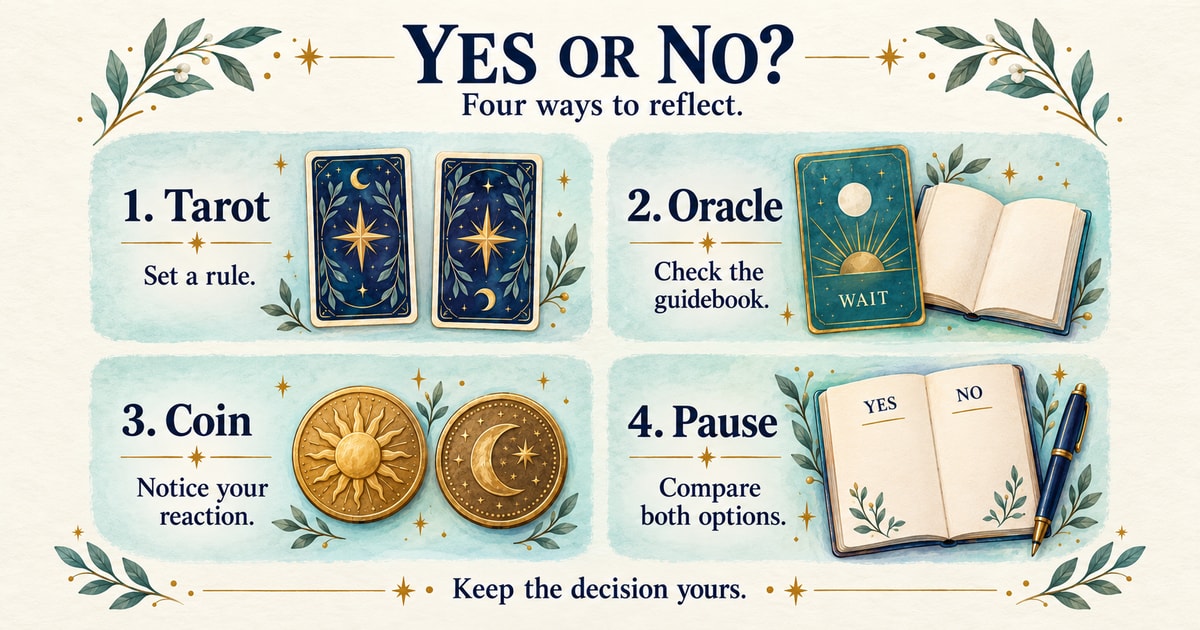
A yes-no oracle gives a symbolic answer according to a rule you choose: a tarot card’s orientation, an oracle deck’s instructions or a coin assigned to two options. It can open a useful reflection, but it does not establish what will happen or what another person thinks.
The four approaches below include a no-tools pause as an alternative to drawing or tossing anything. You may bring spiritual intention to a card practice, while keeping the interpretation distinct from verified information. Your reaction is worth considering, not automatically the right answer.
Set up a question you can actually use
Choose a low-stakes, reversible choice about your own actions. “Would I like to try the local drawing group this Saturday?” gives you something to explore. “Will everyone like me there?” asks for information a draw cannot supply.
Write the question, the rule and what counts as unclear before you begin. Ask once for this exercise; if you dislike the result, record that reaction instead of changing the rules or repeating until you get a yes. You remain free to make a different choice for a clear reason.
Four approaches, with different jobs
1. Single tarot card: set a rule
One optional convention is upright for yes and reversed for no. Allow both orientations while shuffling, draw one card and apply the rule you wrote down. This is not a universal tarot rule: many readers interpret reversals differently, and you can use a different clearly defined method.
Then read the card’s theme as a question, not an extra factual verdict. Under the orientation rule, a reversed Eight of Swords gives a symbolic no; its image might prompt “Am I assuming I have fewer options than I do?” A Five of Pentacles might bring resources or support to mind. Neither card proves that a particular obstacle exists.
For card-based yes, no and maybe conventions, see our full yes-or-no tarot guide.
2. Oracle card: check the deck’s instructions
Some oracle decks include explicit yes, no or wait messages; others use qualities, images or longer reflections that do not fit a binary answer. Read your guidebook before assigning categories. A word such as Trust does not automatically mean yes, and a wait message need not become a hidden no.
If the deck does not supply a yes-no system, let the card generate a follow-up question instead. A theme of Patience might become “What information am I waiting for?” You have not failed to read it if the result is unclear.
Our guide to oracle cards explains creator-defined systems. For a layout that leaves more room than yes or no, try three short oracle spreads.
3. Coin: notice your reaction
Assign heads to one option and tails to the other, then toss once. You can notice which outcome you hope for before looking, and how you feel when you see it. Relief, disappointment or no clear reaction are all observations; you do not have to obey the coin.
There is a useful distinction between a preference and a better decision. In three studies of choices between art posters, reactions to coin outcomes reflected earlier preferences. The researchers did not find reliable support that coin flipping made later choices more consistent with those preferences. That limited finding does not establish that a coin reveals the best course in a real-life dilemma.
Ask “What did I like or dislike about that suggestion?” rather than “What has the coin proved?”
4. Quiet pause: compare both options
Without a card or coin, imagine saying yes, then imagine saying no. For each, write what appeals to you, what concerns you and what you would need to know. You may notice a bodily response, but do not turn calm into an automatic yes or tension into an automatic no.
This is a reflective comparison, not a random oracle result. You can skip focusing on sensations and use words or a practical pros-and-cons list. If neither option feels workable, look for a third option, a smaller trial or a decision you can postpone.
Turn the result into a small, testable next step
Imagined example: you ask whether to try the drawing group. A coin suggests yes, but you feel reluctant. Rather than deciding that reluctance reveals a final no, you write: “I like the idea of drawing, but I am worried about the cost and arriving alone.”
Your next step might be to check the fee and ask the organiser what a first session is like. After that, you could choose a single trial visit or decide it is not for you. The coin supplied a prompt; the details and choice remain yours.
Keep three short lines in your notes:
- What I know: facts already checked, separate from assumptions.
- What I noticed: the result, your interpretation and your response.
- What I will do next: one question, conversation, check or reversible action.
When yes or no is the wrong shape
Do not use a draw to decide whether to change medication, make a legal or financial commitment, or dismiss a safety concern. Get the relevant facts and qualified help. Another person’s consent or feelings require communication, not an oracle verdict.
If you keep seeking another answer, put the tools aside and name what remains unresolved. A useful question might be “What would help me decide?” or “Which boundary matters here?” Uncertainty can remain at the end of a reading; you do not need a symbolic yes to give yourself permission to think carefully.