
25 May · Make a little room for your cards
A familiar deck, a fresh question and a moment you do not have to rush: World Tarot Day can be that simple. Whether tarot is part of your spiritual practice, an art you love or a new curiosity, the day offers a reason to reconnect with it.
- The date
- 25 May each year.
- The invitation
- Explore, reflect or share what you enjoy.
- The starting point
- Use the deck and time you already have.
A modern celebration with room for different practices
World Tarot Day is commonly observed on 25 May and credited to tarot author Den Elder in 2003. It is a community occasion rather than a public holiday with a required ceremony. Readers, artists, collectors and beginners can make it their own, from a private ritual to a small gathering.
You might approach the cards as a way to connect with intuition, explore spiritual questions or reflect on a turning point. You do not have to set those meanings aside to enjoy the day. Leave room for other people’s approaches too: nobody needs to agree on every interpretation to enjoy looking at the same pictures.
Seven ways to celebrate without turning it into a project
Pick one idea, not a checklist you must finish. Five minutes with a single card can be enough; if you have twenty minutes, try the annual spread. With more time, invite a friend to share a card study or reading swap.
-
Reconnect with a familiar deck
Take out a deck you already own. Look through it slowly and notice an image you had stopped seeing. Check the expected card list in its booklet; many tarot decks have 78 cards, but some editions add bonus or alternative cards. A quiet intention can make this feel like a fresh meeting rather than a chore.
-
Make an annual journal entry
Use the five-card spread below, or draw one card for the question: What do I want to give more attention to? Record the date, deck, interpretation and one action. Next year, compare your notes with what actually happened, including the parts that did not fit your first interpretation.
-
Swap readings with a consenting friend
Agree on an open question, a short time limit and what is off-limits. Ask whether the person wants an interpretation, conversation or simply help noticing the images. Keep the reading private unless they agree otherwise. For a comfortable start, use our guide to preparing for a reading linked below.
-
Study one overlooked card
Choose a card you tend to skim past. Describe three visible details before checking the guidebook, then compare your response with the traditional meanings. If you read reversals, include those too; if you do not, there is no need to introduce them for the occasion. Note one question the card brings to mind.
-
Follow one thread of tarot history
Look at a museum’s historic cards and compare their suits, clothing and symbols with your deck. Ask which features stayed familiar and which changed. Appreciating the cards’ documented history does not take away their spiritual meaning; it gives that meaning a richer setting.
-
Rehome or retire a deck thoughtfully
If a deck no longer suits you, ask whether a friend or beginner would like it, and explain any missing or damaged cards. Some readers keep a retired deck as a meaningful object; others let it go. There is no universal requirement to keep, burn or dispose of it in a particular ritual.
-
Welcome someone new
Show a willing beginner the Major and Minor Arcana, let them choose an image and explore what they notice. Try three cards for situation, perspective and a possible next step. You do not need to impress them with predictions. Our beginner and introductory guides below offer a gentle place to continue.
For your next step, explore tarot for beginners, an introduction to how the cards are used, or preparing for a comfortable reading. If choosing a deck is part of your celebration, our deck-selection guide can help you look beyond a sale or a striking box.
A five-card year-ahead reflective spread
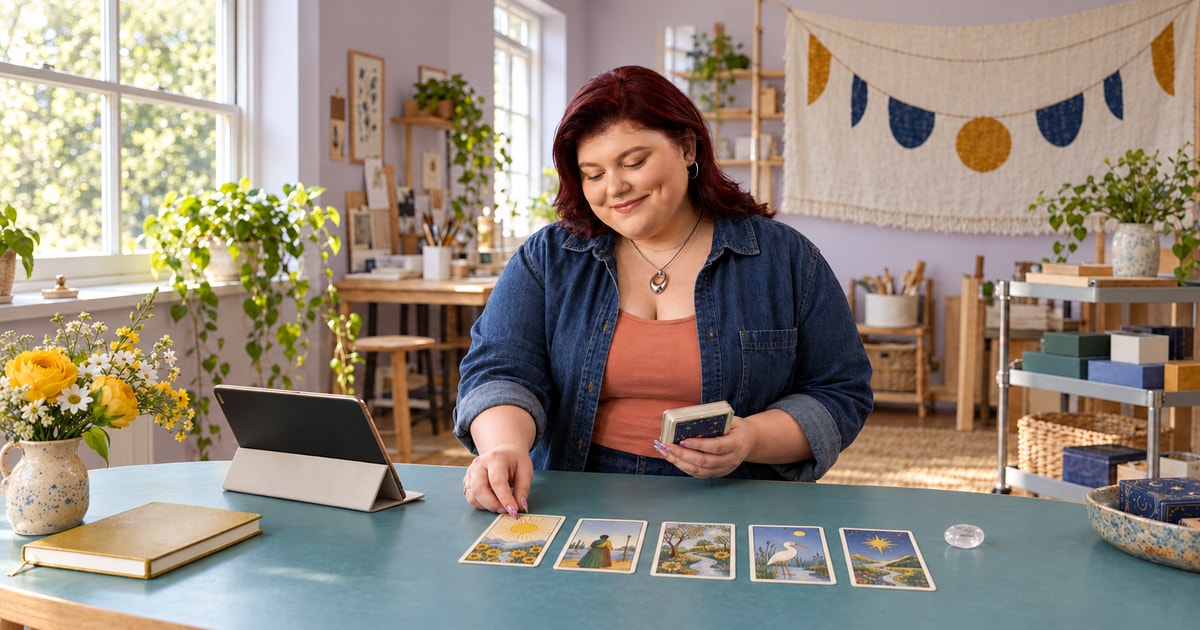
Use this for World Tarot Day, a birthday or another annual marker. Begin with a quiet question about your relationship with the coming year. Shuffle in a way that suits your hands and deck; cutting is optional. Deal five cards in the numbered order below. A row works well, but two short rows are fine if your space is small.
Deal in order: reflect → choose → act
- 1Year behind
- 2Carry forward
- 3Set down
- 4Quality to develop
- 5First step
The layout is a guide to the questions, not a timeline of events that must happen. The full prompt for each position follows.
1. The year behind
Ask: What did the past twelve months teach me?
Name a lesson from your real experience. The Five of Pentacles might bring to mind a difficult season and the help you needed; it is not proof that another loss is coming.
2. What to carry forward
Ask: Which habit, relationship or project deserves more room?
Choose something worth continuing. The Three of Pentacles might point toward collaboration, feedback or a skill you enjoyed developing.
3. What to set down
Ask: What am I holding that no longer helps?
Explore a habit, expectation or plan that needs reconsidering. The Eight of Cups can prompt reflection on moving on, but does not instruct you to end a relationship or leave a job.
4. A quality to develop
Ask: What quality would I like to practise in the year ahead?
Look for an approach you can choose: patience, curiosity, steadiness or rest. Strength might suggest gentle courage, not a prediction that you must face a battle.
5. One first step
Ask: What can I do in the next seven days?
Make the action small and specific. The Eight of Pentacles could become one practice session booked in your calendar, with time to review whether it helped.
Spend around fifteen or twenty minutes with the spread if that feels comfortable. Write your first interpretation before pulling extra cards. You may find a reading spiritually significant, but that does not make it reliable evidence of future events. A dramatic card is not proof that illness, separation or danger is on its way.
If a card unsettles you, pause rather than forcing yourself through the reading. Describe what is actually pictured, notice the story you added and return to the question in that position. You can put the deck away. No reading requires you to solve a frightening image by buying another reading or a cleansing service.
Worked reading: making room for a creative practice
Imagine your annual question is: How can I give a creative hobby a steadier place in my life? Here is one way the five positions could become a practical journal entry.
- 1. Five of Pentacles · year behind
- I felt short of time and tried to do everything alone. My lesson is to notice when I need help, not assume I have failed.
- 2. Three of Pentacles · carry forward
- The feedback from a small group helped me keep going. I want to make room for that exchange again.
- 3. Eight of Cups · set down
- I can reconsider the idea that every piece must become a finished project. Some experiments can stay experiments.
- 4. Strength · quality to develop
- I want gentle persistence rather than a burst of effort followed by self-criticism.
- 5. Eight of Pentacles · first step
- I will set aside twenty minutes on Saturday to practise one technique, then note what I enjoyed and what I want to try next.
The final step is yours to choose; the card does not guarantee the result. At the next annual check-in, compare the entry with the action you took, any changes you made and what surprised you. That keeps the journal a conversation with your life rather than a search for a perfect prediction.
A short history worth celebrating
Tarot’s documented past and its spiritual traditions are different kinds of story. You can appreciate both without treating later interpretations as proof of an ancient origin.
- Fifteenth century · A card game in northern Italy
- Tarot developed as a game using suits, trumps and a Fool. Surviving Visconti-Sforza cards show the artistry of early luxury decks.
- Late eighteenth century onward · New esoteric interpretations
- Writers in France developed influential occult interpretations. Later traditions added further correspondences; these are not proof that the cards originated in ancient Egypt.
- 1909 · Pamela Colman Smith’s influential deck
- The Rider-Waite-Smith deck, illustrated by Pamela Colman Smith with Arthur Edward Waite, became a major influence on modern tarot reading. Other deck traditions continue alongside it.
The Metropolitan Museum of Art’s historic playing-card exhibition places early tarot in its gaming and artistic context. Its Immaterial episode on tarot also explores the cards as art. For further background, read Britannica’s tarot overview.
The Rider-Waite-Smith deck is influential, not the only source of meaning. Marseille, Thoth and contemporary decks may organise images or interpretations differently. Follow your own deck’s guidebook rather than assuming every system matches. For a symbolic route through the Major Arcana, explore the Fool’s Journey; that reading framework is not a claim about the cards’ historical origin.
A practical deck check, with room for your own ritual
Some readers regard a deck as a treasured spiritual object; others think of it as a creative tool. Either way, practical care and a symbolic reset are not the same thing. A pause, a gentle shuffle or an intention can mark a fresh start without being a requirement for a reading to count.
- Check the expected set. Use the booklet’s card list, including any bonus or alternative cards. If one is missing, look for it or ask the publisher about a replacement; a missing card is not an omen.
- Look after the finish. Handle cards with clean, dry hands on a clean surface. Follow the maker’s instructions before wiping a coated, gilded or unusual deck. Do not assume a cleaning method suitable for one edition will suit another.
- Protect the corners. Check the box, pouch or wrap and keep the deck dry, away from prolonged direct sun and pressure that bends it. Keep liquids and rough objects off the card surfaces.
- Keep your record usable. Note the date, deck, spread positions, cards and your interpretation. Add what you decided to do and a later review, including anything you understood differently.
- Choose a next practice. Revisit one spread you already enjoy before learning another. A celebration is not a test of how many layouts you know.
Deck finishes differ: the publisher St Soleil’s care guidance, for example, emphasises clean, dry handling and protection from moisture and abrasion. Use the guidance for your actual deck. Our guide to shuffling and caring for tarot cards covers practical handling choices.
Keep the celebration comfortable for everyone
Before a reading swap, agree what you will discuss, how long you have and whether any notes or photographs may be shared. Ask about the sitter’s own choices instead of treating cards as evidence of an absent person’s thoughts. A friend can decline a question or change their mind about taking part.
You do not need a new purchase, an elaborate ritual or a claim of certainty to belong. If someone uses a frightening interpretation to pressure you into paying for curse removal or another service, step away. A picture in a spread does not establish that you are cursed or owe anyone a payment.
Let the day leave you with one thing worth keeping
A question you want to revisit. A card you finally noticed. A conversation with someone who loves the deck too. Choose one small way to reconnect, and let that be enough for this World Tarot Day.
Frequently asked questions
1. When is World Tarot Day?
World Tarot Day is commonly observed on 25 May each year. An individual workshop or gathering may take place on a nearby date, so check the organiser’s details rather than assuming every event follows the same timetable.
2. Who started World Tarot Day?
The modern observance is commonly credited to tarot author Den Elder in 2003. It has become a community occasion for enjoying the cards, sharing knowledge and welcoming curious newcomers.
3. Is World Tarot Day an official holiday?
It is a community observance, not a public holiday that requires a particular ceremony or time off. People and organisations can arrange their own activities, and you can take part without joining a group.
4. How can I celebrate World Tarot Day?
Choose something you will enjoy: revisit a deck, make a yearly journal spread, swap readings with a consenting friend, study a card, explore tarot history, rehome an unused deck or introduce a beginner to the cards. One activity is enough.
5. Do I need to be an experienced reader to take part?
No. Look closely at one card, name three things you notice and read its guidebook entry. A beginner’s curiosity belongs here just as much as a long-standing practice.
6. What spread can I use for World Tarot Day?
Try five positions: the year behind, what to carry forward, what to set down, a quality to develop and one first step. Write a question for each position before drawing, then end with an action you can choose.
7. Can a World Tarot Day reading predict my year?
A year-ahead reading may feel spiritually significant, but it is not reliable evidence of future events. Read the cards as themes to explore and choices to consider. Do not use a difficult card as proof of coming illness, loss or danger.
8. How should I clean or reset my deck?
Follow the maker’s care instructions for that particular finish. Check the expected card list, handle the deck with clean, dry hands and use a protective box or pouch. A symbolic reset, such as putting cards in order or setting an intention, is optional.
9. Do I need to buy a new deck for World Tarot Day?
No. The deck you already own is enough. If you want another, consider the artwork, legibility, guidebook, card size and your budget rather than treating a celebration or a discount as a deadline.
10. Where did tarot cards come from?
Tarot developed in fifteenth-century northern Italy as a card game, with additional trump cards and a Fool alongside the suits. Surviving luxury decks are valuable historical artworks; the modern observance is much younger than the cards.
11. When did tarot’s occult traditions develop?
Influential esoteric systems developed in late eighteenth-century France and expanded later. The Rider-Waite-Smith deck of 1909 became particularly influential in modern reading. These are parts of tarot’s history, not evidence of an ancient Egyptian origin.
12. What is a reading swap?
Two people agree to read for each other, taking turns as reader and sitter. Set the question, time limit and boundaries first. Either person can decline a topic, keep feedback private or stop without explaining.
13. Can I celebrate World Tarot Day alone?
Yes. A quiet moment with a familiar deck, a card study or a dated journal entry makes a complete celebration. There is no requirement to attend a gathering, post online or share a personal reading.
14. Does celebrating World Tarot Day require a religion?
No particular religion or belief is required. Some people use tarot within a spiritual or religious practice; others approach it through art, reflection or games. Respect your own beliefs and those of anyone joining you.
15. What if I miss 25 May?
You can do the activities on another day. A birthday, seasonal change or any date you can return to works for an annual check-in. The journal comparison matters more than keeping a perfect calendar streak.