

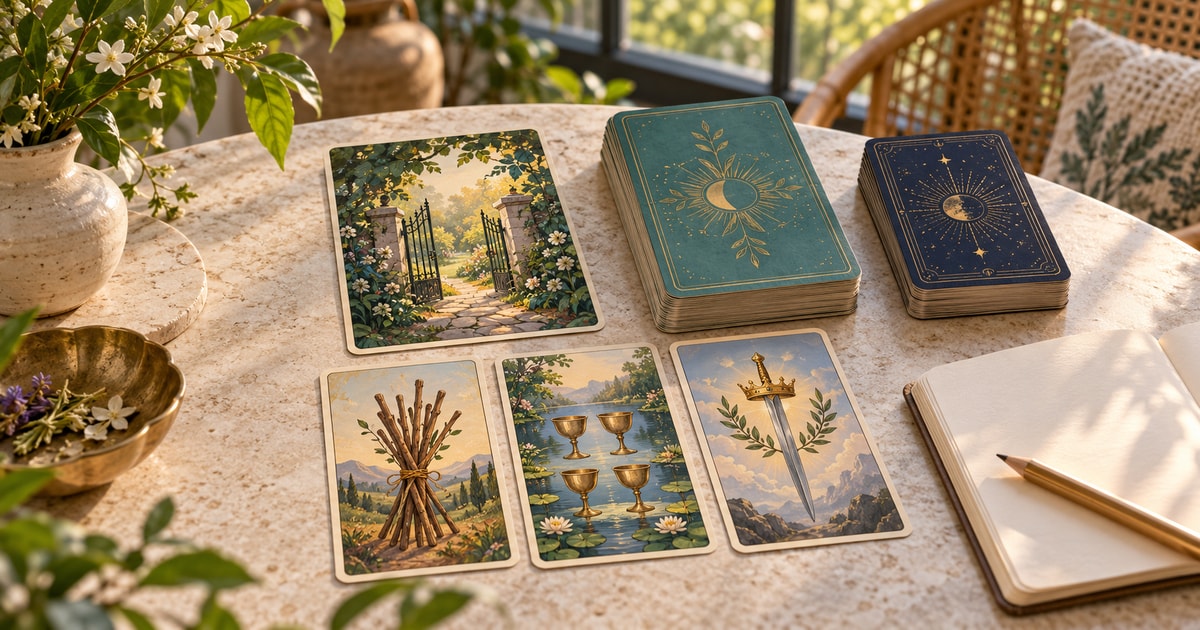
To use oracle cards alongside tarot, give each deck a clear role. Draw one oracle card to set a theme before a tarot spread, add one as a closing takeaway, or use one as a focused clarifier. Choose the role before drawing so the reading does not become a search for a different answer.
You can bring intuition and spiritual meaning to the pairing. Keep track of what the cards suggest, what you already know and what still needs checking; a meaningful connection is not proof of a future event.
Set up two decks with different jobs
A standard tarot deck has 78 cards, with Major and Minor Arcana. Its structure gives you a framework to study, although artwork and interpretations vary. Oracle decks use their creators’ own systems: some have categories, numbered cards or separate reversed meanings. Read your particular deck’s instructions rather than assuming every oracle card is just a one-word message.
For this exercise, keep the decks in separate piles and shuffle them separately in whatever way you can comfortably manage. That makes it easier to remember which deck is doing which job. Have both guidebooks available if supplied. Decide the question, spread positions and whether you will read reversals before you begin.
If the tarot structure is new to you, our introduction to tarot cards explains the Major and Minor Arcana. You do not need two decks to read well; pairing is an option, not an upgrade you must buy.
Three ways to pair oracle and tarot
1. Theme first
Draw one oracle card before laying out the tarot cards. Look at its image and guidebook entry, then turn the theme into a question you can explore. If you draw a card about boundaries, for example, ask “Where could I make my limits clearer?” rather than assuming the card has identified a hidden problem.
Lay a small tarot spread with positions you have chosen beforehand, such as where I am, what is in the way and a next step. Read the tarot cards through those positions, with the oracle card as a starting point—not a rule that every card must agree with.
Useful when you want help choosing a focus.
2. Takeaway last
Complete the tarot spread first and write a short summary. Then draw one oracle card as a closing perspective. Compare its message with what you have already written: does it add something specific, challenge an assumption or simply repeat the theme?
Choose one sentence to carry away. If the oracle card does not connect, keep the tarot summary and note the mismatch. A closing card does not have to overrule a difficult reading or turn it into a positive message.
Useful when a detailed spread needs a concise journal note.
3. One focused clarifier
Name exactly what is unclear before drawing. With the Moon, you might ask “Which uncertainty do I need to investigate?” With the Seven of Cups, try “What could help me compare these options?” These are possible reading angles, not fixed meanings for every deck or situation.
Place one oracle card beside the relevant tarot card and read it as another prompt. It cannot verify a suspicion, uncover someone else’s private thoughts or supply missing facts. For this exercise, stop after one clarifier; write down what remains unresolved instead of drawing until you get a preferred answer.
Useful when one part of the spread needs a second angle.
A worked example: Boundaries and three tarot cards
This is an imagined reading, not an account of a client session or a quotation from a named oracle deck. Suppose your oracle card’s keyword is Boundaries. You choose the theme-first method and ask “How could I handle my commitments more clearly this week?”
- Where I am — Ten of Wands: a possible prompt about carrying too much. Which commitments are actually yours, and which have you taken on by habit?
- What is in the way — Four of Cups: one possible angle is disengagement or uncertainty about an offer. Is suitable help available, or would the offer create more work? Check rather than assuming.
- A next step — Queen of Swords: a possible invitation to communicate clearly. What could you say directly and respectfully about what you can manage?
Journal takeaway: “I will list this week’s commitments, decide what I can realistically do and ask to renegotiate one task.” The action comes from considering your situation, not from a card guaranteeing how the conversation will go.
Keep the original question and cards in your note. If later events seem connected, add a dated follow-up without rewriting the first interpretation. Record what did not fit as well as what did.
Make it a weekly check-in if that suits you
As an optional routine, draw one oracle card on Sunday—or whichever day starts your week—as a theme. On days you choose to read, draw one tarot card and ask how its imagery might help you think about that theme. Write one observation and one practical response; skip a day when there is nothing useful to add.
At the end of the week, review the notes rather than judging whether the cards “got it right.” Did a question help you notice a habit, start a conversation or make a realistic plan? Our daily oracle-card routine offers a simpler one-deck alternative.
When the cards seem unrelated or disagree
Read each card in its assigned role first. An encouraging oracle message and a demanding tarot card can suggest different aspects of the same question; you do not have to make them agree. Write both interpretations, then decide whether either offers a useful question. “No clear connection” is an acceptable conclusion.
If the question needs facts—such as what another person wants, what a contract says or why a symptom is happening—use the relevant conversation, document or qualified help. The cards can help organise what you want to ask, but another draw cannot establish that information.
For deck types, choosing a deck and reading without tarot, continue to What Are Oracle Cards? Return to either deck on its own whenever the combination adds more confusion than insight.