

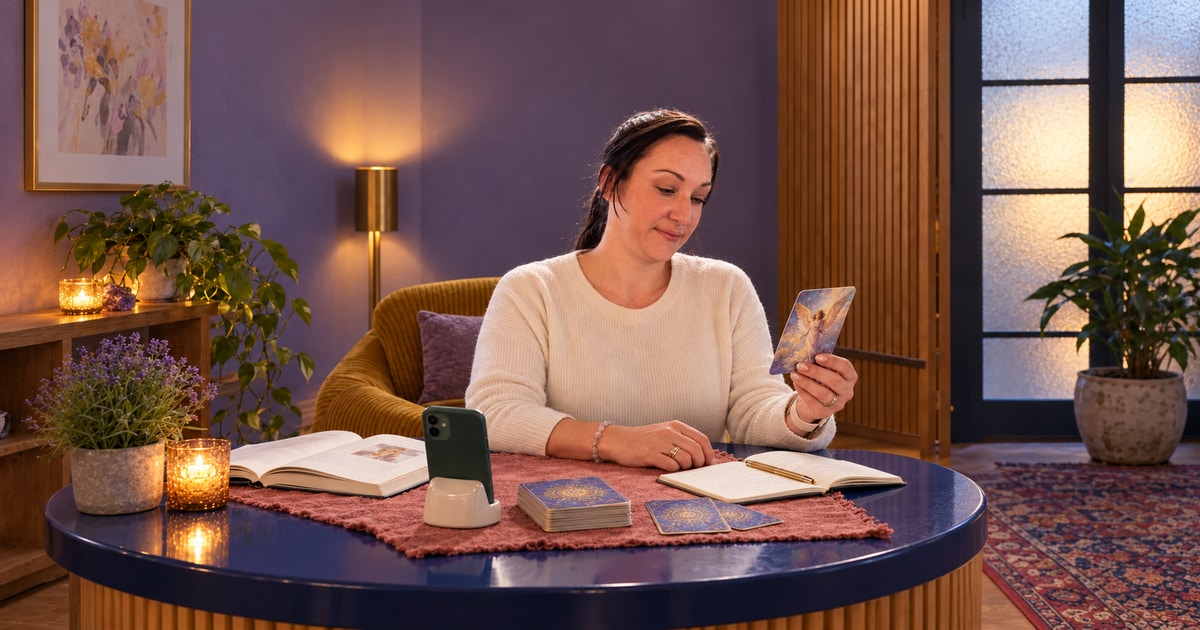
A card can give your journal a starting point
Angel and oracle cards combine a deck creator’s themes, images and interpretations. They can invite a moment of spiritual connection, a question to sit with or a few honest lines on paper. You do not need to feel certain about every message for the practice to be meaningful.
This guide focuses on one useful way to work with them: drawing a card and writing in response. The card offers a starting point; your own experience, beliefs and judgement remain part of the conversation.
What are angel cards, and how do they fit into oracle decks?
Oracle decks are designed around their creators’ chosen themes and systems. There is no single required set of card names or meanings across every deck. Many use keywords, symbolic artwork and a companion guidebook, but the amount of text and the way the cards work can vary.
Angel-themed oracle decks may focus on angels, virtues, encouragement or a sense of spiritual support. Some people use them alongside prayer or meditation; others approach the imagery as a reflective prompt. An angel theme does not mean every message is brief, gentle or a perfect fit for every reader.
You can honour a sense of spiritual guidance while recognising that a personal interpretation is not independent confirmation of an outside message or another person’s thoughts. You do not have to turn a card into a forecast to find something valuable in it.
For the wider distinction between these decks and tarot, visit what oracle cards are and how they work. The guide to angel oracle cards explores the angel-themed genre more closely.
Begin with one card and a few lines
Keep a notebook or a private note on your device nearby. If it suits your beliefs, you might begin with a short prayer, a quiet breath or an intention. No elaborate ritual or new purchase is required.
- Choose a gentle invitation Try “What deserves my attention today?” or “What would help me meet this week with more care?” You do not need a dramatic question.
- Draw one card and notice it Look at the artwork before rushing to the meaning. Name one detail, feeling or word that catches your attention. If there is no printed keyword, write your own short description.
- Read the guidebook with room to respond Notice the creator’s explanation, then ask where it does or does not connect with your life. You may keep an intuitive association alongside the guidebook rather than making one cancel the other.
- Write a few honest lines Record the date, card and your response. A sentence can be enough. You can finish with a question, a small action or an acknowledgement that nothing clear has emerged.
If a regular rhythm would help, a simple daily oracle-card routine gives you another way to structure the moment. Daily use is an option, not an obligation.
Five ways to answer the card in writing
Choose one approach rather than doing all five at once. The example words below are sample prompts, not messages from a particular deck.
1. The keyword and its contrast
A word such as Trust, Rest or Courage can open two sides of a subject. Explore where the quality feels available and where it feels difficult.
“When I think about trust, I feel steady about … and uncertain about …”
Keep in view: You do not have to force a positive answer. Trust can include discernment and boundaries; it need not mean ignoring a concern.
2. One detail in the picture
Choose something small: a gate, a lamp, a path, a colour or the direction a figure is facing. Let it begin an association rather than decoding every symbol.
“The detail I keep looking at is … It reminds me of …”
Keep in view: You can write your first response before reading the guidebook, then compare them. A personal association does not have to be the creator’s intended meaning to be useful to your journal.
3. A letter in reply to the card
Respond to the message as a conversation. If a card says “You are supported,” you might explore what support means to you instead of treating the sentence as something you must already feel.
“When I read this message, I want to answer … The support I could ask for is …”
Keep in view: If angel work is part of your practice, this may also be a prayerful reflection. Keep the response in your own words, and do not assume help is available without finding out.
4. A morning note and an evening check
Write an intention or question in the morning. Later, add a brief observation about the day. This keeps what you hoped for separate from what you noticed.
“Morning: today I want to notice … Evening: what I actually noticed was …”
Keep in view: You are not scoring a prediction. Include an ordinary day or a mismatch too; there is no need to turn every event into confirmation of the card.
5. A review at the end of the week
Reread a few entries and notice repeated concerns, changes in tone or a question that still needs attention. Choose a review day that suits you; it does not have to be Sunday.
“This week I kept returning to … One thing that changed was …”
Keep in view: Repeated themes may reflect what has been on your mind. They do not, by themselves, establish a warning or mean you must draw more cards.
A sample entry: making room for trust and boundaries
Here is an imagined journal entry. It keeps the card theme, a personal response, known information and a possible next step separate:
- Card theme
- Imagine drawing a card with the keyword Trust.
- First response
- I have been waiting for my creative project to feel perfect before showing anyone a page.
- What I know and what is open
- I have a first draft. I do not yet know what feedback would be helpful or how another person will respond.
- A gentle next step
- Ask a trusted friend whether they would be willing to comment on one page, and explain what sort of feedback I am ready for.
The useful movement is from a broad word toward a specific, manageable question. Trust does not have to mean sharing everything, overlooking discomfort or assuming that another person will react as you hope.
Let the practice stay supportive
A journal does not have to sound serene. You can write “I do not feel supported today” or “I cannot connect with this image.” An honest response may be more useful than copying a reassurance you do not believe.
- If a message feels too broad, turn it into a question rather than inventing a story to make it fit. “Abundance” could become “What do I already have, and what do I still need?”
- If an image unsettles you, you can put the card away. Drawing repeatedly until you feel reassured is not a requirement of a meaningful practice.
- If journaling feels tiring, shorten it or skip it. A missed day is not a broken connection, and buying another deck is not necessary to restart.
If a reading touches a serious decision, let actual information, relevant conversations and appropriate support help you decide. The image is not proof that a choice is safe. If writing becomes distressing, stop for now and turn toward support that meets the situation; you do not need to keep reading to resolve it.
Our guide to tarot and mental wellness looks at fitting a card practice alongside everyday care. A reflective routine can sit beside that care without becoming a treatment or a test of faith.
Choose the next step that suits your way of reading
Before choosing a deck, look at sample cards, the guidebook language and whether the themes feel meaningful to you. You can prefer angel imagery without having to accept every statement in a guidebook. A deck you already own may be enough for these writing exercises.
Try one prompt for a few entries, then ask whether it helped you notice something, express a feeling or frame a useful question. Keep what supports your practice and change what does not. The notebook is a record to reflect on, not a set of predictions you must prove correct.
Leave space for your own reply
A card may feel comforting, thought-provoking or simply unclear. Let it offer a question without taking away your voice. A short, truthful response can be enough for today.