

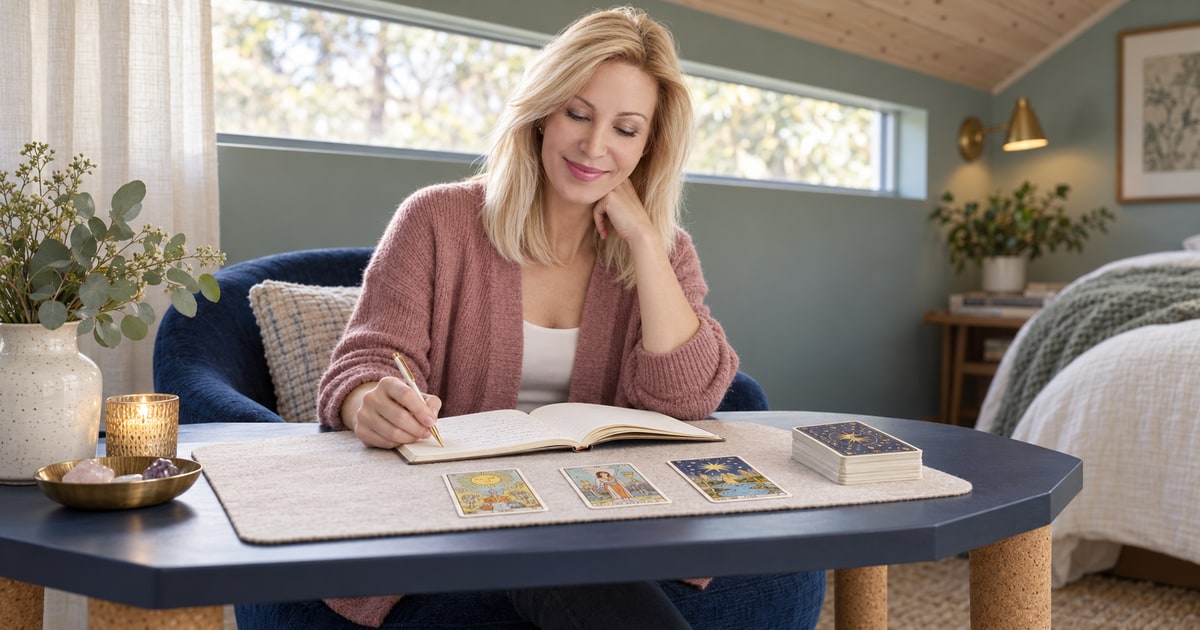
If tarot is part of your spiritual life, a brief card-and-notebook pause may be a way you prefer to reflect when you feel worried. You do not need to make a prediction or find a reassuring card. The aim here is to name a thought and choose a little support, not to make anxiety disappear.
Tarot is not an established treatment for anxiety, and this routine is not a test of your wellbeing. You may find it meaningful, unhelpful or too much today. Putting the cards aside is an equally valid choice. For the wider approach, see Tarot and Mental Wellness.
Before you draw: keep the choice with you
- 1Make room to pause Choose a comfortable position and notice your surroundings. Breathe in a way that feels comfortable; you do not need a counted breath or a breath hold for this exercise.
- 2Choose a question you can answer Try “What support would be useful while I prepare?” rather than “Can the cards guarantee nothing bad will happen?” You can write without drawing a card.
- 3Choose an ending before beginning Use one card or the three positions below, write a short note and put the deck away. You do not have to feel reassured or solve the worry before stopping.
If you want a separate breathing exercise, follow the NHS breathing guidance rather than treating a tarot spread as a breathing prescription. Its instructions emphasize comfort and not forcing the breath.
An optional three-card reflection
Assign these positions before drawing. You can keep all cards upright, deliberately select a familiar card or use the questions with no deck at all. A short one-card version is simply: “What support would be useful right now?”
- 1NoticeWhat am I noticing right now?
- 2ThoughtWhat thought keeps returning?
- 3Next stepWhat support or small action can I choose?
For the first position, describe your own observations in ordinary words; the card cannot tell you what is happening in your body. For the second, write the thought as a thought, not as a confirmed future event. For the third, choose something within reach: preparing one note, taking a break or asking someone for practical help.
Look at one visible detail in each card, then write a possible connection to its position. You can consult the guidebook or leave an interpretation unfinished. The short self-reading routine offers another simple structure.
Example: worrying about a presentation
Notice: “I’m restless while I wait.” Thought: “I’m telling myself everyone will dislike my talk.” Next step: “I’ll check my opening notes and ask a colleague one practical question.”
If the Four of Swords appears, you might associate its resting figure with a pause after preparation. That does not tell you how the audience will react. Write the choice you made, close the notebook and allow the outcome to remain uncertain.
Five cards, five possible questions
These are Rider–Waite–Smith-style interpretations, not findings about your health. Use a question only if it fits; you do not have to draw one of these cards or agree with its suggested theme.
Nine of Swords
A theme of worry or a difficult night.
What thought am I repeating? What do I know, and what am I imagining?
Eight of Swords
A theme of restriction or feeling stuck.
Which limits are real, which are assumptions, and what support could help? Do not assume every constraint is self-created.
Four of Swords
A theme of rest or stepping back.
What would a manageable pause look like? Rest need not be something I earn.
Temperance
A theme of proportion and pacing.
What can be made smaller or taken one part at a time?
The Star
A theme of hope or renewed perspective.
Who or what has supported me before, and would reaching out be useful now?
A difficult image, including the Nine of Swords, is not evidence that your fear will come true. A hopeful image is not proof that everything is safe. If Temperance interests you, its guide to balance and proportion explores the symbolism in more detail.
When stopping is the useful next step
The image makes you more distressed
Turn it over, put the deck away or choose a different activity. An uncomfortable response does not mean you failed or uncovered a warning.
You want repeated draws for certainty
Leave the first interpretation in your notes rather than pulling until the cards look reassuring. Consider telling a trusted person or clinician that you are finding it hard to stop.
A real-world need requires attention
Attend to the actual situation instead of interpreting it through a card. Do not use a reading to decide whether a physical symptom is harmless or whether help is needed.
If you keep a journal, date your question and note what you chose to do. Record later events separately, including what did not fit. A notebook can hold observations you may wish to discuss with a professional; a pattern in card draws does not diagnose anxiety or establish its cause.
Let support extend beyond the deck
Occasional worry and an anxiety disorder are not the same thing. The National Institute of Mental Health explains the distinction. If anxiety is affecting sleep, work, relationships or everyday activities, talk with a health care professional rather than waiting for a different reading.
NIMH’s guide to generalized anxiety disorder describes psychotherapy, medication or both as treatment options to discuss with a qualified provider. A tarot practice can remain a personal spiritual choice alongside care; do not change treatment or medication on the basis of a card.
If you are struggling or having thoughts of suicide, call or text 988 in the US. In a life-threatening emergency, call 911; outside the US, use your local emergency or crisis service.
A small practice, not an obligation
You can leave a reading unfinished, choose a familiar image instead of a random draw, or skip tarot entirely. Your need for support does not depend on drawing the right card.
Return to the mental-wellness guide for more about reflective boundaries and keeping care with the people qualified to provide it.