

Quick guide
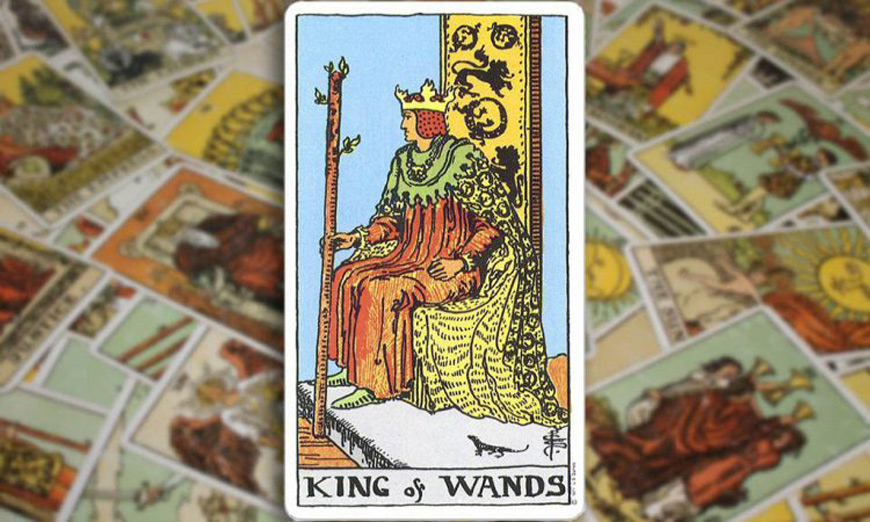
The King of Wands in the Rider-Waite-Smith deck is a seated king holding a wand that is still sprouting leaves, with lions and salamanders worked into his throne and robe and a small live salamander at his feet. Upright, the traditional keywords are leadership, vision, boldness, charisma and taking decisive action. Reversed, readers talk about impulsiveness, a domineering streak, a leader who cannot delegate, or big plans with no follow-through. Like all court cards, he can stand for a person, a role you are playing, or a mood in the situation. The question he usually raises is what you would do if you were fully in charge and had to lead rather than wait.
| At a glance | |
|---|---|
| Arcana / number / suit | Minor Arcana, court card (King), suit of Wands |
| Upright keywords | Leadership, vision, confidence, boldness, charisma, entrepreneurship, honesty, decisive action |
| Reversed keywords | Impulsiveness, arrogance, a controlling style, ruthlessness, burnout from overreach, unfinished ventures |
| Element / astrological association (tradition) | Fire; most modern guidebooks pair him with Leo, some with Aries or Sagittarius |
| Yes/no reading (convention) | Usually read as yes, especially when the question involves taking the lead |
The image and its symbols
Pamela Colman Smith drew the King of Wands sitting slightly turned on his throne, as if he is about to stand up. He holds a tall wand with green shoots along its length, which readers take as a sign that his energy is still alive and growing rather than finished. His robe is orange and his cloak is marked with salamanders, the small lizards that medieval writers believed could live in fire. The same creatures appear carved on the throne beside lions, the usual emblem of courage and rule, and one small salamander sits on the ground near his foot. Beneath his crown he wears a close red cap, which Arthur Waite called a cap of maintenance, a detail shared by the other three kings.
Two things stand out when you read the card. First, he is the only RWS king who looks ready to leave his seat. The Kings of Cups, Swords and Pentacles sit square and settled; the King of Wands sits forward, which is why so many readers describe him as a leader who prefers doing to supervising. Second, the salamander at his feet is drawn with its tail reaching back toward its mouth, an old symbol for a cycle that is complete. Together, the sprouting wand and the closed loop suggest someone who has finished one chapter of work and is already looking for the next. Waite’s own keywords for the card included honesty and conscientiousness.
Upright meaning
Upright, the King of Wands is traditionally read as mature fire: the drive and enthusiasm of the Wands suit, directed by experience. As a person he is the founder, the head coach, the director who knows what the project is for and says so clearly. As a role, the card suggests stepping up to lead, making the decision that others are waiting for, or setting a direction and holding to it. As a mood, it describes a time when you feel bold, clear and willing to take responsibility for the outcome.
In a spread, readers look at the position before deciding which of those three to use. In a “someone around you” position, the King of Wands usually describes a confident, direct person whose energy shapes the room. In an advice position, he tends to say: decide, commit and act, because the moment calls for leadership rather than more research. In an outcome position he is often read as a venture succeeding because somebody took charge of it. He does not predict that you will meet a particular person, and he does not say that a bold choice is the right one; he describes the quality of leadership the situation is asking about.
Reversed meaning
Reversed, the King’s fire is read as either too much or too little. Too much looks like arrogance, a temper, impatience with anyone slower, and a habit of pushing decisions through without listening. It is the manager who cannot delegate, the partner who always has to be right, the entrepreneur who launches five things and finishes none. Too little looks like a leader who has lost confidence and lets the team drift.
Waite’s reversed keywords were gentler than most modern ones: good but severe, austere yet tolerant. That older reading is a useful corrective. The reversed King is not a villain; he is a capable person whose strengths have tipped into their shadow. In practice the card asks you to check whether your boldness is serving the goal or just your ego, whether the people you lead feel heard, and whether you have taken on more than one person can carry. If the “king” in question is somebody else and their forcefulness has become frightening or controlling, that is a safety question, not a tarot one.
In a love reading
In a relationship reading, the King of Wands upright is usually read as a passionate, generous and protective partner, or as a stage in a relationship that feels confident and outward-looking: planning a move, starting a business together, meeting each other’s worlds with enthusiasm. For someone single, readers often interpret the card as being attracted to confidence and warmth, or as a prompt to show those qualities yourself rather than waiting to be chosen. The King of Wands is not a card about a specific gender, age or appearance, whatever older guidebooks said.
Reversed in a love reading, the card tends to point to one partner dominating decisions, a hot temper, or a relationship that runs on grand gestures and little patience. These are prompts for a conversation with the actual person, not a diagnosis of them. A card cannot confirm that someone loves you, is faithful, or will commit by a given date. If a partner’s control, anger or threats are the reason you are reading, the National Domestic Violence Hotline at 1-800-799-7233 (text START to 88788) is the right call, and 911 in an emergency.
In a career or money reading
Work is where the King of Wands feels most at home. Readers link him to leadership roles, starting a business, pitching a big idea, or taking a visible decision that others have been avoiding. In a job-search reading he is commonly read as an employer who values initiative, or as advice to present yourself as someone who leads rather than someone who waits for instructions. In a spread about a difficult boss, he can describe a charismatic but demanding leader.
With money, the King of Wands is traditionally read as confident, strategic decisions: investing in a venture you understand, negotiating a raise, or backing yourself with a calculated risk. Reversed, he can describe reckless spending, gambling on an idea without the numbers, or putting money into someone else’s bold plan because they are persuasive. The card is a good prompt to list what a bold move would cost and gain; it is not a reason to make the move. Take the actual figures to an accountant or a licensed financial adviser, and see the hub on understanding finances with tarot for how to keep money spreads useful and realistic.
How to work with this card
- Decide who he is. Before anything else, ask whether the King of Wands is a person, a role you need to take, or a mood in the situation.
- Name the decision. Write down the one call that is waiting for a leader, and what you would say if you had to make it today.
- Check the heat. List the people affected by your plan and ask whether each of them has actually been heard.
- Finish one thing. If several ventures are open, choose the one to complete before starting anything new.
- Look at the salamander. Note what chapter has just closed, so that your next bold step builds on it instead of repeating it.
Cards that often appear with it
With the Queen of Wands, readers traditionally see a partnership of two confident people, or one person balancing drive with warmth and social ease. With the Three of Wands, the King is read as a leader whose plans are expanding and who is waiting for results; with the Eight of Wands, the same leader is in a hurry and things are moving fast. Paired with the Emperor, the card leans toward structure and authority: a founder who now has to build systems rather than just inspire people. With the Five of Wands, many readers see a leader in the middle of a competitive or argumentative team, and the prompt is to referee rather than join the fight. These pairings are conventions, not rules.
Key takeaways
- The King of Wands shows a seated king with a flowering wand, lion and salamander emblems and a small salamander at his feet, and is traditionally read as mature leadership and bold vision.
- As a court card he can be a person, a role you are being asked to take, or the mood of a situation.
- Reversed, he raises questions about impulsiveness, control, ego and unfinished ventures.
- In love he suggests passion and confidence; at work he points to leadership and calculated risk. He cannot confirm anyone’s feelings or guarantee a venture.
- Use him as a prompt to name the decision that is waiting for a leader, and to check that your boldness still serves the goal.
Related reading
- Reading the tarot court cards
- Understanding finances with tarot
- Six of Wands tarot card meaning
- Queen of Swords tarot card meaning
- Tarot cards for beginners
Frequently asked questions
1. What does the King of Wands mean?
In the Rider-Waite-Smith tradition the King of Wands means mature leadership: vision, confidence, honesty and the willingness to decide and act.
2. What does the King of Wands card show?
A seated king holds a wand with green shoots on it; lions and salamanders decorate his throne and robe, and a small salamander sits near his feet.
3. Is the King of Wands a person or a situation?
It can be either. Court cards are read as a person around you, a role you are being asked to play, or the mood of a situation, and the spread position usually decides which.
4. Is the King of Wands a yes or no card?
By convention it is a yes, particularly when the question involves taking the lead or starting something.
5. What does the King of Wands reversed mean?
Reversed, readers usually see impulsiveness, arrogance, a controlling style or a leader who has lost confidence. It is a prompt to check whether boldness still serves the goal.
6. What does the King of Wands mean in love?
Upright he is traditionally read as a passionate, generous and protective partner or a confident stage in a relationship. He cannot confirm what a specific person feels.
7. What does the King of Wands mean for feelings?
Readers often interpret him as strong attraction and warmth, but a card is a prompt for reflection, not a way to read another person’s mind. The reliable method is to ask them.
8. What does the King of Wands mean in a career reading?
He is commonly linked to leadership, starting a business, pitching a big idea or being seen as someone who takes initiative.
9. Does the King of Wands represent a specific zodiac sign?
Most modern guidebooks pair him with Leo, and some with Aries or Sagittarius. These are traditions for reading the card, not facts about people born under those signs.
10. What do the salamanders on the King of Wands mean?
Salamanders were believed in medieval lore to live in fire, so they mark the card as belonging to the fire suit. The one at his feet, with its tail curving toward its mouth, is read as a completed cycle.
11. Which cards combine well with the King of Wands?
The Queen of Wands for a partnership of confident people, the Three or Eight of Wands for plans expanding or speeding up, the Emperor for structure, and the Five of Wands for leading a competitive team.
12. What should I do after pulling the King of Wands?
Decide whether he is a person, a role or a mood, name the decision that is waiting for a leader, and check that the people affected have been heard before you act.
Evidence note: The meanings on this page are conventions attached to the Rider-Waite-Smith deck (1909) and the guidebooks that follow it, including Waite’s own keywords for the card. Tarot began as a card game in fifteenth-century Italy, as Britannica’s entry on tarot explains, and its use for reflection came centuries later. No card has been shown to predict events or describe a real person’s character, and a vivid description that seems to fit almost anyone is an example of the Barnum effect. If your question is about a business decision, a contract, money or your health, use the card to organise your thoughts and then speak with a qualified professional.