

Quick guide
The Major Arcana is the set of 22 numbered trump cards in a tarot deck, running from the Fool (0) to the World (21). Readers often describe the sequence as the Fool’s Journey: a story in which a carefree traveller leaves home, meets teachers, faces tests and arrives at a sense of completion. The story is a teaching device that helps you remember the cards and notice which stage of a project, relationship or change you feel you are in. It is not a prediction. Tarot cannot tell you what will happen, read another person’s mind or set a date for an outcome. Used well, the 22 cards are a shared vocabulary for reflection, and this page gives you all of them in one place, with keywords for upright and reversed positions and a plain way to read a spread that is full of them.
A standard tarot deck has 78 cards. Fifty-six of them belong to four suits (Wands, Cups, Swords and Pentacles) and look much like playing cards with an extra court rank. The other 22 are the Major Arcana, the cards with names such as the Magician, the Tower and the Star. These began life as the trump cards of an Italian card game in the 1430s, where they were called trionfi and outranked the ordinary suits. Britannica’s entry on tarot traces that history, and it is worth knowing: the pictures were designed for play first, and the habit of reading them for meaning arrived centuries later. The images most people recognise today come from the Rider-Waite-Smith deck of 1909, drawn by Pamela Colman Smith, and nearly every modern guidebook builds on that deck.
What the Major Arcana is for
In a reading, the Minor Arcana describes the texture of a situation: a disagreement at work, a small win, a bill that needs paying. The Major Arcana is read as the theme underneath. A Six of Pentacles might describe a loan between friends; the Devil beside it asks whether the arrangement has become a habit that neither person can name. That is why many readers treat a Major card as a cue to slow down and ask a larger question. The Fool’s Journey gives those 22 themes an order, so that the cards stop feeling like a random list and start feeling like chapters of one story you can walk through.
The Fool’s Journey in four stages
- Setting outThe Fool (0) steps off the edge with a bag, a white rose and a small dog. Everything is possible and nothing is decided.
- Meeting the teachersCards 1 to 7 are figures of skill, intuition, care, order, tradition, choice and will. Each one shows the traveller a way to act in the world.
- Facing the testsCards 8 to 14 turn inward: patience, solitude, luck, fairness, surrender, endings and balance. These are lessons that cannot be taught, only lived.
- Coming homeCards 15 to 21 move from the Devil’s chains through the Tower’s shock to the Star, the Moon, the Sun, Judgement and the World, where the circle closes.
The stages are a memory aid. Real life rarely moves in order, and a reading can land anywhere on the path.
All 22 Major Arcana cards at a glance
The keywords below follow the Rider-Waite-Smith tradition and the guidebooks that copy it. They are starting points, not fixed rules. If your deck’s booklet gives a different emphasis, use it.
| Number | Card | Upright keywords | Reversed keywords |
|---|---|---|---|
| 0 | The Fool | New beginnings, openness, a leap of faith | Recklessness, hesitation, poor timing |
| 1 | The Magician | Skill, focus, having the tools you need | Scattered effort, manipulation, unused talent |
| 2 | The High Priestess | Intuition, stillness, inner knowing | Ignored instincts, secrets, surface thinking |
| 3 | The Empress | Nurturing, abundance, creativity | Smothering, creative block, self-neglect |
| 4 | The Emperor | Structure, authority, stability | Rigidity, control, lack of discipline |
| 5 | The Hierophant | Tradition, learning, shared values | Questioning rules, personal beliefs, dogma |
| 6 | The Lovers | Choice, partnership, alignment of values | Disharmony, mismatched values, avoiding a choice |
| 7 | The Chariot | Determination, control, momentum | Lack of direction, forcefulness, stalled progress |
| 8 | Strength | Patience, courage, gentle influence | Self-doubt, raw emotion, loss of nerve |
| 9 | The Hermit | Reflection, solitude, searching | Isolation, withdrawal, loneliness |
| 10 | Wheel of Fortune | Change, cycles, a turning point | Resisting change, bad timing, repeated patterns |
| 11 | Justice | Fairness, cause and effect, accountability | Unfairness, avoiding responsibility, bias |
| 12 | The Hanged Man | Pause, surrender, a new viewpoint | Stalling, resistance, needless sacrifice |
| 13 | Death | Endings, transformation, release | Clinging to the past, stagnation, fear of change |
| 14 | Temperance | Balance, moderation, patience | Excess, imbalance, impatience |
| 15 | The Devil | Attachment, habit, materialism | Release, regaining control, facing a habit |
| 16 | The Tower | Sudden change, upheaval, revelation | Averted crisis, fear of change, delayed collapse |
| 17 | The Star | Hope, renewal, calm | Discouragement, loss of faith, disconnection |
| 18 | The Moon | Uncertainty, illusion, intuition | Clarity returning, confusion lifting, hidden fear |
| 19 | The Sun | Joy, success, clarity | Temporary gloom, overconfidence, delayed happiness |
| 20 | Judgement | Reckoning, awakening, a call to act | Self-doubt, refusing the lesson, harsh self-judgement |
| 21 | The World | Completion, integration, achievement | Loose ends, incompletion, delay |
The Fool’s Journey told in three acts
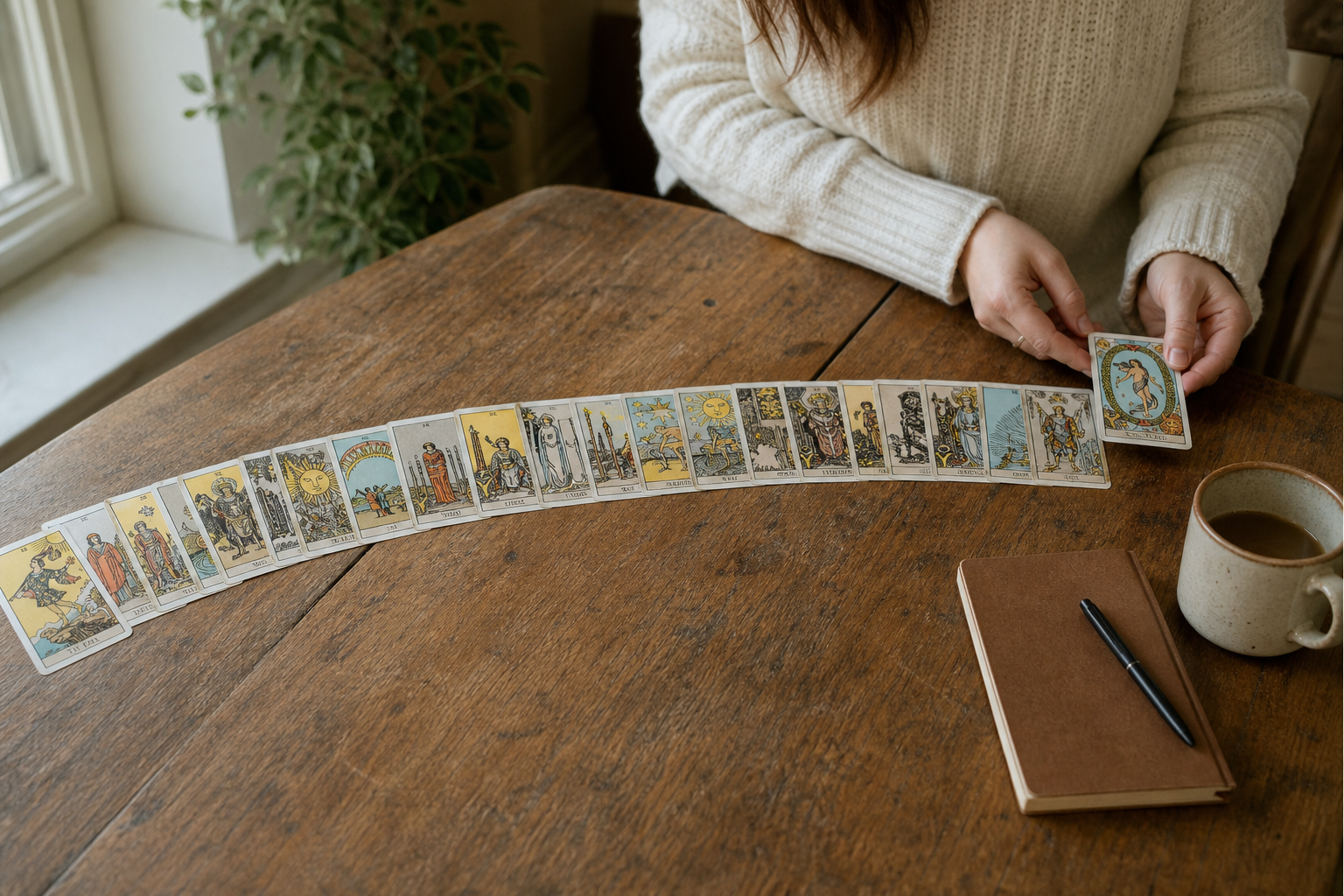
Here is the story as teachers usually tell it. Read it once for the shape, and then again with your own deck laid out in a line of 22 cards. The details named below are all visible in the Rider-Waite-Smith images, so you can check each one as you go.
Act one: the Fool leaves home (cards 0 to 7)
The Fool stands at a cliff edge in bright sunlight, bundle over one shoulder, a white rose in his hand and a small dog jumping at his heels. He is not looking where he is going. That is the point: he represents a start made in good faith before the facts are in. The first figure he meets is the Magician, who stands at a table holding one hand up and one hand down, with a wand, a cup, a sword and a pentacle laid out in front of him. The lesson is that the traveller already has the tools. Next comes the High Priestess, seated between a black pillar and a white one with a scroll on her lap. She teaches that not everything worth knowing can be said out loud. The Empress, in a field of ripe wheat beside a stream, shows care and growth; the Emperor, on a stone throne decorated with rams’ heads, shows order and boundaries. The Hierophant sits between two pillars with two followers at his feet and a pair of crossed keys below him; he stands for tradition, shared belief and formal learning. The Lovers card shows an angel above two figures and a tree with a serpent in it, and it asks the traveller to choose with their values. The Chariot closes the act: a crowned driver stands between a black sphinx and a white one, holding no reins, moving forward by will alone. By the end of act one the Fool has learned to act, to listen, to care, to build, to belong, to choose and to push ahead.
Act two: the tests of character (cards 8 to 14)
The second act turns inward. Strength shows a woman gently closing a lion’s mouth, with an infinity sign above her head; power here is quiet and patient. The Hermit climbs a grey mountain alone, holding a lantern with a six-pointed star inside it; he stands for the search that has to be done in solitude. The Wheel of Fortune, with a sphinx on top, a snake sliding down and a jackal-headed figure rising, says that circumstances turn whether or not we are ready. Justice holds a sword upright in one hand and scales in the other and reminds the traveller that choices have consequences. The Hanged Man hangs by one foot from a living tree, face calm and a halo around his head: a pause that changes the way things look. Death, a skeleton in black armour on a white horse carrying a banner with a white rose, rides past a king, a bishop, a woman and a child while the sun rises between two distant towers; the card is about endings that make room. Temperance, an angel with one foot on land and one in water pouring liquid between two cups, is the balance that follows. Act two is where the story stops being about what the Fool can do and starts being about who the Fool is becoming.
Act three: the dark, the dawn and the return (cards 15 to 21)
The Devil card looks like the Lovers card turned sour: two chained figures beneath a horned creature on a block. Look closely at the chains and you will see they are loose enough to lift off, which is the whole message about habits. The Tower is struck by lightning and its crown is knocked off while two people fall; the structure was built on a narrow rock, and the shock reveals what was never sound. Then the sky clears. The Star shows a woman kneeling by a pool, pouring water onto land and water under eight stars; hope here is a quiet, practical thing. The Moon, with a dog and a wolf howling, a crayfish crawling out of a pool and a path winding between two towers, is the stretch of the road where nothing is clear and the traveller has to keep walking anyway. The Sun answers it: a child on a white horse under a smiling sun with sunflowers behind a wall. Judgement shows an angel sounding a trumpet while figures rise from coffins with their arms open, a call to take stock and respond. The World closes the circle with a dancer inside a wreath, holding two wands, with the same four creatures that appeared at the corners of the Wheel of Fortune. The journey ends where it began, with a step, except that now the traveller knows the road.
How to read a spread that is full of Major Arcana
Every reader eventually lays out a Celtic Cross and finds six trump cards staring back. The old advice was to treat that as a sign of fate at work. A calmer approach works better and keeps the reading honest.
- Count them, then relax. In a 10-card spread from a shuffled 78-card deck you can expect about three Major cards on average. Five or more is unusual, and readers traditionally take it to mean the question matters to the person at a big-picture level. It is a cue to reflect, not a warning.
- Find the lowest and the highest number. A spread that runs from the Fool to the Chariot feels like beginnings and first attempts. One that runs from the Devil to the World feels like consequences and closing chapters. The span tells you which part of the story you are standing in.
- Read Majors as themes and Minors as details. If the Tower sits above the Three of Pentacles, the Minor card describes a shared project and the Major card asks what in that project was built on shaky ground. Let the two levels talk to each other.
- Look for pairs that reinforce each other. Death with the Tower is change that was not chosen. The Hanged Man with the Hermit says waiting is the work. The Star with the Sun is relief after a long stretch. Pairs sharpen a reading more than any single card.
- Turn each card into a question. Instead of saying the Tower means something will collapse, ask what has been built on a narrow foundation. Instead of saying the Lovers means a new partner, ask what choice is waiting for an honest answer.
- Close with one action. The Fool’s Journey is a story about movement, so end every Major-heavy reading with a single step the person can take this week. That keeps the cards in their proper role as a prompt rather than a verdict.
Habits that keep the Major Arcana useful
- Learn the 22 in order first. Lay them out in a line, say one keyword for each and tell the story out loud. It takes ten minutes and makes every later reading easier.
- Notice which card you avoid. Most people have one Major card they would rather not draw. That card usually points to the lesson they are already in the middle of.
- Keep a journal of Major draws. Writing down the date, the card and what was happening lets you see your own patterns, which is more useful than any general meaning.
- Use the Majors on their own for big questions. A single Major card drawn for a quiet moment of reflection is one of the oldest and simplest practices there is.
- Do not treat a Major card as fate. There is no evidence that any card predicts events. A trump card describes a theme you can think about, nothing more.
- Do not read someone else’s Major cards for them. Drawing the Lovers or the Devil about a person who is not in the room tells you about your own hopes and fears, not theirs.
- Do not let Death, the Tower or the Devil frighten you. In the tradition they stand for endings, upheaval and habits. Each one is a prompt about change, never a sentence.
- Do not use the cards to decide health, legal or money matters. Those questions belong with a doctor, a lawyer or a qualified adviser.
Key takeaways
- The Major Arcana is 22 trump cards, numbered 0 to 21, whose images come mostly from the Rider-Waite-Smith deck of 1909.
- The Fool’s Journey is a teaching story that gives the cards an order: setting out, meeting teachers, facing tests and coming home.
- Keywords for upright and reversed positions are conventions from guidebooks, useful as starting points and never as fixed rules.
- In a spread, read Major cards as themes and Minor cards as details, and turn each Major card into a question rather than a forecast.
- Tarot does not predict events or read minds. Its value is in giving you a structured way to reflect and decide.
Related reading
- Tarot Cards for Beginners
- The Fool card meaning
- The Magician card meaning
- The High Priestess card meaning
- The Hierophant card meaning
- The Chariot card meaning
- The Hermit card meaning
- The Temperance card meaning
- The Moon card meaning
- The Judgement card meaning
Frequently asked questions
1. What is the Fool’s Journey in tarot?
It is a teaching story that reads the 22 Major Arcana cards in numbered order as the stages of one person’s growth, from the Fool’s first step to the World’s sense of completion. It is a memory aid and a reflection tool, not a prophecy about your life.
2. How many Major Arcana cards are there?
There are 22, numbered 0 to 21. The Fool is 0 and the World is 21. The other 56 cards in a tarot deck make up the Minor Arcana.
3. Why is the Fool numbered zero?
In the early Italian game the Fool was a special card that stood outside the ranked trumps. Modern readers keep the zero because it lets the Fool be both the traveller and the blank slate at the start of the sequence.
4. Who invented the idea of the Fool’s Journey?
The order of the trumps is centuries old, but reading them as one person’s journey is a twentieth-century teaching device. Eden Gray’s 1970 guide is usually credited with popularising the phrase, and later writers expanded it.
5. Why do some decks swap Strength and Justice?
The Rider-Waite-Smith deck places Strength at 8 and Justice at 11 to fit its astrological scheme. Marseille-style decks keep the older order with Justice at 8 and Strength at 11. Neither is wrong; follow the numbering of the deck you are using.
6. Does a Major Arcana card mean something big is going to happen?
By convention, Major cards point to themes and turning points rather than daily details. That is a reading habit, not evidence that a bigger event is on the way. Treat the card as a larger question to think about.
7. What does it mean if my spread is mostly Major Arcana?
Readers traditionally take a Major-heavy spread as a sign that the question touches something that matters deeply to the person. The useful response is to slow down, read the cards as themes and end with one concrete action.
8. Which Major Arcana cards are considered difficult?
Death, the Tower, the Devil and the Moon are the ones people most often dread. In the tradition they stand for endings, sudden change, habits and uncertainty. Each is a prompt about something to look at, not a sentence.
9. Does the Death card mean someone will die?
No. In the Rider-Waite-Smith tradition the Death card stands for an ending that makes room for something new. Tarot has not been shown to predict events of any kind, including illness or death.
10. Can I learn the Major Arcana without memorising all 22 cards at once?
Yes. Learn the three acts of the story and one keyword per card first. The pictures carry most of the meaning, so once you know the shape of the journey the details fill in quickly.
11. What is the difference between the Major and Minor Arcana?
The Major Arcana is the 22 named trump cards. The Minor Arcana is the 56 suit cards: Wands, Cups, Swords and Pentacles, each running from Ace to Ten plus a Page, Knight, Queen and King.
12. Can I do a reading using only the Major Arcana?
Yes, and many readers do for big-picture questions or a single daily card. Set the Minor cards aside, shuffle the 22, and draw one or three. The reading will feel thematic rather than detailed.
13. How do reversed Major Arcana cards work?
Most readers who use reversals read the card as a blocked, delayed or inward version of its upright meaning. Some readers do not use reversals at all. Both approaches are accepted conventions, so choose one and stay consistent.
14. Which Major Arcana card is the best one to draw?
There is no best card. The Sun, the Star and the World are read as encouraging, but a reading is a whole picture. A hopeful card next to a difficult one usually makes for a more useful reflection than either alone.
15. Is the Fool’s Journey the same in every deck?
The order and names are stable across Rider-Waite-Smith-based decks. The Thoth deck renames several cards, and Marseille decks use French titles and a different Strength and Justice order. The underlying story is recognisable in all of them.
16. Can the Fool’s Journey tell me what stage of life I am in?
It can help you describe how a situation feels to you right now, which is a useful exercise. That description comes from your own reflection, not from the cards knowing anything about you.
17. Where do the Major Arcana cards come from?
The trump cards appeared in Italian decks in the 1430s for a card game. Divinatory meanings were attached in eighteenth-century France, and the familiar pictures were drawn for the Rider-Waite-Smith deck in 1909.
18. Why do the Major Arcana cards feel so personal when I draw them?
The images are broad enough that almost anyone can see their own life in them, an effect psychologists call the Barnum effect. That is what makes the cards good prompts for reflection, and it is also why they should not be treated as proof of anything.
19. Is it safe to use tarot for health, legal or money decisions?
Use the cards to sort out your thoughts and name your worries, then take the question itself to a doctor, a lawyer or a qualified financial adviser. Tarot is a reflection tool, not a substitute for professional advice.
Evidence note: The card meanings on this page are traditions attached to the Rider-Waite-Smith deck (1909) and the guidebooks that follow it, and the Fool’s Journey is a twentieth-century teaching device rather than a historical fact about the cards. Tarot has not been shown to predict events, read minds or set timelines; the sense that a card describes you is well explained by the Barnum effect. Historical details come from Britannica’s entry on tarot. If you are using the cards while your mood is low or you are having thoughts of harming yourself, call or text 988 (US) to reach the Suicide and Crisis Lifeline.
[…] Tarot and the Fool’s Journey: the 22 Major Arcana in order […]