

You can read tarot for yourself. The challenge is not that the cards “refuse” a personal question: it is keeping your hopes, fears and interpretations distinct. A useful self-reading leaves room for an unwelcome meaning, an alternative explanation or an honest “I do not know.”
These seven habits can make that harder. The fixes below are practical boundaries to try, not rules that guarantee accuracy. Whether your practice is spiritual, reflective or both, you can enjoy the symbolism without treating it as proof of what will happen.
Seven self-reading mistakes and what to try instead
Wanting a particular answer is understandable. The difficulty is noticing only what supports it. Psychologist Raymond Nickerson’s review of confirmation bias describes selective searching and interpretation in favour of existing beliefs. That is a general reasoning problem, not evidence for tarot prediction; the following suggestions apply that concern to a reading practice.
1. Redrawing until the spread looks better
Putting the Five of Pentacles back because you wanted reassurance changes the question from “What can I explore?” to “Can I find a pleasing card?” A difficult image deserves consideration, but you do not have to force it to fit.
Try instead: decide your draw size before shuffling, then record those cards. If you use a clarifier, give it a specific job, such as exploring a confusing symbol, rather than replacing the original answer. “Unclear today” is a valid note.
2. Repeating the same concern in new words
“Do they like me?”, “What do they feel?” and “Are we meant to be?” may keep circling the same uncertainty. More cards do not provide independent evidence of another person’s feelings, and the changing answers can leave you less settled.
Try instead: write the underlying concern once. Shift toward your own choices: “What would help me communicate honestly?” Revisit the topic when circumstances or your question have meaningfully changed, not simply because the first spread felt uncomfortable.
3. Reading when you cannot consider alternatives
You do not need to be perfectly calm to use tarot. But after an argument, you might read every Swords card as criticism or every Cups card as a promise of reconciliation. Notice whether the reading is helping you think or intensifying the argument in your head.
Try instead: put the question in a notebook and return when you can entertain more than one meaning. There is no universal waiting period. If you need immediate practical help, seek it directly rather than waiting for a reassuring draw.
4. Changing the focus after seeing the cards
An open-ended reading is not inherently a mistake. “What might I reflect on today?” can be a clear intention. The problem is quietly changing the subject until the imagery matches whichever story you prefer.
Try instead: record a question or general focus before drawing. Name each position in a spread and keep those roles stable. With a daily card, note an observation and a possible reflection; do not turn it into a firm prediction about the day.
5. Treating an outcome card as a verdict
The Ten of Swords can invite reflection on endings or exhaustion; it does not establish that disaster is coming. Equally, the Sun does not guarantee success. Meanings depend on the deck, the spread position and the interpretive approach you chose.
Try instead: describe the image, check your deck’s guidebook and write more than one plausible interpretation. Ask what action is available to you. Keep any outcome reading conditional rather than making a promise or threat out of a card.
6. Making claims about someone who is not there
A spread about an ex can bring your own expectations into view, but it cannot verify their private thoughts, intentions or fidelity. A compelling story is not a substitute for something the person has actually said or done.
Try instead: explore your boundaries, assumptions and next conversation. “What do I need to clarify before reconnecting?” keeps the focus on your agency. Respect the other person’s privacy and consent; do not accuse or pressure them because of a reading.
7. Letting the cards make the whole decision
A house purchase, a legal dispute or a health concern involves facts that a spread cannot establish. A reading might help you name a fear or prepare a question, but it cannot tell you whether a property is sound, a claim is valid or a symptom needs attention.
Try instead: separate your reflective notes from practical checks. Gather relevant information and qualified advice where needed. Let a card prompt a question for the appropriate person, not override their evidence or delay necessary action.
A clearer self-reading routine
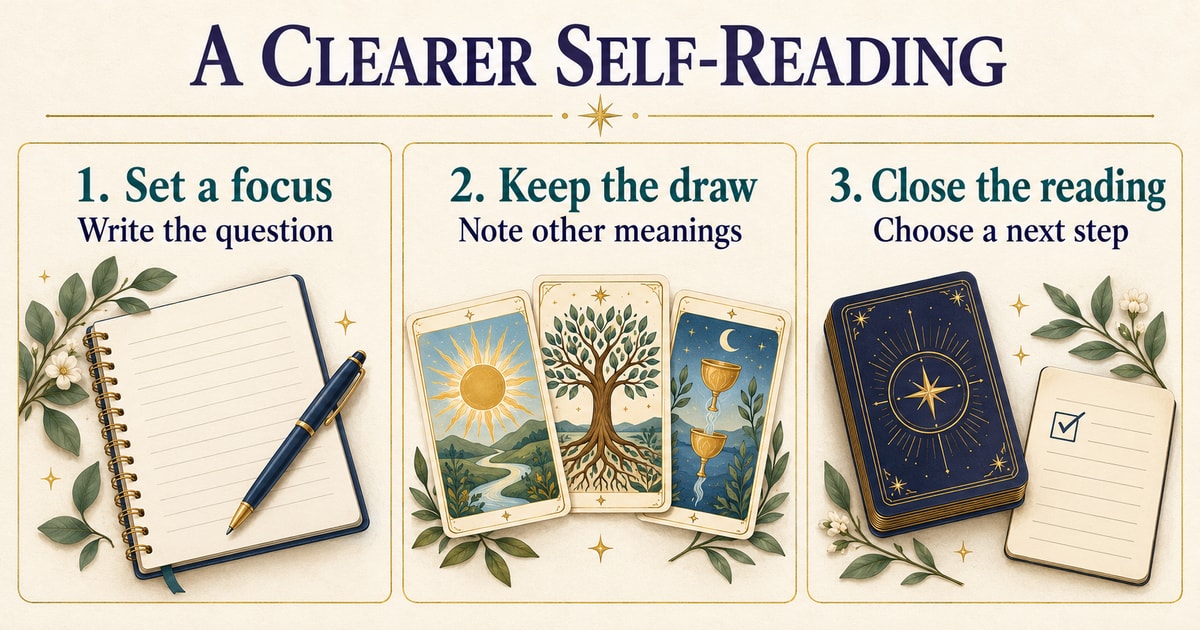
Use these three stages as a short notebook template. They also explain the routine shown in the illustration above.
- Set a focus. Write the date, question, spread positions and any reversal method. Add what you hope or fear the cards will say.
- Keep the draw. Record the cards and their positions. Distinguish a guidebook meaning, a personal association and an observable fact. Note an alternative interpretation or where nothing seems to fit.
- Close the reading. Choose one manageable next step or leave the question open. Close the deck and add later observations separately, without rewriting your original note to make it appear correct.
Worked example: a conversation, not a forecast
Imagined reading: you ask, “What could help me prepare for a difficult conversation?” and draw the Five of Pentacles. One possible reflection is feeling left out; another is overlooking available support. Neither establishes what the other person thinks.
Your note might be: “I feel excluded, but I have not asked what happened. I will arrange a suitable time to talk and check my assumption.” The useful next step comes from reflection and communication, not a promise that the card will resolve the relationship.
When doing less is the useful choice
If you keep checking the deck for permission to act, or each reading makes you more frightened, stop the session. You do not owe the cards another draw. Talk through the actual situation with someone you trust, and return to the deck only if it supports rather than crowds out ordinary life.
For more on interpreting a reading without mistaking confidence for evidence, see how accurate tarot readings are. If you are still learning the deck and spread positions, continue with Tarot Cards for Beginners. A self-reading can finish with a better question; it does not need to finish with certainty.