

A date that does not lead to another is not proof that you did something wrong. Interest, timing, compatibility and circumstances can all differ. Tarot can offer a way to reflect on your own part in an evening without turning the cards into a report on someone else’s thoughts.
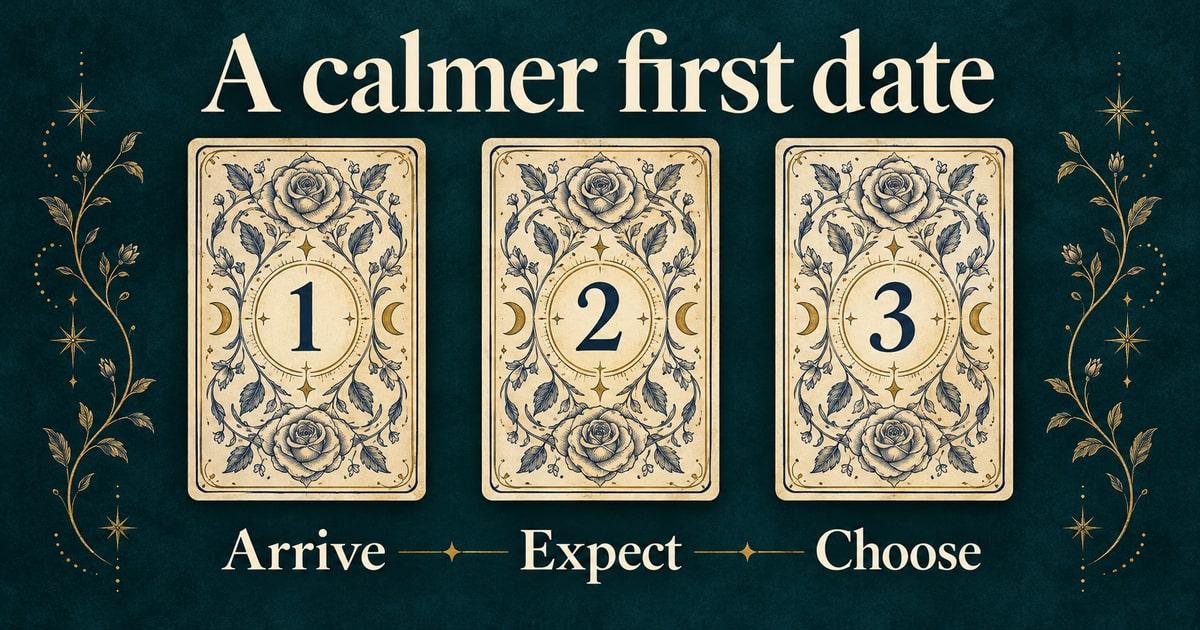
Use this three-card spread to notice how you arrive, what you expect and one choice you can make next time. You may bring a spiritual or intuitive perspective to it; keep the interpretation open enough to compare with what actually happened.
A three-card spread about your choices
Think about a recent date or a pattern you have noticed across a few evenings. Ask: “What could I bring more awareness to on my next date?” Set the positions before drawing, lay three cards from left to right and write down the question and card names.
1. Arrive — what am I bringing?
Notice your mood, energy and circumstances. A Nine of Swords might open a question about worry; the Five of Cups about a disappointment you are carrying. Neither diagnoses you or proves you are not ready to date. With the Four of Swords, you could ask whether rest or a shorter evening would help.
Try: “Before I meet someone, what do I need to acknowledge or take care of?”
2. Expect — what am I hoping for?
The Seven of Cups or Ten of Cups might invite you to notice an imagined future. Hoping for a relationship is not a mistake. The question is whether you are leaving room to discover this particular person. A Page of Pentacles can offer a different prompt: approach the evening with curiosity rather than a conclusion.
Try: “What would make this one meeting worthwhile, even if it does not become a relationship?”
3. Choose — what can I do differently?
Keep this position about your actions, not “what my date secretly felt.” The Nine of Wands might prompt a boundary, the Three of Cups a warmer conversation or the Eight of Swords a question about feeling constrained. Check whether the association fits your experience before acting on it.
Try: “What is one small change that respects both my comfort and the other person’s freedom to choose?”
These are illustrative ways to work with familiar tarot imagery, not fixed findings about you. If a card does not fit, note that instead of inventing a problem. You do not need to draw again until the spread gives a more flattering answer.
Five habits to check without judging yourself
Use these as possibilities to consider, not a scorecard. There is no script that guarantees a second date, and a difference in communication style does not automatically mean someone behaved badly.
- Planning too far ahead
- Notice whether excitement has become an assumption about a shared future. You can express interest without deciding the next few months together. Try: “I enjoyed this. Would you like to meet again?” Leave space for their answer rather than imposing a timetable.
- Interviewing instead of connecting
- A run of questions may feel less like a conversation than you intended. Follow something they said, share a small experience of your own and let pauses happen. You do not need to count one disclosure for every question or perform a particular social style.
- Returning to the ex
- It is fine to acknowledge your history. Ask whether the conversation has shifted toward processing an old relationship rather than meeting someone new. You might redirect gently or choose another place to talk it through. A card does not order you to stop dating.
- Performing rather than listening
- If you are focused on appearing impressive, pause to notice what interests you about the person in front of you. Ask a genuine follow-up instead of planning the next anecdote. Listening also includes noticing whether they show curiosity about you.
- Overlooking your own comfort
- Consider your energy, hunger, access needs, budget and the setting. A quieter place or shorter meeting may suit you better. You do not owe enthusiasm, physical affection or another date to avoid disappointing someone. Respect their boundaries too; love is respect’s guidance emphasizes communicating and honoring each other’s limits.
From an anxious spread to a realistic plan
Suppose you draw the Nine of Swords, Seven of Cups and Three of Cups. You might write: “I am worried about being liked, I have been imagining a relationship before we know each other, and I would like the evening to feel more relaxed.” That is your interpretation, not a verdict supplied by the cards.
Choose one practical response: suggest a short meeting in a comfortable public place, ask about a shared interest and decide afterward whether you enjoyed being together. The aim is a more present conversation, not making someone like you or securing a particular outcome.
After the date: reflect, then leave room
- Record what you observed. What did you enjoy? When did you feel comfortable or uncomfortable? Separate something said or done from a guess about what it meant.
- Notice your own preference. Ask whether you want another meeting, not only whether you think they want one. Mixed feelings are allowed.
- Choose a clear next step. You might send a simple invitation, decline kindly or take a break. Respect a no or a lack of response rather than using repeated readings to search for a hidden yes.
Rejection can hurt without defining your worth. If repeated dates leave you feeling low, talk with someone supportive and consider taking the pace down. If you need emotional crisis support in the United States, including for thoughts of self-harm, you can call or text 988. Another spread does not need to come before getting help.
For other relationship questions and spreads, continue with Love Tarot Readings: A Grounded Guide. For a simple way to keep your observations and interpretations separate, try the tarot journaling spread.