
Quick guide
Tarot is a deck of 78 illustrated cards that most people today use for reflection and structured conversation rather than as a way to see ahead. The deck has two parts: 22 Major Arcana cards, numbered 0 (The Fool) to XXI (The World), and 56 Minor Arcana cards in four suits, Wands, Cups, Swords and Pentacles, each running Ace to Ten plus Page, Knight, Queen and King. A reading begins with a question, moves through shuffling and laying cards in a pattern called a spread, and ends with interpretation, where each card’s traditional meaning is connected to its position and to the question. Tarot started as a card game in 15th-century Italy, was taken up for fortune-telling in 18th-century France, and reached its familiar form in the Rider-Waite-Smith deck of 1909. A reading cannot see the future, read another person’s mind, confirm a pregnancy, diagnose an illness, pick lottery numbers or guarantee an outcome. What it can do is hand you images that help you see a situation from a new angle, name what you feel and decide what to do next. This guide covers the deck, the reading process, the history, why readings feel accurate, and how to choose between reading for yourself and paying a professional.
What tarot cards are: the 78-card deck
A standard tarot deck holds 78 cards. Twenty-two are the Major Arcana, the numbered trump cards that run from 0, The Fool, to XXI, The World, with names such as The Magician, The Lovers, Death and The Sun in between. Readers treat these as the big themes of a reading: a change of direction, a loss, a lesson, a fresh start.
The other 56 cards are the Minor Arcana, and they resemble an ordinary deck of playing cards with one extra face card per suit. The four suits are Wands, Cups, Swords and Pentacles, and each contains Ace through Ten plus four court cards: Page, Knight, Queen and King. In tradition, Wands stand for action and work, Cups for feelings, Swords for thinking and conflict, and Pentacles for money, health and practical life. The 16 court cards are often read as people or attitudes. The number on a pip card adds a second layer: Aces are beginnings, Fives are usually friction, Tens are completion.
| Part of the deck | Cards | Traditional theme | Example |
|---|---|---|---|
| Major Arcana | 22 (0 to XXI) | Turning points and life lessons | The Tower: sudden upheaval |
| Wands | 14 (Ace to King) | Energy, work, ambition, creativity | Three of Wands: plans taking shape |
| Cups | 14 (Ace to King) | Emotion, love, friendship | Two of Cups: a partnership |
| Swords | 14 (Ace to King) | Thought, truth, worry, conflict | Three of Swords: heartbreak |
| Pentacles | 14 (Ace to King) | Money, home, health, daily effort | Eight of Pentacles: steady practice |
| Court cards | 16 (four per suit) | People, roles and attitudes | Queen of Swords: a clear, direct speaker |
How a tarot reading works, step by step
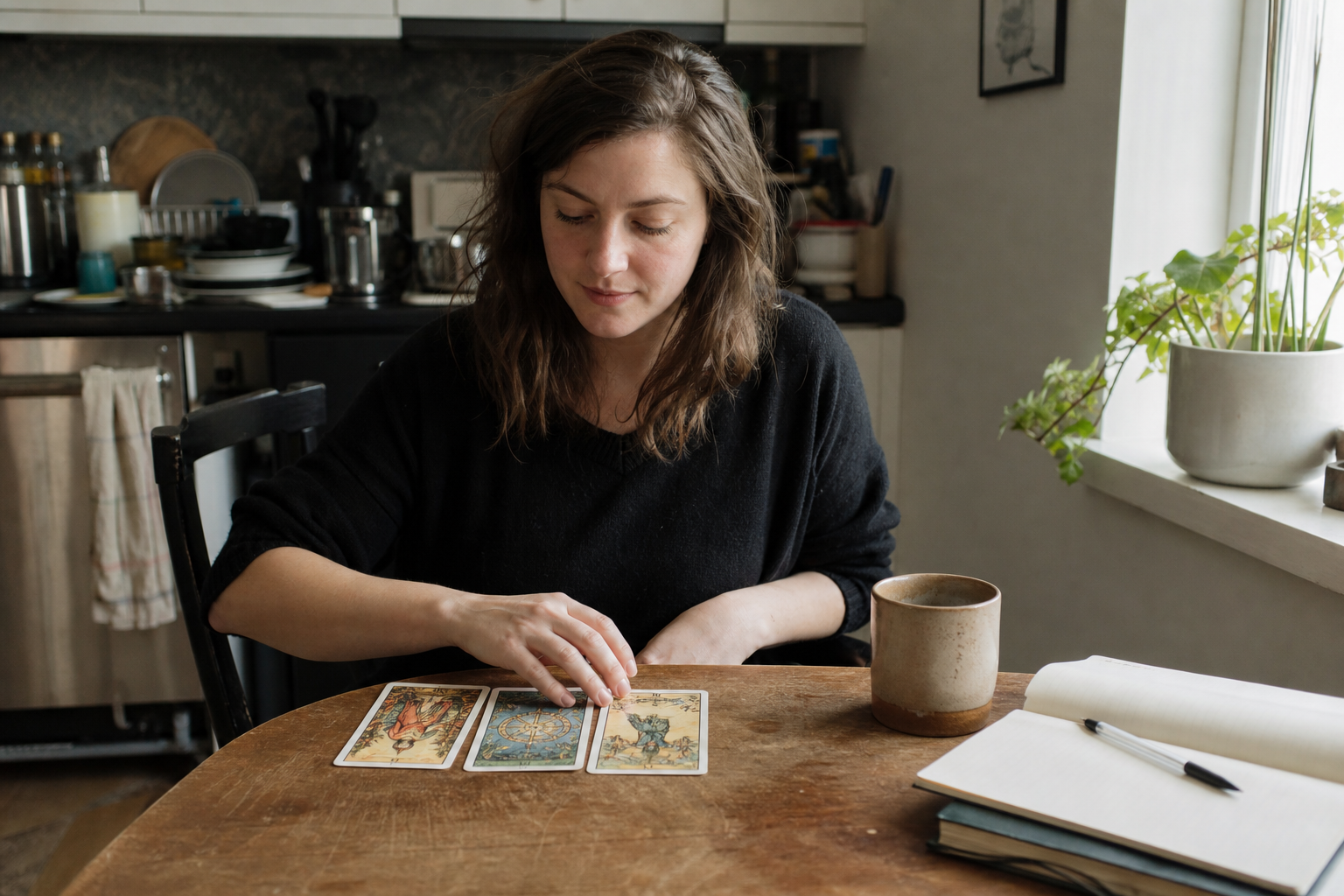
Every reading, whether it takes two minutes at a kitchen table or an hour with a professional, follows four moves. First comes the question. Good questions are open and centered on the person asking: what should I keep in mind about this job offer. Closed questions about other people (does he still love me) or fixed events (will I get the promotion) push the reading toward guesswork.
Second, the cards are shuffled. There is no correct method; the point is to mix the deck and give the person a moment to settle on the question. Third, cards are drawn and laid out in a spread, a pattern where each position has a job, such as past, present and future. Fourth comes interpretation. The reader considers each card’s traditional meaning, whether it is upright or reversed, and the position it fell in, then reads the cards together as a story that answers the question.
- 1. AskSettle on one open question about your own situation and say it out loud or write it down.
- 2. Shuffle and drawMix the deck in whatever way feels natural, then draw the number of cards the spread needs.
- 3. Lay the spreadPlace each card in a position with a defined job, such as past, present, future or situation, obstacle, advice.
- 4. Interpret and decideRead the cards as a connected story, note what lands, and turn it into one concrete next step.
Common spreads and what each position means
Beginners are usually told to start with one card a day and a three-card line, and that advice is sound. The Celtic Cross, a ten-card layout popularized by the Rider-Waite-Smith guidebook, is what most people picture when they think of tarot, but it is a lot to hold in your head at once. The table below runs from the simplest spread to the most detailed.
| Spread | Cards | Positions | Best used for |
|---|---|---|---|
| One card | 1 | Theme of the day or a single prompt | Daily practice, quick focus |
| Three card (time) | 3 | Past, present, future | Seeing how a situation has moved |
| Three card (advice) | 3 | Situation, obstacle, advice | Decisions and next steps |
| Five card cross | 5 | Present, challenge, past, future, outcome | A fuller picture without ten cards |
| Celtic Cross | 10 | Present, challenge, past, future, hopes, fears, outside view, outcome | Complex questions, longer sessions |
A short and accurate history of tarot
Tarot did not begin as a fortune-telling tool. The earliest decks appeared in northern Italy in the first half of the 15th century, when a set of illustrated trump cards was added to a four-suit pack to play a trick-taking game called tarocchi. The oldest surviving cards were painted for the Visconti and Sforza families of Milan. For roughly three hundred years tarot remained a game, and in parts of Europe it still is.
Divinatory use grew in France in the late 18th century. In 1781 Antoine Court de Gebelin claimed the cards preserved ancient Egyptian wisdom, a claim with no historical support. Soon after, Jean-Baptiste Alliette, writing as Etteilla, published instructions for reading the cards and designed the first deck made for that purpose. Nineteenth-century occultists tied the cards to Kabbalah, and the Golden Dawn in England built a system around them. In 1909 Arthur Edward Waite and the artist Pamela Colman Smith produced the Rider-Waite-Smith deck, the first popular deck with full scenes on every Minor Arcana card, and it remains the reference point for most modern decks. Encyclopaedia Britannica has a concise account of the game and its later use.
What a reading can and cannot do
It helps to be plain about limits before talking about benefits. A tarot reading cannot see the future, read another person’s thoughts, confirm a pregnancy, diagnose or rule out an illness, choose lottery numbers, find a missing person, or guarantee that a relationship, job or move will work out. Any reader who says otherwise is mistaken or selling something. Health questions belong with a doctor, legal questions with a lawyer, and a crisis with 911 or the 988 Lifeline.
Within those limits, tarot has real uses. It gives you a fixed set of images to react to, which makes it easier to notice what you already think and feel. It forces a vague worry into a specific question and slows a decision down for twenty minutes. Words such as energy, intuition and the universe come up often in tarot writing; treat them as the language of the practice rather than as established facts.
Why readings feel accurate: the psychology, explained fairly
Most people who try tarot come away feeling the cards described them well, and it is worth understanding why without dismissing the experience. The first factor is the Barnum effect: statements that could apply to almost anyone (you need others to like you, you sometimes doubt your decisions) feel personal when addressed to you. Card meanings are written in this register, so a reading lands more often than chance would suggest. The second is confirmation bias: we remember the cards that fit and forget the ones that did not. The third is skilled questioning. A good reader watches your reactions and follows what draws a nod, which makes the reading feel tailored because, in a sense, it is.
None of this makes tarot useless. The same mechanisms are at work in a good conversation with a friend, and the value lies in the thinking the reading prompts. Enjoy the resonance, note the prompts, and keep the decisions yours.
Reading for yourself or booking a professional
Both have a place. Reading for yourself costs the price of a deck, usually 20 to 40 dollars, plus a guidebook or a free reference online. It suits daily reflection and low-stakes decisions, and it teaches you the cards fast. The drawback is that your own hopes are in the room. A professional brings distance and fluency with the meanings. Look for someone who asks what you want from the reading, explains the cards as they go, and never claims to predict, diagnose or remove anything. Leave, and report to the FTC, if a reader talks about curses or asks for gift cards or wire transfers.
Reading your own cards
- Cheap, private and available any time
- The fastest way to learn the 78 cards
- Suits journaling and small daily decisions
Booking a reader
- Outside perspective you cannot give yourself
- Fluent with meanings, positions and combinations
- Costs money; quality varies, so vet carefully
Key takeaways
- Tarot has 78 cards: 22 Major Arcana and 56 Minor Arcana in four suits of fourteen.
- A reading is four moves: ask, shuffle and draw, lay a spread, interpret and decide.
- The cards began as a 15th-century Italian game; fortune-telling came from 18th-century France, and the 1909 Rider-Waite-Smith deck set the modern standard.
- A reading cannot predict events, read minds, confirm pregnancy or diagnose illness; it can sharpen a question and prompt honest reflection.
- Readings feel accurate because of the Barnum effect, confirmation bias and skilled questioning; they can still be useful once you know that.
- Start with one card a day and a three-card spread; book a professional for questions you are too close to.
Related reading
- Learn How Tarot Readings Work
- Tarot Cards and Readings
- Tarot Cards for Beginners: a complete starting guide
- How Accurate Are Tarot Card Readings
- Psychics and Tarot Cards
- What Are Psychic Mediums
- Knowing If Tarot Readings Are Right for You
- How Tarot Cards Can Benefit You
Frequently asked questions
1. What are tarot cards, in one sentence?
Tarot cards are a deck of 78 illustrated cards, 22 Major Arcana and 56 Minor Arcana, that people use to prompt reflection on a question by drawing cards, laying them in a pattern and interpreting the traditional meanings together. The practice grew out of a 15th-century Italian card game.
2. How many cards are in a tarot deck and how are they divided?
A standard deck has 78 cards. The Major Arcana are 22 numbered trumps from 0, The Fool, to XXI, The World. The Minor Arcana are 56 cards in four suits, Wands, Cups, Swords and Pentacles. Each suit runs Ace to Ten plus Page, Knight, Queen and King, giving 14 cards per suit.
3. What is the difference between the Major and Minor Arcana?
The Major Arcana are read as the large themes of a reading: turning points, lessons, the shape of a chapter. The Minor Arcana describe the everyday texture of the same situation, such as a hard conversation, a bill or a new friendship. A spread with several Majors is usually treated as weightier.
4. How does a tarot reading actually work?
A reading has four parts. The person asking settles on an open question. The deck is shuffled and a set number of cards is drawn. The cards go into a spread where each position has a meaning, such as past, present and future. The reader then interprets each card in its position and reads them together as one story.
5. Can tarot cards predict the future?
No. There is no controlled evidence that tarot cards predict events, and no reading can give you a date, a result or what another person will do. A reading can describe how a situation looks to you now, raise possibilities you had not considered and prompt a decision. The future position is a direction, not a fixed outcome.
6. Where did tarot come from?
Tarot began in northern Italy in the early 15th century as a trick-taking game called tarocchi, played with a four-suit pack plus illustrated trumps. It was used for fortune-telling in France from the 1780s, when Court de Gebelin and Etteilla wrote about it. The Rider-Waite-Smith deck of 1909 shaped most modern decks.
7. Is it true that tarot comes from ancient Egypt?
No. The Egyptian story was put forward by Antoine Court de Gebelin in 1781 and repeated by later occult writers, but historians have found no evidence for it. The documented record starts in 15th-century Italy with the game of tarocchi. Some decks use Egyptian imagery, but that is a design choice, not an origin.
8. What is the Rider-Waite-Smith deck and why does it matter?
It is the deck published in London in 1909, designed by Arthur Edward Waite and illustrated by Pamela Colman Smith. Its innovation was a full scene on every Minor Arcana card rather than a plain arrangement of suit symbols, which makes the cards much easier to read.
9. What is a tarot spread?
A spread is a fixed pattern for laying out cards in which each position carries a meaning. In a three-card spread the positions might be past, present and future, or situation, obstacle and advice. The Celtic Cross uses ten. The spread turns a random draw into a structured answer: the same card reads differently in each position.
10. What does it mean when a card is reversed?
A reversed card lands upside down after shuffling. Many readers treat it as a weakened, blocked, delayed or inward version of the upright meaning; some read it as the opposite; others ignore reversals and read every card upright. None of these is more correct than another. Beginners often skip reversals at first.
11. Why do tarot readings feel so accurate?
Three ordinary mechanisms do most of the work. The Barnum effect makes general statements feel personal. Confirmation bias makes us remember hits and forget misses. Skilled questioning lets a reader follow the reactions that land. Add rich, open-ended images and almost any draw will connect to something real in your life.
12. What is the Barnum effect?
The Barnum effect, also called the Forer effect, is the tendency to accept vague, general descriptions of personality as uniquely accurate for oneself. Bertram Forer demonstrated it in 1948 by giving students identical horoscope-style profiles, which they rated as highly personal. Card meanings are often written in the same general style.
13. Do you have to be psychic to read tarot?
No. Reading tarot is a learned skill: knowing the 78 cards, the logic of spreads and how to build a story from several images. Some readers describe their process as intuitive or psychic, and that is their framework; the mechanics are the same either way. A few months with a deck and a guidebook is enough to read competently.
14. Should I read my own cards or pay for a reading?
Read your own cards for daily reflection, learning and small decisions; it is cheap and it teaches you the deck. Book a professional when you are too close to a question to see it clearly or when you want a conversation rather than a solo exercise. Choose a reader who explains as they go and never claims to predict or diagnose.
15. What questions work best in a tarot reading?
Open questions about your own choices and outlook work best: what should I weigh before accepting this offer, what is my part in this conflict, what do I need to notice this month. Questions that ask the cards to see the future, read someone else’s mind or confirm a medical or legal fact do not work, because no reading can do those things.
16. How much does a tarot reading cost in the United States?
A deck for reading yourself usually costs 20 to 40 dollars. Online readers commonly charge by the minute, so a short session can run from a few dollars to well over a hundred. In-person readers often charge per session, from roughly 30 dollars to 150 or more for an hour. Be wary of anyone who asks for extra money to remove a problem.
17. What are the warning signs of a tarot scam?
Leave if a reader says you are cursed or blocked and offers to remove it for a fee, asks for payment by gift card, wire transfer or cryptocurrency, claims to diagnose illness or confirm pregnancy, promises a guaranteed result, or keeps raising the stakes. Fair readers charge a clear price for their time. Report fraud to the Federal Trade Commission.
18. How do I start learning tarot as a complete beginner?
Buy a Rider-Waite-Smith style deck and its guidebook, learn the 22 Major Arcana first, then the four suits and the meaning of the numbers. Draw one card each morning, write a sentence about it, and check the guidebook at night. Add a three-card spread after a few weeks and keep a notebook. The beginner guide above walks through each step.
Evidence note: Historical dates follow standard reference works: playing-card tarot appears in 15th-century Italy, divinatory use is documented in France from the 1780s, and the Rider-Waite-Smith deck was published in 1909. There is no controlled scientific evidence that tarot readings predict future events. Card meanings are traditions, not facts. Health, legal and financial questions belong with qualified professionals. In a crisis in the United States, call or text 988. Report a reader who charges to remove a curse or block to the Federal Trade Commission.