


A small ritual, not another demand
When life feels heavy, tarot can offer a quiet way to name what you are carrying and consider a caring next step. You do not have to force a positive message, solve the whole situation or keep reading until you feel certain.
Try a brief check-in with clear boundaries. The cards can hold spiritual meaning for you without being able to tell you when the hard season will end or what someone else is thinking.
Three rules that leave room for real life
Give the reading a stopping point
Choose a pace that leaves room to live between readings. A weekly check-in is one option, not a rule everyone must follow. If you notice yourself repeating the same question to obtain a reassuring card, pause rather than drawing until an answer feels right.
Decide before shuffling: one question, one draw and a short session. A dated note lets you return to the same reflection without asking the deck to settle the worry again.
Keep real-world choices grounded in facts
A card can help you name an emotion or consider an option; it cannot decide whether a job, home or relationship is safe or suitable. Do not make an irreversible choice simply because the Tower or another intense card appears.
If there is an immediate safety concern or a real-world deadline, seek appropriate help and act on the facts. Do not wait for a calmer mood or another card. For a non-urgent choice, gather information, talk with someone you trust and use the hard decisions guide to organise your options.
Ask about your needs and your next response
It is natural to wonder what an ex, friend or employer is thinking. A tarot reading does not give reliable access to another person’s private thoughts. Shift the question toward what you can notice, communicate or choose.
You can still explore a relationship: “What boundary do I need?” or “What would I like to ask directly?” is more workable than treating a card as confirmation that someone will return, apologise or change.
When a question loops, try a second question
The first question in each pair is understandable, especially during grief, uncertainty or a breakup. These feelings are not “bad” or something to banish. If the deck cannot settle the question, the follow-up may give your reflection somewhere practical to go.
- If you keep askingWill this be over soon?
- Try exploringWhat would make this week five percent easier?
- If you keep askingIs my ex thinking about me?
- Try exploringWhat do I need from my own friends right now?
- If you keep askingWhy is this happening to me?
- Try exploringWhat has helped me through hard stretches before?
- If you keep askingWhat is going to happen next?
- Try exploringWhat is one thing within my control today?
- If you keep askingDid I deserve this?
- Try exploringWhat am I handling well, even now?
“Five percent easier” simply means a small, manageable improvement; there is no score to reach. If the most honest answer is “I need company” or “I need to rest,” you can act on that without drawing a card.
A gentler tarot check-in
For a difficult day, choose one question and one card. Five or ten minutes might suit you, but the point is a manageable ending, not completing a timed exercise. If a familiar calming ritual, prayer or quiet intention helps you settle, make space for it without feeling obliged to create a special atmosphere.
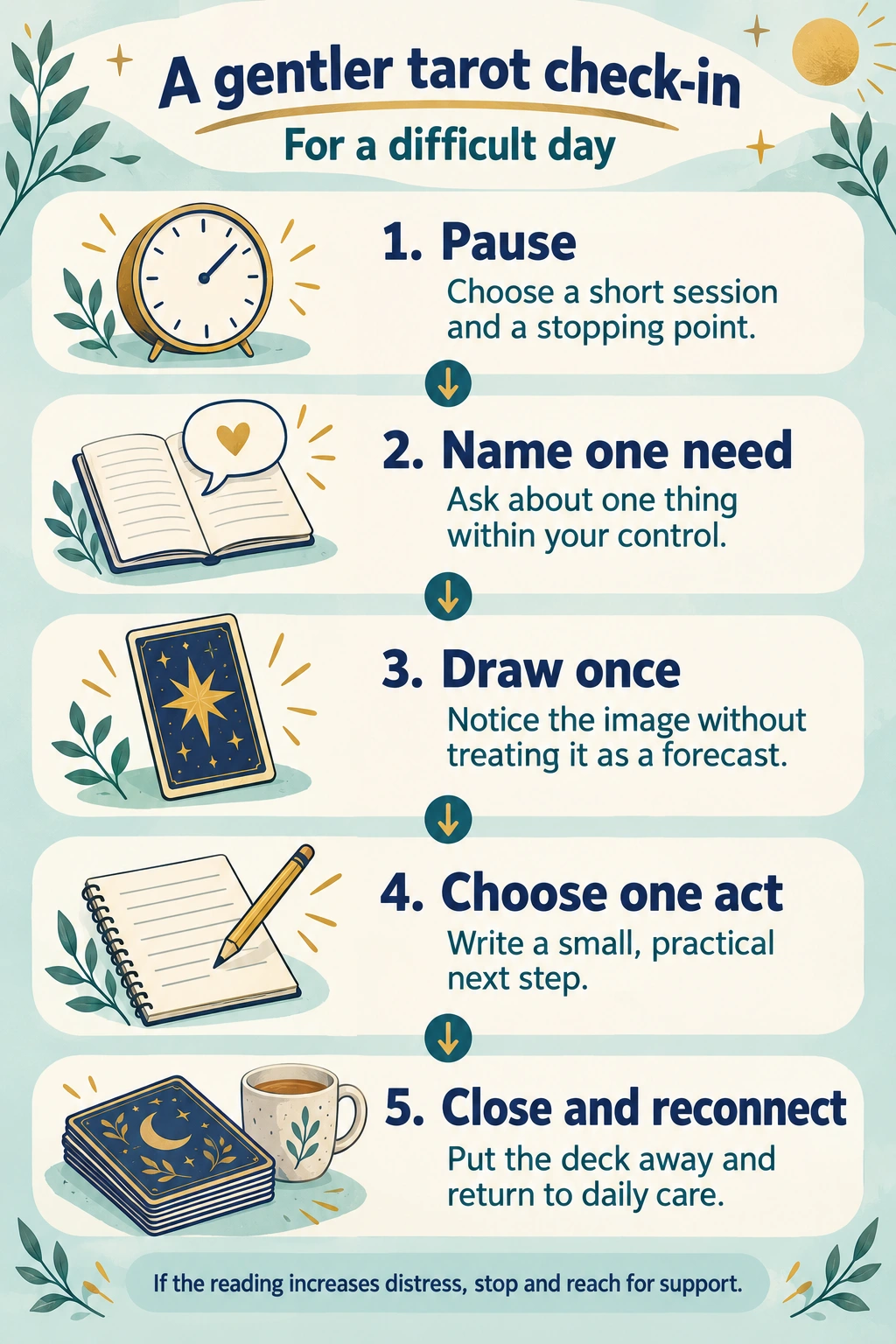
- Pause. Choose a short session and a stopping point.
- Name one need. Ask about one thing within your control.
- Draw once. Notice the image without treating it as a forecast.
- Choose one act. Write a small, practical next step.
- Close and reconnect. Put the deck away and return to daily care.
If the reading increases distress, stop and reach for support.
Write the date, your question, the card and one sentence about what you noticed. If you draw a difficult image, you can name the feeling it brings up without treating it as news about your future. Close the notebook rather than adding more cards to cancel the first one.
An imagined check-in
Suppose you are worn down after a difficult week and draw the Nine of Wands. Instead of “I must keep fighting,” you might read its tired, watchful figure as a prompt to notice your limits.
“I am carrying too much today. My next step is to ask my sister whether she can help with one errand. After writing this, I will put the deck away and have lunch.”
Later, review the action: Did you ask? Was the help available? What else would you need? You are checking whether your reflection was useful, not whether a card guaranteed an outcome.
Two card images to reflect with gently
These are starting interpretations from the Rider–Waite–Smith tradition. Let the image open a question rather than impose a lesson about why you are struggling.
Five of Cups: acknowledge the loss
In the Rider–Waite–Smith image, a cloaked figure faces three fallen cups while two remain upright behind. You can make space for what hurts without immediately being asked to look on the bright side.
A possible question: “What am I grieving, and which source of support could I turn toward when I am ready?” The remaining cups are not a demand to feel grateful or proof that everything will work out.
Nine of Wands: notice your limits
A bandaged figure leans on a staff, with eight wands behind. Readers often associate this image with persistence, guardedness and the strain of having been through a lot.
A possible question: “Where do I need a boundary, a break or help carrying this?” You do not have to interpret resilience as an instruction to endure more. The Nine of Wands guide explores that balance in more detail.
When to put the cards down and reach out
Take a break if readings leave you more frightened, keep pulling you back to the same worry or crowd out sleep, meals, work or contact with other people. Choosing not to read is a valid part of a spiritual practice; it is not a failure of intuition.
If distress persists, worsens or makes daily life difficult, speak with a health care professional. The National Institute of Mental Health’s help guide explains signs that additional support may be useful.
In the US, call or text 988 for emotional or crisis support, including thoughts of suicide or urges to hurt yourself. In a life-threatening emergency, call 911. Outside the US, use your local crisis or emergency service.
You do not have to solve this in one reading
A meaningful check-in can end with one honest sentence and one kind, practical action. For a wider routine that includes journaling, boundaries and support, continue with Tarot and Mental Wellness.