

A soulmate tarot reading can be a way to explore your hopes for a meaningful relationship. This eight-card version asks about your expectations, past patterns, present choices and one practical next step. It does not ask the cards to identify a particular person or set a date for their arrival.
If “soulmate” has spiritual meaning for you, you can bring that meaning to the reading while leaving room for another person’s choices. Readiness is not a test of whether you deserve love. You can want connection without needing to become a perfect partner first.
Set up an eight-card clock spread
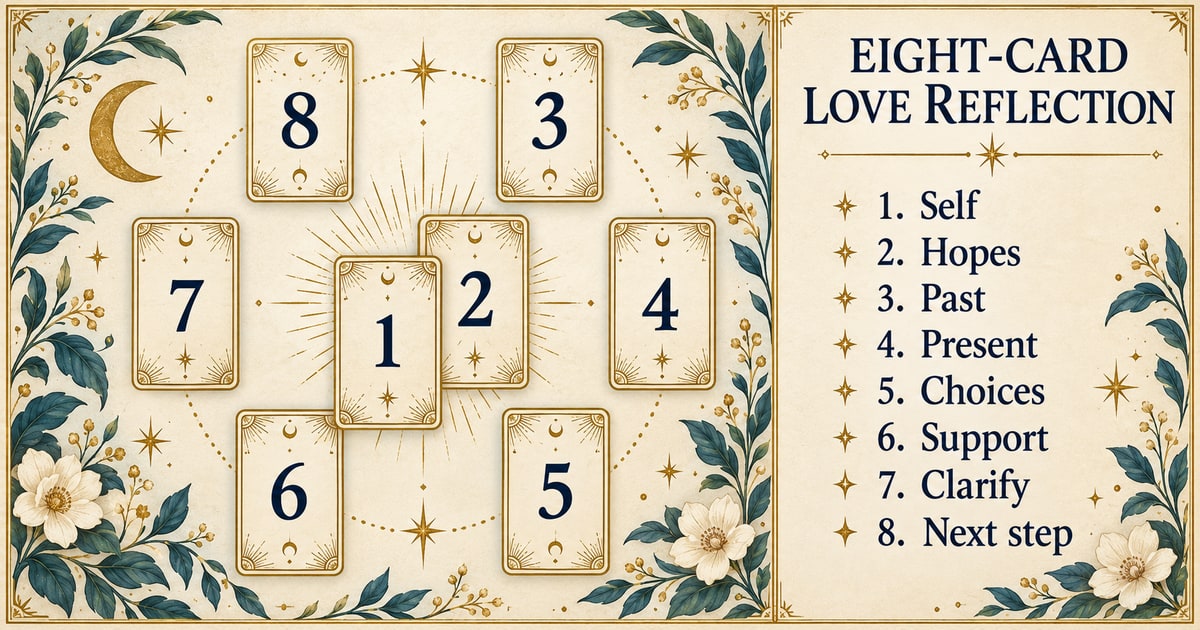
Spread layouts vary. Here, two cards form the centre and six sit around them like clock positions. The diagram above shows the arrangement; every position is also described in text below. The clock is a placement guide, not a prediction about hours or dates.
- Choose a question about your own choices. Try “What would help me approach a relationship with openness and clear boundaries?” Write a brief first response before drawing. Avoid assuming that an ex will return or that a particular person must be your soulmate.
- Shuffle and place all eight cards. Put card 1 slightly left and lower in the centre, with card 2 slightly right and higher. Overlap a corner if you like, keeping both visible. Place cards 3–8 at 1, 3, 5, 7, 9 and 11 o’clock respectively.
- Read once, then record. Work through cards 1–8 in order. If you use reversals, decide that before the draw. Do not replace an uncomfortable card just to obtain a reassuring answer.
You can use a notebook instead of a physical layout: number eight lines and record each card beside its question. For preparation, see shuffling, laying out and journaling with tarot.
Eight positions, eight distinct questions
The examples use common Rider–Waite–Smith associations, not fixed answers or claims that a card is more likely to appear in a particular spot. Start with what you see, then check the interpretation against your own experience.
1. Self — centre, left/lower
Ask: “How do I see myself as a partner?” The Hermit might invite reflection on solitude, privacy or discernment. It does not prove you are hiding from love. Name a strength you bring and a need you want to express.
2. Hopes — centre, right/upper
Ask: “What am I hoping for in a partner?” The Sun could suggest warmth, openness or enjoyment. Translate that picture into ordinary behaviour: sharing interests, communicating clearly or feeling comfortable together. A bright card does not confirm a perfect match.
3. Past — 1 o’clock
Ask: “Which past experience still shapes my choices?” The Six of Cups may bring up nostalgia or familiar expectations. Identify a specific memory and whether it remains useful; do not assume the past must repeat or that a former partner is destined to return.
4. Present — 3 o’clock
Ask: “What needs attention now?” The Eight of Swords can prompt questions about feeling restricted. Separate a belief from an actual obstacle such as time, access or safety. If the Tower appears, examine uncertainty or a disrupted expectation; it is not proof of an approaching relationship disaster.
5. Choices — 5 o’clock
Ask: “What part of my response is within my control?” The Seven of Swords might prompt thought about avoidance, privacy or how you communicate. It does not establish deception. Choose something you can do differently without taking responsibility for someone else’s harmful actions.
6. Support — 7 o’clock
Ask: “What support could help me?” The Three of Pentacles can suggest collaboration or learning. Consider a trusted friend, an accessible community activity or professional support when appropriate. You do not have to work everything out alone.
7. Clarify — 9 o’clock
Ask: “What do I need to ask, learn or verify?” Justice might bring attention to fairness or clear agreements. Turn the interpretation into an actual question, such as “Are we looking for the same kind of relationship?” Cards cannot supply the other person’s answer.
8. Next step — 11 o’clock
Ask: “What is one realistic action I can take?” The Page of Cups may suggest an emotional opening: accepting a welcome invitation or expressing a feeling. Choose only what feels safe and appropriate, respect any refusal and give your action a review date.
Read the cards together, without turning them into a verdict
Compare the centre pair first. The Empress and Knight of Swords might bring up care and quick communication. They do not show that two real people are compatible or incompatible; ask which qualities you value and how they could work together in daily life.
Imagined example: the Sun in position 2 makes you think about warmth, the Eight of Swords in position 4 brings up a busy schedule, and the Page of Cups in position 8 suggests a small opening. You decide to accept one invitation that fits your week, rather than conclude that you must find someone immediately. Your record separates the symbols from the facts: you want connection, you have limited time and you can choose one manageable social plan.
Close with three notes: what you noticed, what you still do not know and what you will do next. A review date is a date you choose to revisit your notes, not a deadline for love to arrive. For more preparatory questions, see five tarot journal prompts for making room for love.
Keep the reading useful outside the cards
If you already have a partner, use the spread to prepare a conversation about your own needs, not to announce what they secretly feel. If you read with someone else, agree on the questions and whether each person wants to take part. A “soulmate” interpretation never overrides consent, a boundary or what someone actually tells you.
Repeated readings about the same person can become a way of postponing a difficult question. Save this draw, choose the next step and allow time to notice what happens. If you choose a paid reading, confirm the price and length; do not accept a guarantee that extra payments can bring a particular person back.
If a relationship involves fear or control, you do not need a card’s permission to seek support. In the United States, the National Domestic Violence Hotline is available at 1-800-799-7233 or by texting START to 88788. Use a safer device if you think yours is monitored. For immediate danger, call 911.
Continue to the Love Tarot Readings guide for other layouts for single people and couples.