
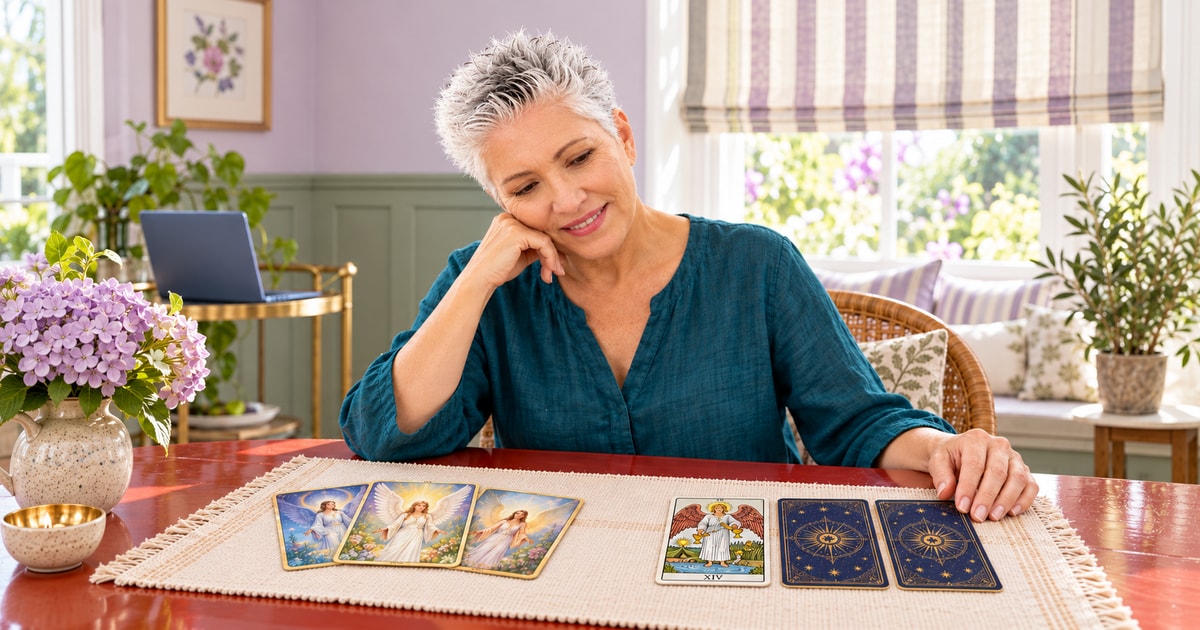
The main difference is the deck’s system, not its spiritual power. Tarot usually follows a recognisable 78-card structure. Angel oracle decks use a structure designed by their creator, with meanings explained in that particular guidebook.
There is an important exception: angel-themed tarot decks exist too. An angel on the artwork does not tell you whether a deck is tarot or oracle. Look at its contents and guide rather than choosing by the name alone.
Angel cards can mean two different things
An angel oracle deck is built around angel imagery or messages without needing to follow tarot’s Arcana, suits and courts. For example, the publisher lists Angel Answers Oracle Cards as a 44-card deck with a guidebook. That is a description of that product, not a rule that every angel deck contains 44 or 45 cards.
An angel-themed tarot deck uses angels within a tarot framework. The publisher lists Guardian Angel Messages Tarot as a 78-card deck with a guidebook. The angel theme does not turn it into an oracle deck.
Before choosing, check a numbered Minor Arcana card, the court ranks and a sample guidebook entry. Our angel oracle card guide looks more closely at the oracle side of this distinction.
Six practical differences to compare
Here, “angel cards” means angel oracle cards. These comparisons help you choose a reading style; they are not a ranking of which deck is more accurate, more spiritual or better for every beginner.
Card count and structure
An angel oracle deck follows its creator’s design. Check the actual card count, numbering, categories and guidebook; there is no universal angel-card structure.
A standard tarot deck has 78 cards: 22 Major Arcana and 56 Minor Arcana, with four suits and four court cards per suit. Some editions add cards or change the structure.
Where meanings come from
Start with that deck’s imagery, wording and guidebook. A card called Trust in one deck need not mean the same thing as a similarly named card elsewhere. Your personal response can add a journal prompt.
Learn the tradition behind the deck as well as its own guide. RWS, Thoth and Marseille do not use identical imagery, titles or court systems; tarot’s shared structure does not make every interpretation interchangeable.
Tone and emotional range
Many angel decks use reassuring language, but do not assume every message will be gentle or that encouragement means you must stay in an unhappy situation. Preview the actual cards.
Tarot includes comforting and challenging themes. The Tower and Three of Swords need context, not automatic predictions of disaster. A thoughtful reading can be kind without avoiding difficult feelings.
Upright and reversed cards
Read the guide before deciding how to handle an upside-down card. An oracle system may include reversed meanings, use a different method or work entirely upright.
Reversals are optional, not a requirement for a serious reading. Methods vary: a reader might explore an inward theme, a delay or a contrast with the upright meaning. It does not always mean “blocked.”
How to begin learning
One card and its guidebook entry can be a manageable beginning. Learning how to form a helpful question and apply a prompt thoughtfully still takes practice.
One card can also be enough to start. You do not need to memorise 78 entries first. Study can deepen over time, but there is no fixed number of weeks before you are allowed to read.
What a reading can explore
Use a card for a daily reflection, prayerful contemplation or a position in a spread. An angel theme can be meaningful when it fits your spiritual practice.
Use a single card or a spread to explore perspectives, tensions and possible actions. The familiar structure gives you a framework; it does not make a conclusion certain.
If you want to understand tarot’s structure, the Major Arcana and the Fool’s Journey introduces its 22 trump cards. To compare the traditions behind different decks, see RWS, Thoth and Marseille. The Rider-Waite-Smith deck is influential, but tarot did not begin with it in 1909.
Does one offer a clearer spiritual message?
You may feel more connected to angel imagery, traditional tarot scenes or a particular creator’s language. That connection can make a practice feel personal and worth returning to. It does not establish that the cards transmit verified messages from angels, predict events reliably or reveal another person’s private thoughts.
If angels are part of your beliefs, you can approach a draw as prayerful reflection while leaving room for uncertainty. Ask what the card invites you to consider, then distinguish that interpretation from what you actually know about the situation. Neither a comforting sentence nor a frightening image should decide for you.
Historically, tarot began as a card game in fifteenth-century northern Italy; fortune-telling uses developed later. The Metropolitan Museum of Art explains its early structure and history, and Britannica gives a further overview. That history helps identify a tradition; it does not prove one kind of deck has greater supernatural authority.
A three-step practice with both decks
You do not need to own both types. If you already do, give them complementary roles so that the reading remains clear.
- Choose one question. Try “What can I bring to a difficult conversation?” Decide in advance to draw one tarot card and one angel oracle card. If you prefer only one deck, use it on its own.
- Give each card a role. Let the tarot card suggest a theme to examine. Let the angel oracle card offer a quality or reminder to consider. Read both guidebook entries; keep the meanings distinct rather than making the second card cancel the first.
- Write one action and review it. Record the question, both cards and your interpretation, including anything uncomfortable or unclear. Choose one realistic action, then revisit your notes after taking it. Do not keep redrawing until the cards say what you hoped.
A worked example: preparing for a conversation
This is an imagined pairing, not a report of a real reading or a card title from a particular angel deck. The question is: “How can I approach the conversation more thoughtfully?”
Tarot: Temperance
You notice the mixing of water between cups and explore balance, pacing or combining different needs. You might ask, “Where would a measured response help?” This is one possible interpretation, not an instruction that every situation requires compromise.
Angel oracle: a patience prompt
Imagine that the second card invites patience. You could pause, prepare the question you need answered and agree on a time to talk. Patience does not mean ignoring a deadline, tolerating mistreatment or waiting indefinitely for someone else to act.
A useful note might be: “I will write down my main concern and ask one clear question instead of guessing the other person’s answer.” The action belongs to you. You can assess how the conversation goes without treating either card as a promise. For more ways to combine decks, continue to using oracle cards alongside tarot.
Which should you choose?
Choose an angel oracle deck if its actual wording, artwork and spiritual theme suit the kind of contemplation you want. Check that the guide helps you think, rather than requiring you to accept every sentence as an unquestionable instruction.
Choose tarot if you enjoy learning a connected system of suits, ranks and recurring themes. Choose a guide that matches the deck, and begin small. You can use tarot gently, just as you can explore a demanding question with an oracle deck.
Choose both only if the second adds something useful. You do not need another purchase to be more intuitive or spiritually worthy. Large print, readable images, comfortable card size and a guide you understand can matter more than a label promising a powerful connection.
Look at the system behind the pictures
Angel is a theme; tarot is a recognisable structure; oracle decks follow their own designs. Once you know which you are holding, you can decide how it belongs in your practice.
For a fuller introduction to oracle structures and choosing a deck, read What Are Oracle Cards?