

Quick guide
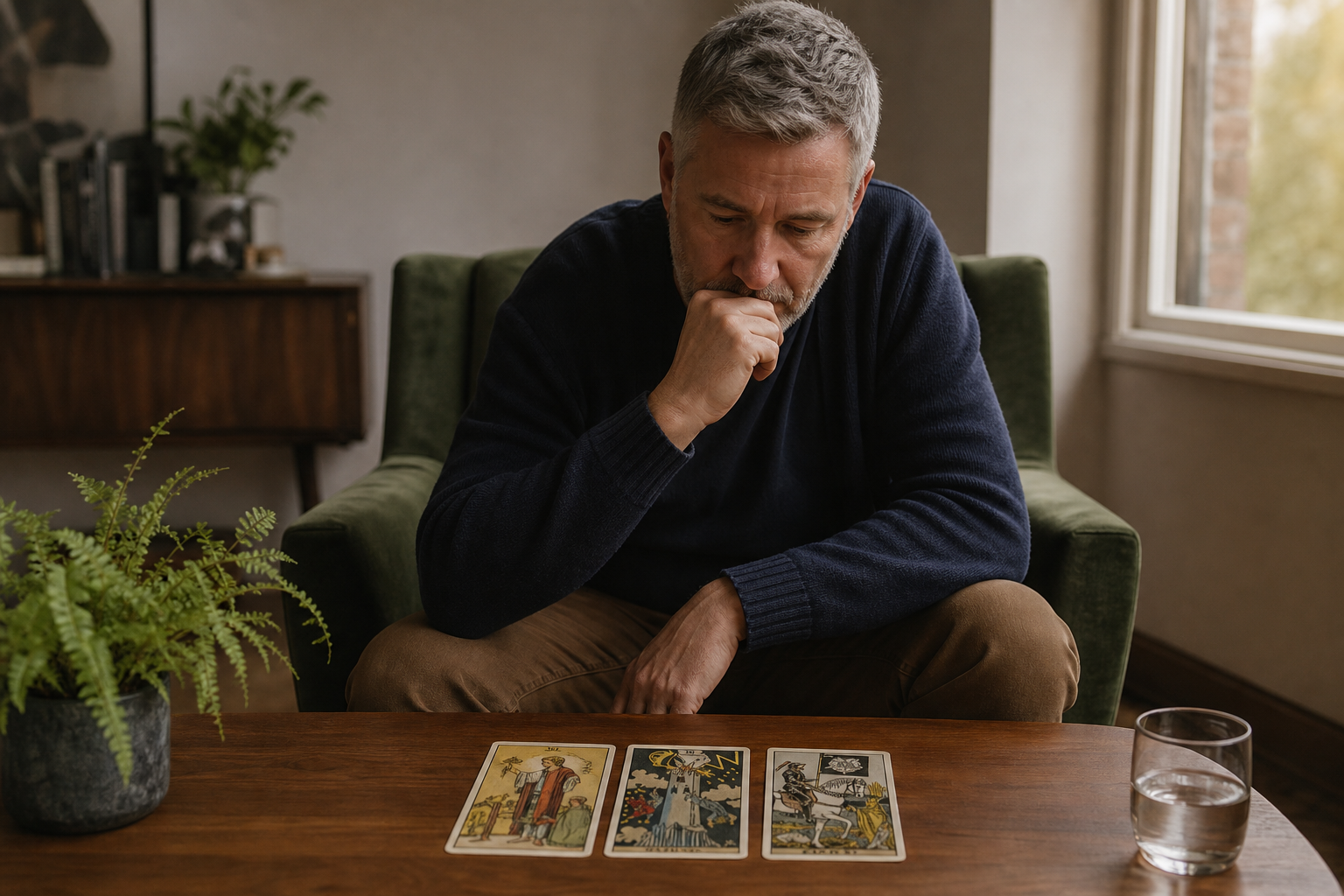
A handful of tarot cards have a reputation for bad news: Death, the Tower, the Devil, the Ten of Swords, the Three of Swords, the Five of Pentacles, the Moon and the Nine of Swords. In the Rider-Waite-Smith tradition, none of them is a sentence. They are images of ordinary human experience, such as endings, sudden change, habits that hold too tightly, grief, hard times, uncertainty and sleepless worry, and every guidebook since 1910 has read them as prompts rather than verdicts. A tarot card cannot predict a death, a breakup, an accident or a diagnosis, and it cannot see into another person’s mind. What a difficult card can do is give a name to something you are already feeling and help you ask a better question about it. This hub explains why these cards earned their reputation, what the tradition actually says about each one, how position and neighbouring cards change the reading, and what to do if a reading frightens you.
Everyone who reads tarot for long enough has the moment: the deck is cut, the card is turned, and there is the skeleton on the white horse. Or the tower in flames. Or the figure lying face down under ten swords. The stomach drops, and a question rushes in before the mind can catch up. Is something terrible about to happen? The honest answer is that a card cannot know, and the tradition behind these images never claimed it could. This page is the hub for difficult cards on tarotreading.co. It is written for the moment after the stomach drops, when a calm explanation is most useful.
Why some cards earned a bad reputation
Tarot began as a trick-taking card game in northern Italy in the 1430s, and for its first few centuries nobody read fortunes with it, as Britannica’s history of tarot explains. The images we now call frightening were part of a parade of allegorical figures in the trump suit: Death rode alongside Love, Fortune, Time and Judgement, as it did in the art and poetry of the period. When fortune-telling conventions were attached to the cards from the late eighteenth century onward, the dramatic images naturally picked up dramatic meanings.
The deck most people use today, drawn by Pamela Colman Smith for Arthur Edward Waite and published in 1909, made the images even more vivid. Smith gave the Minor Arcana full scenes for the first time, so the Ten of Swords stopped being ten blades on a plain background and became a person lying beneath them. The pictures were designed to be memorable, and they are. That is why they can unsettle a beginner. But Waite’s own 1910 guidebook gives every one of these cards a mixed and often hopeful set of meanings, and no serious tradition since has read them as announcements of doom.
There is another reason these cards feel heavy. Films and television use the Death and Tower cards as shorthand for danger because audiences recognise them instantly. That is storytelling, not tarot. In an actual reading, Death turns up in questions about job changes, house moves and finishing degrees far more often than in anything to do with physical death, which the card has never traditionally meant.
What to do in the first minute
When a card frightens you
- PauseLeave the card where it is and take two slow breaths. Nothing in the reading changes while you wait, and the first interpretation that rushes in is rarely the most useful one.
- Describe the pictureSay what is actually in the image, in plain words: a tower, lightning, two people falling, a crown. Describing before interpreting keeps the reading honest.
- Name the themeMatch the image to its traditional theme: ending, sudden change, habit, grief, hardship, uncertainty or worry. Then ask where that theme already exists in your situation.
- Choose one small stepFinish with an action you can take this week, such as a conversation, a decision or a rest. A card that leads to a step has done its job.
A difficult card is a prompt about something already present, not a forecast of something coming.
Eight difficult cards, read calmly
The table below takes the eight cards most often called bad and sets the fear beside the tradition. The first column describes the Rider-Waite-Smith image so you can recognise the card in any deck that follows that design.
| Card and image | What people fear it means | What the tradition actually says | A useful question |
|---|---|---|---|
| Death (XIII). A skeleton in black armour rides a white horse carrying a banner with a white rose; a king lies fallen, a bishop pleads, and the sun rises between two distant towers | Someone is going to die | An ending that makes room for something new: a chapter closing, a role outgrown, a habit laid down. The sunrise in the corner is part of the picture | What in my life has already ended, even if I have not said so out loud? |
| The Tower (XVI). Lightning strikes a tower on a crag, knocking the crown from its top; flames pour from the windows and two figures fall | Disaster, ruin, catastrophe | A sudden change that exposes what was built on weak ground: a belief, a plan or an arrangement that could not hold. Often read as a shock that clears the air | What am I propping up that would be easier to let go of? |
| The Devil (XV). A horned figure sits on a black pedestal above a chained man and woman; the chains around their necks are loose enough to lift off | Evil, temptation, something sinister | Attachment and habit: a pattern, substance, relationship or belief that feels binding but is held in place by choice. The loose chains are the point of the image | Which habit or arrangement am I calling necessary that is actually a choice? |
| Ten of Swords. A figure lies face down with ten swords in his back under a black sky, while dawn breaks over calm water | Betrayal, violence, the worst possible outcome | The end of a painful situation that has run its full course. Readers often say the only way from here is up, pointing to the dawn on the horizon | What has finished so completely that I can finally stop fighting it? |
| Three of Swords. A red heart pierced by three swords against a grey sky and falling rain | Heartbreak, infidelity, a relationship ending | Grief and painful clarity: a truth that hurts to see. The card describes a feeling, not a fact about another person’s behaviour | What truth am I avoiding because it will sting to say it plainly? |
| Five of Pentacles. Two figures, one on crutches, walk through snow past a lit stained-glass window showing five coins | Poverty, illness, being abandoned | A hard patch, and the help that is close by but overlooked. The lit window beside the travellers is the traditional focus of the card | Who or what could I lean on this month that I have not asked? |
| The Moon (XVIII). A moon with a face shines over two towers, a dog and a wolf howl, a crayfish climbs from a pool and a path winds into the hills | Deception, madness, hidden enemies | Uncertainty and imagination: a time when you cannot see clearly and should wait before deciding. Often a prompt to notice fears that have grown in the dark | What am I assuming here that I have not actually checked? |
| Nine of Swords. A person sits up in bed with their head in their hands, nine swords hanging on the wall behind them | Despair, nightmares, something terrible ahead | Worry, especially the three-in-the-morning kind, usually larger than the problem that caused it. The swords are on the wall, not in the bed | What would this worry look like if I wrote it down and looked at it in daylight? |
Read the third column twice and a pattern appears. Every one of these cards describes something that happens to everyone: things end, plans collapse, habits bite, hearts hurt, money runs short, clarity fades and sleep goes. The deck is a map of ordinary experience, and a map needs the hard terrain as well as the pleasant valleys. A tarot deck with no difficult cards would be useless for reflection, because real decisions involve loss and risk.
Why no card is a sentence
Three things stop any tarot card from being a verdict, and it helps to be able to name them when fear says otherwise.
The cards do not know you. Tarot has never been shown to predict events or to read anyone’s mind. A deck of 78 cards shuffled fairly will produce Death about once in every 78 draws whether the person asking is at a funeral or a wedding. The meaning comes from the person reading, matching the image to a situation they already know about. That is useful, in the way that a thoughtful friend asking “what is ending for you right now?” is useful, but it is not foreknowledge. Readers who insist a difficult card foretold something usually remember the hits and forget the misses, a pattern Britannica describes under the Barnum effect.
Position and neighbours change everything. The Tower in a “what to release” position is advice to let a shaky plan fall. The Tower in a “past” position describes a shock you have already survived. The Tower beside the Star, the card that traditionally follows it, is read by most guidebooks as hope after upheaval. A difficult card alone on the table is not a reading; it is one word of a sentence you are still writing.
The images contain their own hope. Smith drew a sunrise into Death, a lit window into the Five of Pentacles, loose chains into the Devil, and dawn into the Ten of Swords. These details were not accidents. The tradition reads them as the way out, included in the same picture as the trouble.
How position changes a difficult card
Use a simple past, present, future, advice and outcome layout to see how the same card shifts. The Five of Pentacles is the example here.
- Past position. A hard stretch you came through, often with less help than you deserved. The question becomes what you learned about asking for support.
- Present position. Money, health or belonging feels thin right now. The card points at the lit window: help you are walking past.
- Challenge position. The fear of being seen as needy is the obstacle. The card asks you to notice that pride is keeping you out in the snow.
- Advice position. Go inside. Call the friend, visit the service, accept the offer. The card is unusually direct here.
- Outcome position. Readers do not treat this as a forecast of poverty. They read it as a reminder that the situation will keep feeling cold until the help is accepted, which is something you control.
Difficult cards in company
Experienced readers rarely interpret a hard card alone. A few traditional pairings show how the surrounding cards shape the meaning.
Tower with the Star. The upheaval has a purpose; calm and renewal follow the shock. This is one of the most hopeful pairs in the deck.
Death with the Six of Wands. An ending that is also a victory, such as leaving a job to start the thing you were always meant to do.
Devil with the Eight of Swords. A habit plus a story about being trapped. Together they usually read as a situation that feels locked but has an exit you have not tested.
Three of Swords with the Six of Cups. Grief tied to the past, perhaps a memory or a relationship that belongs to an earlier time. Readers often take it as a prompt to mourn properly rather than to reopen.
Ten of Swords with the Sun. The worst is over and something plainly good is already visible. Many readers call this the recovery pair.
Nine of Swords with the Four of Swords. Worry and rest side by side: the reading is almost always a direct instruction to sleep, pause and let the swords stay on the wall.
What to do when a reading frightens you
Sometimes the calm explanation does not land, and a reading leaves you shaken. That is a normal reaction to vivid images, and it deserves a plan rather than a shrug.
- Write the question down. Fear usually attaches to a question you did not quite ask. Writing the real question often shrinks the card to its proper size.
- Describe before you interpret. List what is literally in the picture, including the hopeful details: the sunrise, the lit window, the loose chains.
- Check the position and the neighbours. A difficult card in an advice slot, or next to the Star or the Sun, is almost never read as a warning.
- Give it a day. Close the deck and return tomorrow. If the card still feels true, it is pointing at something real in your life that deserves attention, and that is useful information.
- Talk to a person. If the fear is about your health, money, safety or a relationship, the cards cannot answer it. A doctor, an adviser, a counsellor or a trusted friend can.
- Do not keep redrawing until a pleasant card appears. That teaches you to distrust the deck and your own first reaction.
- Do not make a large decision on the strength of one reading. Tarot is for reflection before a decision, not a substitute for one.
- Do not pay anyone to remove a curse, block or negative energy. A reader who says a difficult card shows a curse that can be lifted for a fee is running the most common tarot scam there is. The US Federal Trade Commission explains what to do if you were scammed.
- Do not read for yourself when you are already in crisis. If you are frightened for your safety, or low enough that the Nine of Swords feels like a description of every night, put the cards down and reach a person. In the US you can call or text 988 at any hour.
A gentler way to meet the hard cards
A simple exercise helps many beginners. Take the eight cards from the table out of the deck and lay them face up in a row. Look at each one for a full minute and find the hopeful detail: the rising sun, the lit window, the dawn, the loose chains, the winding path that does reach the hills. Then shuffle them back in. Readers who do this once or twice tend to stop flinching, because the images have become familiar pictures of familiar experiences rather than threats. The cards have not changed. The relationship with them has.
Key takeaways
- Death, the Tower, the Devil, the Ten and Three of Swords, the Five of Pentacles, the Moon and the Nine of Swords describe endings, change, habits, grief, hardship, uncertainty and worry: ordinary parts of life, not verdicts.
- No tarot card predicts death, illness, betrayal or disaster, and no card can see what another person feels or does.
- Position and neighbouring cards change a difficult card completely; read the sentence, not the word.
- Each hard image contains its own hopeful detail, drawn in on purpose.
- If a reading frightens you, pause, describe, name the theme, take one small step, and talk to a person for anything medical, legal, financial or safety-related.
Related reading
- The Tarot Cards You Hope Not to Pull
- What Does the Moon Tarot Card Mean?
- What Do the Sword Cards Mean?
- Tarot and Mental Wellness
- Reading Reversed Tarot Cards
- Are Tarot Cards Dangerous, Bad or Evil?
- Tarot Cards for Beginners
Frequently asked questions
1. Which tarot cards are considered bad?
The cards most often called bad are Death, the Tower, the Devil, the Ten of Swords, the Three of Swords, the Five of Pentacles, the Moon and the Nine of Swords. In the Rider-Waite-Smith tradition they describe endings, change, habits, grief, hardship, uncertainty and worry, not disasters.
2. Does the Death card mean someone will die?
No. The Death card has traditionally meant an ending that makes room for something new, such as a job, a chapter or a habit coming to a close. Tarot cannot predict a death, and the Rider-Waite-Smith image includes a sunrise for that reason.
3. What does the Tower card really mean?
The Tower describes sudden change that exposes something built on weak ground, such as a plan, belief or arrangement that could not hold. Readers usually treat it as a shock that clears the air rather than a catastrophe.
4. Is the Devil card evil?
No. The Devil in tarot is about attachment and habit: something that feels binding but is held in place by choice. The chains in the Rider-Waite-Smith image are loose enough to lift off, which is the traditional point of the card.
5. What does the Ten of Swords mean?
It describes the end of a painful situation that has run its full course. The dawn on the horizon in the image is why most readers say the only way from here is up.
6. Does the Three of Swords mean my partner is cheating?
No. The Three of Swords describes grief and painful clarity, a feeling rather than a fact. A tarot card cannot see another person’s behaviour or intentions, and no reading can confirm infidelity.
7. What does the Five of Pentacles mean?
A hard patch in money, health or belonging, and the help nearby that is being overlooked. The lit church window beside the two travellers is the traditional focus of the card.
8. Is the Moon card a warning about deception?
The Moon describes uncertainty and imagination, a time when you cannot see clearly and should wait before deciding. It often points to fears that have grown in the dark rather than to a real enemy.
9. What does the Nine of Swords mean?
Worry, especially the kind that arrives at night and feels larger than the problem that caused it. In the image the swords hang on the wall, not in the bed, which readers take as a reminder that the fear is bigger than the danger.
10. Can a tarot card predict something bad happening?
No. Tarot has not been shown to predict events or read minds. A difficult card describes a theme that may already be present in your situation and invites a better question about it.
11. What should I do if a tarot reading frightens me?
Pause, describe what is literally in the picture, name the theme, and choose one small step. If the fear is about health, money, safety or a relationship, talk to a professional or a trusted person rather than the cards.
12. Should I redraw if I get a bad card?
It is better not to. Redrawing until a pleasant card appears teaches you to distrust both the deck and your first reaction. Sit with the card, check its position and neighbours, and come back tomorrow if needed.
13. Does the position in a spread change a difficult card?
Yes, completely. The Tower in an advice position suggests letting a shaky plan fall; in a past position it describes a shock you have survived. A difficult card alone is one word, not a sentence.
14. Are reversed bad cards worse?
Usually the opposite. Death reversed is read as change delayed, the Devil reversed as a habit loosening, and the Ten of Swords reversed as recovery beginning. Reversals tend to soften difficult cards.
15. A reader said a bad card shows a curse. Is that true?
No. Curses, blocks and negative energy that can be removed for a fee are the classic tarot scam script. No card shows a curse, and no payment can lift one. If you have paid, the FTC explains what to do next.
16. Why do these cards exist at all if they are not predictions?
Because the deck is a map of ordinary experience, and real decisions involve loss, risk and change. A deck with no difficult cards would be useless for honest reflection.
17. Which cards traditionally soften a difficult card next to them?
The Star after the Tower, the Sun after the Ten of Swords, the Six of Wands with Death and the Four of Swords with the Nine of Swords are common pairings that readers interpret as hope, recovery, victory and rest.
18. Should I read tarot when I am anxious or very low?
It is better to wait. Vivid images land hard when you are already struggling. If low mood or fear is persistent, talk to a doctor or counsellor; in the US you can call or text 988 at any hour.
Evidence note: The card meanings on this page are traditions attached to the Rider-Waite-Smith deck (1909) and the guidebooks that followed it, beginning with A. E. Waite’s 1910 companion volume. They are interpretive conventions, not findings. Tarot has not been shown to predict events or read another person’s mind, and no card can confirm a death, a diagnosis, a betrayal or a financial outcome. Historical points come from Britannica’s entry on tarot and the note on how people remember hits and forget misses from Britannica’s entry on the Barnum effect; the guidance on fee-based curse removal follows the US Federal Trade Commission. If a reading leaves you with persistent low mood or thoughts of self-harm, call or text 988 in the US at any hour.