


The Chariot asks where you want your energy to go—and what it takes to steer without forcing. Its confident figure can feel encouraging when you are ready to move, while its contrasting sphinxes leave room for the wishes, doubts and responsibilities pulling alongside you.
Read the image before you read the outcome
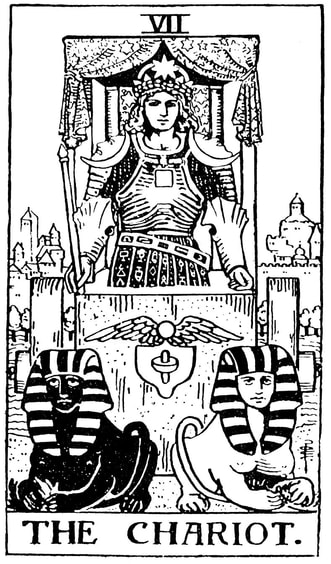
In Pamela Colman Smith’s Rider–Waite–Smith design, an armoured charioteer appears beneath a starry canopy. Two sphinxes rest in front of the vehicle, one dark and one light. A city, towers and a river appear behind the figure. This is not an image of a cart racing uncontrollably down a road.
- The two sphinxes: a useful image for different pulls that need coordination. You might recognise freedom and security, ambition and care, or two priorities asking for attention.
- No visible reins: readers often explore intention and attention here. It is an invitation to consider how you direct yourself, not permission to control someone else.
- The armour and breastplate: possible themes of preparation, protection and boundaries. Ask what helps you act with confidence—and what might make you too rigid.
- The shoulder crescents and star-crowned head: details you can use to explore feeling, awareness and aspiration. Their meanings are not identical in every guidebook.
- The canopy and front emblems: stars above the figure, with a winged disc and smaller emblem on the vehicle, give the scene a ceremonial character. Notice the actual design before assigning each mark a message.
- The city and river: a wider setting beyond the immediate task. You might reflect on what you are leaving, what still supports you and where you hope to go.
In A. E. Waite’s account, mental triumph is a central theme. Contemporary readings may emphasise self-direction, a journey or bringing conflicting needs together. These are interpretive traditions, not one meaning the picture must deliver. Other decks may use horses, different figures or an entirely new scene.
Upright: choose a course and work with it
Upright, The Chariot can invite a shift from considering every possibility to giving a chosen direction some structure. An application, a difficult conversation, a move or a creative project may need one clear next step. Spiritually, you might read it as aligning intention with action rather than waiting for every uncertainty to disappear.
The traditional language of determination and victory can be motivating. It should not become “if I want this enough, I cannot lose.” Other people’s choices, resources and circumstances still matter. A setback is not evidence that you lacked willpower or spiritual worth.
In a present position, ask how your effort is organised now. As advice, explore a plan or boundary. In a future or outcome position, read progress as a possible direction to work toward—not a guaranteed event or deadline. For the wider sequence, see the Fool’s Journey.
Reversed: adjust the direction, the load or the pace
Reversed, the same image can bring attention to scattered effort, conflicting demands or the feeling that someone else is deciding where you should go. You may be pushing toward an old goal that no longer fits, or trying to do too much without enough support.
The sphinxes do not literally begin walking in circles when the card is turned over. That is a metaphor a reader might use, not a change in the drawing. A gentler interpretation is to pause, clarify the destination and decide what can reasonably wait.
You do not have to use reversals. Some readers explore difficulty through spread position or surrounding cards instead. Our guide to reversed tarot cards explains different approaches. Quiet companions such as the Four of Swords, The Star or The Hermit can also invite reflection or a rest in an interpretive reading; they do not diagnose your health.
Love: shared direction is not one person steering
For a couple, The Chariot can prompt a conversation about what moving forward means to each person. Living together, a joint move or a shared project needs agreement on pace and responsibilities. Initiative is useful when it makes space for an answer, not when it turns into pressure.
If you are single, the card can help you name what you want before reacting to whoever appears. Reversed, ask whether competing wishes or another person’s urgency are setting the pace. A reading does not establish someone’s love, faithfulness or intention to return; respect consent and boundaries.
If a relationship involves fear, control or threats, seek support rather than using a card to justify confrontation. In the US, the National Domestic Violence Hotline is available at 1-800-799-7233 or by texting START to 88788. In immediate danger, contact 911 or your local emergency service.
Career, money and travel: give the theme a practical check
At work, you might use The Chariot to focus a job search, launch, application or project. Ask what success would look like, what you can actually do and what support is missing. A reversed reading might invite a smaller scope or a clearer strategy—not a verdict that your career is failing.
For money, consider the habits and decisions within your control: reviewing spending, comparing actual costs or following a realistic plan. A card cannot establish that an investment will pay off, a loan will be approved or money is on its way. Take significant debt, tax, investment or contract questions to an appropriately qualified professional.
Travel, vehicles and relocation are familiar Chariot themes, including the commute or working arrangements around a new role. Let them prompt planning, not certainty about a departure or outcome. Check real bookings, terms and arrangements. If you are still choosing between paths, start with the hard-decisions guide.
A steering check: direction, competing need, next step
Place The Chariot face up as a theme card. If you want a short spread, draw three cards for the questions below. You can also answer them in a journal without drawing any more cards.
-
Name a direction you value
“What do I want to move toward, and is it my choice?” Choose one manageable focus for the week, rather than a result that depends entirely on someone else.
-
Include the competing need
“What other pull deserves a place in the plan?” Name your two sphinxes—perhaps security and freedom, or speed and care. Identify a fact, cost or conversation you still need to check.
-
Choose an action and a stopping point
“What is one step within my control?” Set a workable pace, including a rest or review point. Afterwards, write two lines: what moved, and what stalled.
Example: a job search pulling in two directions
Suppose you want more interesting work but also need dependable hours. The reading need not tell you to abandon either need. A first step could be checking three role descriptions for both responsibilities and working patterns, then deciding which employer questions to ask. That is a clearer use of determination than sending applications until you are exhausted.
Read any extra card beside the question it answers, then set the deck down. For another concrete decision exercise, try the five-card choice spread.
Possible pairings: how the emphasis can change
These examples combine card themes; they do not imply that these pairings occur more often or predict a specific event.
- The Chariot + Strength
- Commitment with courage and patience. Ask how to stay purposeful without becoming forceful. In Rider–Waite–Smith order, Strength VIII follows The Chariot VII.
- The Chariot + Eight of Wands
- Direction meeting a theme of speed or communication. Consider what needs preparation, but do not assume news or travel will arrive on a schedule.
- The Chariot + Two of Swords
- A wish to move alongside a difficult choice. Clarify what information or boundary would help instead of forcing an immediate answer.
- The Chariot + Seven of Cups
- Many possibilities competing for attention. Narrow the question and compare a few realistic options.
Keep exploring
Compare purposeful action with the resourcefulness of The Magician. If you are learning the deck, return to tarot for beginners.
Frequently asked questions
1. What does the Chariot card mean in tarot?
The Chariot commonly represents direction, willpower, focus and self-control. It can invite you to bring competing needs into a workable plan. Traditional victory imagery is part of its symbolism, not a promise that determination will produce a particular result.
2. What number is the Chariot card?
It is numbered VII, or 7, in the usual Major Arcana sequence. In Rider–Waite–Smith ordering it comes after The Lovers VI and before Strength VIII. If you count The Fool 0 as the first card, The Chariot is the eighth card in that count.
3. Why are there two sphinxes on the Chariot card?
The contrasting sphinxes are often read as opposing pulls: freedom and security, speed and care, or different wants within one situation. You can use the image to ask how those needs might work together. They do not have one compulsory meaning in every reading.
4. Why does the charioteer have no reins?
No reins are visible in the Rider–Waite–Smith drawing. Readers often use this detail to explore attention, intention or self-direction rather than pulling harder. It is a symbolic reading, not a claim that real vehicles or animals are controlled by thought.
5. What does the Chariot mean reversed?
Common readings include scattered effort, a stalled plan, uncertainty about direction or pushing beyond a workable pace. A reversal can also invite a pause. It does not diagnose burnout, prove failure or literally change the sphinxes into moving figures.
6. Is the Chariot a yes or no card?
Some readers lean toward yes when a question concerns a considered step forward. Treat that as a convention rather than a guarantee or a test of how hard you work. Ask what conditions, resources and limits the answer would need to include.
7. What does the Chariot mean in a love reading?
It can frame shared direction, initiative and the pace of a relationship. Reversed, it may prompt questions about conflicting wishes or one person setting the pace. Mutual agreement matters; the card does not establish anyone’s feelings, faithfulness or future choices.
8. Does the Chariot mean travel?
Travel, vehicles and relocation are familiar themes in readings of The Chariot. They can help you reflect on a journey or change of setting, but do not confirm a booking, departure, arrival or safe outcome. Check the actual arrangements independently.
9. Which zodiac sign is linked to the Chariot?
The Golden Dawn system associates The Chariot with Cancer, a Water sign in that astrological tradition. These are symbolic correspondences rather than findings about people born under Cancer. Other decks may follow a different system or omit astrology.
10. What does the Chariot mean as a daily card?
Try choosing one manageable priority and noticing what pulls you away from it. Write down one action within your control and a sensible stopping point. At the end of the day, review what happened without treating the card as a score of your performance.
11. What does the Chariot mean in a career reading?
It can focus a reading on a job search, project, application or change of direction. Reversed, consider whether the aim, resources or workload need adjustment. A card is not evidence that a promotion, contract or financial outcome is assured.
12. Is the Chariot a good card to pull?
It can feel encouraging when you want a clear direction. It can also raise a useful challenge about control, competing demands or overexertion. Its usefulness depends on the question it helps you explore, not whether it labels your future as good or bad.
13. How is the Chariot different from Strength?
The Chariot often highlights direction, determination and coordinating effort. Strength often highlights courage, patience and a gentler relationship with difficult feelings or impulses. Read together, they can ask how to stay committed without becoming forceful or rigid.
14. How does the Chariot’s spread position change the reading?
In the present, explore how you are directing effort now. As advice, consider a plan or boundary. In a challenge position, examine conflicting demands or overcontrol. In a future or outcome position, treat progress as a possible theme, not a fixed event or deadline.
15. What is a simple exercise for working with the Chariot?
Place The Chariot face up and draw three cards: the direction I value, the competing need to include, and one manageable next step. Note what you can check in real life, choose a pace and stopping point, then review what moved and what stalled.
While I appreciate the depth of analysis on the Chariot card, let’s remember it’s still just one card in an entire deck. Don’t get too carried away folks – life is complex, and no single card holds all the answers.
I have to argue that relying on cards to make life decisions is not exactly wise. Don’t you think it’s better to consult real-life experts rather than a deck of cards?
@DebateMaster While I see your point, Tarot reading can be complementary to expert advice. It’s about introspection and considering different perspectives, not replacing professional guidance.
Very informative! It’s interesting how the Chariot card carries different meanings when upright and reversed. It seems like a useful tool for self-reflection and decision-making.
“Take control of your destiny,” they say, as if my destiny isn’t already being a couch potato watching reruns all weekend. Thanks for the laugh, Chariot.
‘Mastering opposing forces’, huh? If only the Chariot could help me balance my checkbook and diet at the same time.
I have my doubts about Tarot readings, but I can’t deny that the psychological aspect of feeling empowered by a card like the Chariot is intriguing. Maybe there’s something to this after all.
Did anyone else picture themselves as an ancient charioteer charging into battle after reading this? No? Just me then… alrighty!
Absolutely enlightening article! The Chariot has always resonated with me, and this deep dive just reaffirmed its importance in my tarot practice. Cheers to overcoming obstacles!