


Major Arcana · Card I
The Magician asks what you can do with the tools in front of you. Upright, it brings skill, focused intention and communication into the reading. Reversed, it invites a closer look at scattered effort, unused ability or persuasion that has lost its honesty.
If you approach tarot as a spiritual practice, this can be a meaningful card of bringing inner purpose into everyday life. Its most useful question is not simply “Will I get what I want?” but “What can I responsibly put into motion?”
- Place in the deck
- I, Major Arcana; follows The Fool, usually numbered 0
- Upright themes
- Skill, focus, initiative, resourcefulness and clear speech
- Reversed themes
- Distraction, self-doubt, underused skills or misleading presentation
- Astrological tradition
- Mercury in the Golden Dawn system; correspondences vary by deck
- Yes or no?
- Often an encouraging yes in modern readings, with practical conditions—not a guaranteed outcome
The Magician’s image and its symbols
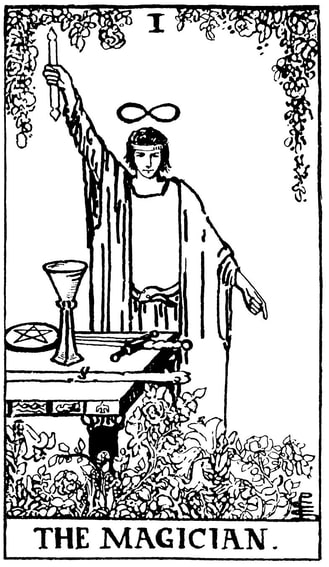
In Pamela Colman Smith’s Rider–Waite–Smith design, a figure stands at a table between a garden below and flowers overhead. The posture links inspiration with a task that can actually be carried out. Notice what the picture shows first, then consider what those details mean to you.
- Raised wand and pointing hand: a connection between above and below. Readers often associate the gesture with “as above, so below,” or an intention taking physical form.
- Four suit tools: cup, sword, wand and pentacle. They give the card a vocabulary for feeling, thought, drive and practical resources.
- Infinity sign: a sideways figure eight, also called a lemniscate. It can suggest continuity, possibility and sustained attention—not a literal supply of unlimited personal energy.
- Snake belt: the serpent closes a circle around the waist. This is commonly read as a symbol of continuity or renewal.
- Red mantle and white robe: in the coloured card, readers often connect these with active will and clarity of intention.
- Roses and lilies: desire and aspiration can be cultivated rather than left as wishes. The garden gives the work a living, growing quality.
A. E. Waite’s original account of the card gives the gesture and suit emblems a spiritual interpretation. Modern practical readings draw on that image in different ways; they need not reproduce every part of his esoteric system.
In the older Marseille pattern, the figure is Le Bateleur, a performer or conjuror at a table. That provides a useful second lens: the same skill can create something worthwhile or put on a convincing show. Your deck’s guidebook can help you distinguish its particular image from the Rider–Waite–Smith version.
Upright: put a real ability to use
The upright Magician encourages deliberate participation. You might already have a useful skill, a supportive contact, a draft, a small budget or enough knowledge to attempt a first version. You do not need to pretend that every resource is available. Naming a genuine gap is as valuable as recognising a strength.
In a reading about work or a creative project, the card can prompt you to demonstrate rather than endlessly describe your capability. For a conversation, it may ask you to make a clear request instead of hoping someone guesses what you need. Its Mercury association supports themes of communication, learning and exchange within that tarot tradition.
Let the spread position shape the message
- Present: what influence or ability can you use now?
- Advice: which one skill would move this situation forward?
- Obstacle: are you overpromising, overpreparing or relying on presentation instead of substance?
- Possible direction: what might develop if you use your resources consistently, while allowing for other people’s choices and outside circumstances?
Reversed: find the break between intention and action
A reversed Magician does not have to mean deception. It may describe a good idea split across too many tasks, a skill you have not practised, or a plan whose first step is still vague. Before labelling yourself unmotivated, ask whether time, money, access, support or rest is missing.
Try distinguishing three situations: I have the skill but no focus; I have the aim but need training; or I have the words but not the follow-through. Each needs a different response. Reducing the task, asking for help or testing a small version can be more useful than pushing harder.
The sharper interpretation is influence used without honesty. If a persuasive offer or relationship is your concern, examine observable behaviour, terms and promises. A card does not establish that someone is manipulative. Pressure to pay for removing a curse or a supposed spiritual block is a reason to stop and seek independent support, not buy another reading to check the threat. If you have already paid a suspected scammer, the FTC’s recovery guidance explains practical next steps.
You can also read reversals as blocked, internal or overextended energy. Choose your approach before the draw instead of changing it to force a preferred answer.
The Magician in love and relationships
Upright, the card can bring charm, initiative and honest expression into a love reading. If you are single, consider showing a genuine interest or making a respectful invitation. Confidence is useful when it leaves room for the other person’s answer; it is not a technique for producing attraction.
For an established relationship, turn a wish into something both people can discuss: “Could we plan an evening together?” is more workable than expecting a partner to recognise an unspoken need. The Magician may highlight what you can offer, but it cannot establish that a relationship already has everything it needs.
Reversed, explore a mismatch between words and actions, including your own. Ask what was actually agreed and what followed. The card cannot confirm a partner’s private feelings, infidelity or a destined reunion. If control, fear or threats are present, prioritise real support: in the US, the National Domestic Violence Hotline is available at 800-799-7233 or by texting START to 88788. For immediate danger, contact emergency services.
The Magician in career and money questions
For career questions, this is a useful symbol for applying a skill: making a portfolio sample, rehearsing an interview answer, clarifying a service or starting a manageable project. Explain what you can deliver and where you still need experience. Clear limits strengthen a proposal more than an impressive promise you cannot keep.
For money questions, use the four tools to separate enthusiasm from the numbers. What will the project cost? What time and materials are available? What do the written terms say? Reversed, the card may prompt a review of scattered efforts or a polished pitch, but it does not identify an investment as safe or unsafe. For debt, tax or investment decisions, use actual records and appropriately qualified advice. Our guide to money and career questions with tarot can help you frame the reflective part.
A four-tool resource check
Choose one ordinary situation you can influence. Write a short answer for each tool. List what is available and what is missing; the exercise is an inventory, not a test of how spiritually capable you are.
Cup · support and feeling
Ask: why does this matter, and who could support me?
Example: I enjoy making illustrations; a friend can give feedback on one draft.
Sword · knowledge and clarity
Ask: what do I know, and what must I check?
Example: I know the drawing software; I need the submission dimensions and deadline.
Wand · energy and initiative
Ask: what amount of effort can I realistically sustain?
Example: I can set aside two short sessions this week, not every evening.
Pentacle · time and materials
Ask: what practical resources or limits shape the next step?
Example: I have a working laptop and a free tool; no new purchase is needed for the sample.
Turn the inventory into one finished step
- Name one aim. “I will finish a small illustration sample,” rather than “I will transform my whole career.”
- Use one tool first. Check the brief, ask for feedback or prepare the workspace—whichever removes the real obstacle.
- Make the action visible. Put a short session in your calendar and define what “done” will look like.
- Check the honesty. Are you describing your skills accurately, respecting consent and keeping promises proportionate to what you can do?
- Review in a week. Record what you tried, what happened and what you need next. Adjust the plan without treating a setback as spiritual failure.
For the illustration example, the first action could be “Open a correctly sized file and sketch one rough layout on Tuesday.” That is small enough to assess. The Magician becomes a prompt for practice, not a demand that a positive mindset overcome every obstacle.
Reading The Magician with other cards
These are possible conversations between symbols, not claims that certain cards appear together more often. Read them in the context of your question and spread positions.
- With the Ace of Wands
- A spark meets the skill to give it form. Ask what first experiment would test the idea.
- With The High Priestess
- Action meets listening. What needs to be understood before it is announced or acted on? Explore The High Priestess’s symbolism alongside the Magician’s more outward gesture.
- With the Seven of Swords
- Consider strategy, privacy and honesty. Check an agreement or your own motives rather than concluding that someone is lying.
- With The Chariot
- Tools meet direction. Which goal is worth steering toward, and what pace can you sustain? The Chariot guide’s steering exercise develops that next question.
Where to go next
- Follow the 22 Major Arcana through The Fool’s Journey.
- Compare The Magician’s prepared tools with The Fool’s open beginning.
- Use the beginner’s guide to practise a consistent reading routine.
Frequently asked questions
1. What does The Magician card mean in tarot?
In a Rider–Waite–Smith reading, The Magician commonly represents skill, focused intention, communication and using resources. It invites you to turn an idea into a responsible action while recognising what you still need.
2. Is The Magician a positive card?
It is usually encouraging because it highlights agency and ability. That does not make every plan workable or put every outcome under your control. Effort, honesty, access to resources and outside circumstances still matter.
3. What does The Magician mean reversed?
A reversal may suggest scattered attention, underused ability, a missing practical step or a gap between a promise and delivery. Some readers consider manipulation, but the card alone cannot establish that someone is dishonest.
4. What does The Magician mean in a love reading?
It can encourage honest expression, a respectful invitation or a shared practical plan. Reversed, it may prompt a check on words and actions. It cannot confirm another person’s private feelings, infidelity or a guaranteed reunion.
5. What does The Magician mean for career and money?
For career questions, consider demonstrating a skill, clarifying a proposal or starting a manageable project. For money, inventory time, costs and materials. Tarot can organise reflection, but actual accounts, terms and qualified advice must inform financial decisions.
6. Does The Magician mean yes or no?
Many modern readers treat it as an encouraging yes, especially for taking initiative. A useful follow-up is to ask what preparation, consent or resources the next step requires. The card does not verify that a future event will happen.
7. What do the four objects on The Magician’s table mean?
The cup, sword, wand and pentacle represent the four Minor Arcana suits. A practical reading connects them with feeling and support, thought and clarity, energy and initiative, and material resources. They are prompts to inventory your situation, not proof that nothing is missing.
8. What does the infinity sign above The Magician mean?
The sideways figure eight is a lemniscate, commonly associated with continuity and possibility. Together with the circular snake belt, it can suggest sustained spiritual or creative practice. It does not mean you have unlimited energy or should ignore rest.
9. What does The Magician mean as a person?
It may describe someone articulate, resourceful and practised in a skill, including you. A reversed interpretation can raise questions about presentation or follow-through. Evaluate a real person through their behaviour rather than assigning a character verdict from a card.
10. Does The Magician mean manifestation?
Some modern readers use manifestation to describe aligning intention, attention and action. You can honour the spiritual meaning while checking practical needs and limits. Thoughts or rituals do not establish control over other people, chance or every external circumstance.
11. Which planet or element is linked to The Magician?
The Golden Dawn correspondence assigns The Magician to Mercury, associated symbolically with communication and exchange. Some modern systems also connect the card with Air, but that is not a universal elemental assignment. Follow the system used by your particular deck.
12. How is The Magician different from The High Priestess?
The Magician often emphasises outward expression, application and making a first move. The High Priestess often invites listening, inward attention and allowing something to remain unspoken. Together they can ask what needs understanding before action.
13. What if The Magician keeps appearing in my readings?
Review the question, spread position and practical theme you have recorded each time. You might be returning to an unfinished idea or a recurring issue of confidence and follow-through. Repetition alone does not prove a message or require you to draw until the card changes.
14. Do I have to read a reversed Magician?
No. Some readers use reversals; others read the full range of a card’s possibilities upright and use spread positions for context. Choose a consistent approach before drawing and consult the guidebook if your deck recommends a specific method.
15. What is a simple exercise for The Magician?
Choose one manageable aim. List support, knowledge, available energy, and practical resources under cup, sword, wand and pentacle. Name one missing piece, schedule one concrete action and review what happened in a week. Keep the plan honest and small enough to assess.
Absolutely love this breakdown of the Magician card! It’s so detailed and really captures the essence of its meaning. Tarot has always fascinated me, and articles like this make it accessible to everyone. Kudos to the writer!
Interesting article, but you didn’t mention that in some traditions, the Magician is associated with the trickster archetype, adding another layer of interpretation.
@Redbull That’s a great point! The trickster aspect reminds us that while the Magician has power, they must be mindful not to be deceptive or manipulative in their pursuits.
This hit me right in the feels! I pulled the Magician card last week and have been feeling so inspired to start my own business. This article feels like a sign that I’m on the right path!
Hahaha! ‘The power to create your reality’? If only it were as simple as pulling a card out of a deck! I’d be creating myself a reality where articles like this don’t exist!
As an astrologer, I appreciate how you linked the Magician card with Mercury – it’s all about communication and intellect! Your insights add depth to my understanding of how Tarot cards can complement astrology.
@article This is just superstitious nonsense. Cards can’t tell you anything about your life or your future.
Oh Tarzan, looks like someone needs a little magic in their life! The cards might just surprise you with their insight if you gave them a chance.
@Tarzan While you’re entitled to your skepticism, many find guidance and introspection through Tarot. It’s not about predicting the future but about reflecting on one’s life.
Ironically, for a card that signifies action and manifestation, this post has made me reflect more than act. Not sure if that was your intention… but thanks for the paradoxical push towards introspection?
I’m sorry, but I think this article is oversimplifying a complex subject. The interpretations can vary widely depending on context, and we shouldn’t ignore how different decks might portray the Magician.