

A pause at the turning of the year. A Samhain tarot reading can be a warm, intentional way to notice what you have gathered, what is changing and what you want to carry forward. There is room for gratitude, remembrance, uncertainty and rest—not just a list of things to release.
The seven-card Turn of the Year spread below is a contemporary reflective layout, with a five-card alternative and a journal practice. Use it within your spiritual beliefs without asking the cards to settle your future or speak with certainty for someone else.
Samhain, Halloween and a modern tarot practice
Samhain is a Gaelic seasonal festival associated with the beginning of winter. In the Irish calendar it falls on 1 November, with festivities on the preceding evening, 31 October. The National Museum of Ireland describes traditions of remembrance, feasting, games and divination around the date. Heritage Ireland explores the folklore of a threshold between the lighter and darker parts of the year.
Halloween takes its name from All Hallows’ Eve, before the Christian feast of All Saints. Seasonal folklore, Christian observances and later customs have intertwined histories; they are not all the same celebration. Contemporary pagans may honour Samhain as a spiritual turn of the year, while other readers use the season for a personal review.
This particular spread is not an ancient Gaelic ritual. Tarot’s early history belongs to fifteenth-century Italian card games, as the Metropolitan Museum of Art explains; the Britannica overview offers further background. You do not need to claim an unbroken ancient tarot tradition to find a seasonal practice meaningful.
The seven-card Turn of the Year spread
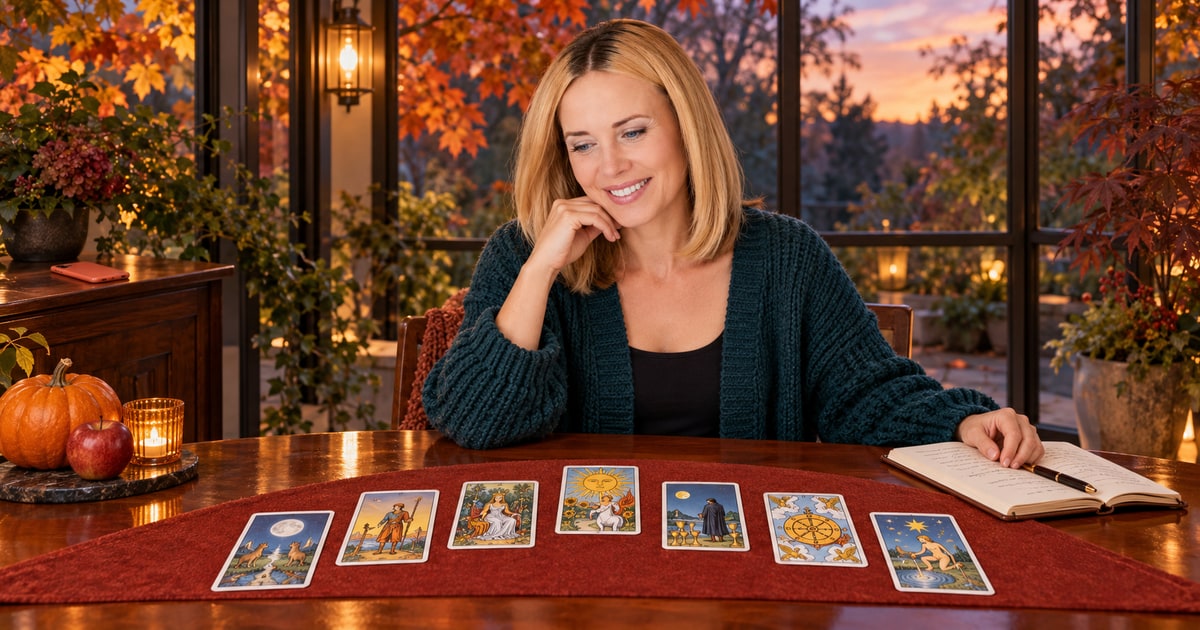
Begin with: “What would I like to understand as this cycle turns?” Choose whether you will read reversals, then shuffle in a way that suits you. Place seven cards from left to right in a shallow arch, with 1 at the far left and 7 at the far right. A straight row works too if space is limited; the positions matter more than the curve.
Read from 1 to 7. The middle card is slightly higher in the arch; the outer cards sit lower.
- 1
- 2
- 3
- 4
- 5
- 6
- 7
Use the numbered prompts below. These are spread positions, not specific cards you need to find in your deck.
1. The harvest
What did I grow, gain or learn during this cycle?
Include effort that went unseen, help you received and what you learned from a disappointment. This is not a test of whether the year was successful enough.
2. The stubble
What has ended, and what might I be ready to put down?
Stubble is what remains after a harvest. Notice an ending without making yourself release a relationship, memory or grief on a deadline.
3. The lantern
Who or what from the past still offers me guidance?
You might remember a loved one, teacher, place or value. Name a memory you actually have, then explore what the card brings to mind.
4. The seed
What interest or possibility would I like to give time?
Consider something that needs rest, practice or a gentler pace. Dormancy is a useful seasonal metaphor, not a promise that a particular future is waiting.
5. The shadow
What concern could I acknowledge gently, with support if needed?
Choose a manageable question. You do not have to uncover a secret, revisit painful experiences or push through distress to complete the spread.
6. The hearth
What person, place or routine could support me in the coming months?
Look for support you can access rather than assuming home or family feels safe. A friend, community space or small daily routine may fit better.
7. The threshold
What intention would I like to carry into the next cycle?
Choose something within your influence: a boundary, a conversation, a practice or a pause. This card is not a forecast or a command.
Look at the pairs before choosing an intention
1 + 2: gather and release
What belongs in your account of the year, and what no longer needs the same place in your life? Not every ending needs an immediate decision.
3 + 4: carry and nurture
Which memory or value could support something you want to grow? Keep a meaningful connection without assuming the cards identify a message from another person.
5 + 6: concern and support
What would make a difficult reflection more manageable? Support can come before exploration; you do not have to face everything alone.
Return to 7 after exploring those pairs. Let the threshold be a sentence you choose, not an instruction you have to obey. If the reading points toward a real decision, our guide to tarot for hard decisions can help you keep options and practical information alongside the symbolism.
A five-card version, with clear numbering
For a shorter reading, leave out lantern and seed, then renumber the remaining prompts 1 through 5. There is no required duration. This version can also work with friends, provided everyone may pass or keep their reflections private.
- 1. HarvestFull-spread position 1
- 2. StubbleFull-spread position 2
- 3. ShadowFull-spread position 5
- 4. HearthFull-spread position 6
- 5. ThresholdFull-spread position 7
Draw five cards for a new short reading. If you are simply shortening a seven-card reading already laid out, you can keep the cards in full-spread positions 1, 2, 5, 6 and 7; note that choice in your journal so the numbering stays clear.
Worked example: finding your footing after a job change
This is an imagined practice example. A reader feels unsettled after changing jobs and asks what could help at the turn of the year. The cards below become questions to explore, not facts established about the reader’s life.
- 1. Harvest: Eight of PentaclesWhich skill have I practised this year, and what example shows that progress? The card prompts a review; it does not establish that every hour of effort paid off.
- 2. Stubble: Six of Cups reversedAm I comparing the new workplace with an idealised memory of the old one? Keep room for both genuine good memories and reasons the change happened.
- 3. Lantern: The HierophantWhat useful standard or lesson do I remember from a teacher or mentor? I can choose which guidance still fits rather than accepting an authority unquestioningly.
- 4. Seed: Ace of CupsIs there an emotional or creative interest I would like to make room for? I can name a possibility without promising a new friendship or relationship.
- 5. Shadow: Five of PentaclesDo I feel excluded, or do I need practical support? Those are different questions. I can check what has actually happened and ask for help where appropriate.
- 6. Hearth: Ten of CupsWhere do I experience welcome or belonging? If home is not restful, another person, place or community may be a better source of support.
- 7. Threshold: StrengthWhat would patient self-respect look like this month? One possible intention is to allow time for learning and ask one clear question when I need help.
One possible next step is to write down an actual skill gained and one question to ask at work. Another is to arrange time with someone who feels supportive. Neither action requires deciding that the cards uncovered the cause of the unsettled feeling. For more reflection on memory and change, see understanding your past with tarot.
Keep a record you can return to
A seasonal reading can become more useful when you preserve the original question and interpretation, including the parts that remain unclear.
- Record the setting. Write the date, deck, question and whether you chose seven or five positions. Note your approach to reversals.
- List the complete draw. Record every card before settling on an interpretation. A photo of the layout can be useful if you want to return later.
- Give each position one sentence. Use your own words and the position’s question. Keep “this reminds me of…” separate from “this happened.”
- Notice a response, if one stands out. Write about a surprise, a comfort or an uncertainty. There does not have to be a dramatic revelation.
- Choose a manageable intention. Turn the threshold card into something you can try or check, not a promise about the coming year. A deliberate pause is also a choice.
- Choose your own review date. Return in a few weeks or at a meaningful seasonal marker. If you observe Imbolc in early February, it can be an optional checkpoint, not a deadline.
Set the evening up for comfort, not performance
- Make the cards easy to see. Use a clear surface and enough light. A candle is optional; an LED candle or ordinary lamp is equally suitable.
- Use accessible tools. A familiar deck may feel welcoming, but a new deck with a guidebook is not forbidden. You do not need smoke, crystals or special purchases.
- Add seasonal touches only if you want them. An apple, a simple meal or a remembered story may be enough. Keep food, drinks and flames away from the cards.
- Agree on boundaries if sharing. No one needs to explain a private memory or accept another person’s interpretation.
- Close in an ordinary way. Put the deck away, extinguish any flame safely and return to something that helps you feel present.
Ritual objects can carry personal or religious meaning. They do not create a payment obligation or make a threatening claim true. Be cautious if someone says that a card proves a curse or that urgent, escalating payments are necessary to protect you. The US Postal Inspection Service explains these pressure patterns. You can keep your spiritual interests and decline a pressured sale.
Make remembrance gentle
If the lantern position feels meaningful, you might recall a person’s words, a shared habit or a value you want to keep. Some readers understand this through spiritual beliefs about ancestors; a card is not independent confirmation of a particular message from the dead.
You can change the prompt, draw fewer cards, or stop. Grief does not have to be released before the year turns. Our tarot and mental wellness guide explores keeping reflection supportive; the NHS offers information about grief and support if coping feels difficult. In the United States, call or text 988 for suicidal crisis or emotional distress; call 911 for immediate life-threatening danger. NIMH lists ways to get help.
Frequently asked questions
1. When is Samhain?
It is traditionally associated with 1 November and its eve, 31 October, in the Irish seasonal calendar. Contemporary observances vary; some people in the Southern Hemisphere choose late April or early May to follow their local autumn.
2. Is Samhain the same as Halloween?
They are connected but not identical. Samhain belongs to Gaelic seasonal traditions; Halloween’s name comes from All Hallows’ Eve, before All Saints’ Day. The customs have layered histories, so it is too simple to describe every Halloween practice as an unchanged ancient Samhain ritual.
3. Do I have to be pagan to use this spread?
No. You can use these prompts as a seasonal reflection without adopting a religious identity. If Samhain is not part of your practice, call it a Turn of the Year or autumn reflection and acknowledge where its themes come from.
4. Can a Samhain reading contact someone who has died?
Some spiritual readers understand remembrance readings through beliefs about ancestors or spirit. Tarot is not an independently verified way to establish a message from a particular deceased person. You can explore a meaningful memory without treating a card as proof of what that person wants you to do.
5. How many cards does the spread use?
Seven in the full version. The shorter version uses five, in this order: harvest, stubble, shadow, hearth and threshold. You can also choose one gentle prompt rather than complete either layout.
6. Must I read exactly on 31 October?
No. Choose a day that fits your practice, energy and local season. A quieter evening before or after the festival can be more useful than forcing a reading into a busy date.
7. Which deck should I use?
Choose a deck whose images and guidebook feel accessible to you. The example uses Rider-Waite-Smith-style meanings, but another tarot deck is fine. There is no special Samhain deck requirement, and you can keep a guidebook nearby.
8. Should I use reversed cards?
Use them if they are part of your normal method, or decide beforehand to read the cards upright. Reversals do not automatically make a seasonal reading darker, more spiritual or more accurate.
9. Do I need sage, crystals or incense?
No. You only need your cards, enough space and light to see them, and a way to keep notes if you wish. Follow your own traditions if you use ritual objects, but you do not need to purchase a cleansing or protection item to be allowed to read.
10. Can the spread predict my next year?
Treat it as a way to explore themes and intentions, not establish future events. The threshold position asks what you choose to carry forward. Revisit the record later alongside what actually happened, rather than reshaping every event to fit it.
11. Can I do this with friends?
Yes, if everyone wants to participate. The five-card version is convenient: each person can draw their own cards and share only what they choose. Agree that anyone may pass, and do not tell someone what a deceased relative supposedly demands of them.
12. What if many cards feel difficult?
Read each image with its position and your circumstances rather than treating the collection as a warning. Death, the Tower or the Ten of Swords do not establish that harm is coming, or that a particular event has already ended. You can stop instead of drawing repeatedly for reassurance.
13. How do I journal the reading?
Record the question, date, deck and full draw. Add a sentence for each position, separate observations from interpretations, and choose a small intention or pause. Pick a review date that works for you and leave room for the reading not to fit later events.
14. What if the reading brings up grief?
Pause or end the reading, and reach out to someone you trust if that feels helpful. There is no requirement to find a message or finish the spread. If grief is affecting daily life or you are struggling to cope, seek appropriate support; you do not have to resolve the card meaning first.
15. Can I change the remembrance position?
Yes. You can ask what value, place or lesson you want to remember, rather than focusing on someone who died. You can also skip that card or use the five-card version. Changing the prompt to care for yourself does not spoil the reading.
Carry one thing forward
You do not have to solve the coming year in one evening. Keep a memory, recognise an effort, choose a manageable intention, or let the reading remain unfinished. A seasonal practice can be meaningful without certainty.
If you enjoy marking meaningful dates with the cards, our World Tarot Day guide offers another occasion for a personal practice.