
Quick guide
The Queen of Swords in the Rider-Waite-Smith deck is a queen seated in profile, holding her sword straight up in one hand and raising the other hand open, as if inviting someone to speak. Her throne is carved with butterflies and a cherub, clouds gather beneath her, and a single bird flies overhead. Upright, the traditional keywords are clarity, honesty, independence, sharp perception and fair judgement. Reversed, readers talk about coldness, bitterness, harsh criticism, or a mind so guarded that nobody is let close. Like every court card, she can be a person, a role you are playing, or the mood of a situation. A useful question is how to recognise what you know, listen to what you feel and ask directly about what remains uncertain.
- Arcana and suit
- Minor Arcana · Queen court card · Swords
- Upright themes
- Clarity, honesty, independence, perception, boundaries and fair judgement
- Reversed themes
- Harsh words, guardedness, overthinking or judgement coloured by an old hurt
- Element and astrology
- Air. In the Golden Dawn framework: Water of Air, spanning 20° Virgo to 20° Libra. Some readers simplify this to Libra; deck conventions vary.
- Yes or no
- Reader-dependent. One approach treats her as a conditional yes when a plan can withstand honest questions, rather than a fixed answer.
The title Queen does not require you to assign this card to a woman. It can describe a quality, role or approach for a person of any gender. Our guide to reading court cards explores that flexibility.
The image and its symbols
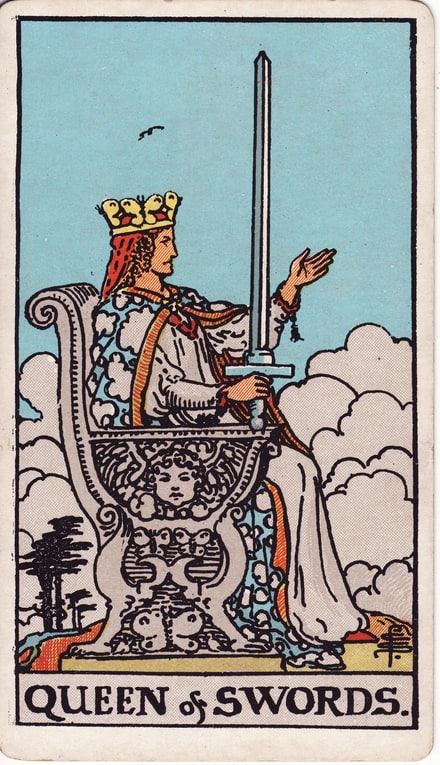
Pamela Colman Smith’s Rider–Waite–Smith image places the Queen in profile on a stone throne. Her right hand holds the sword upright, while her left arm extends with an open hand. Butterflies, a winged child’s head, a cloud-patterned cloak and a single bird give you several details to explore.
In Waite’s original description, her expression carries the weight of sorrow. His historical meanings include bereavement and separation. Those associations can explain the card’s reputation, but drawing her is not a prediction that you will lose someone.
One helpful symbolic reading brings two gestures together: the upright sword suggests clear discernment, and the open hand leaves room to listen. Butterflies may suggest change, while the bird and sky can evoke perspective. These are interpretations of the image, not a fixed code that every deck must follow.
If you use astrological correspondences, Liber LXXVIII’s Golden Dawn-based scheme assigns this Queen to 20° Virgo through 20° Libra and calls her Water of Air. That is more specific than saying she is simply a Libra card, and it does not identify a person’s birth sign or character.
Upright meaning
Upright, the Queen of Swords is traditionally read as clear thinking under pressure. As a person she is the friend who tells you the truth kindly, the manager who separates the problem from the personalities, the mentor who has been through loss and come out with sharper judgement rather than resentment. As a role, the card suggests stepping back from a tangle of feelings to look at the facts, saying plainly what you need, and setting a boundary without apologising for it. As a mood, she describes a day when your mind is clear, your words are precise, and you can hear hard news without flinching.
Position shapes the reading. In a past position she can describe a decision made with the head rather than the heart, and perhaps a loss that taught you to think this way. In a present position she is often read as advice to gather information before you act, and to ask direct questions rather than guessing at motives. In a future or outcome position, you might explore what would help you reach greater clarity: a direct conversation, a document to check or an unanswered question. The card does not promise a favourable verdict or tell you what another person is thinking; it can describe the quality of attention you want to bring.
Reversed meaning
Reversed, the Queen’s sharpness can be explored as blocked or used too forcefully: words that wound, judgement coloured by an old hurt, or a protective distance that no longer feels helpful. This is a pattern to consider, not a verdict that someone is cold or a bad person. Waite’s reversed keywords were malice, bigotry, artifice and deceit, which describe intelligence used without honesty. A softer modern reading is simply overthinking: the Queen reversed can be a person who analyses every message until the meaning is lost.
In practice the reversed card asks three questions. Are you being honest, or just harsh? Has a past hurt become the lens through which you judge everyone new? Is there a safe way to acknowledge what you feel as well as what you think? If the person the card describes is somebody else, the useful response is to notice patterns rather than to diagnose. For ordinary relationship communication, the Gottman Institute distinguishes criticism of someone’s character from a complaint about a specific issue. Its guide to the four horsemen describes criticism, contempt, defensiveness and stonewalling. A card is not a test for these patterns; look at what is actually happening.
In a love reading
In a relationship reading, the Queen of Swords upright is usually read as honesty and independence inside a partnership: two people who say what they mean, keep their own interests and friendships, and respect each other’s judgement. She can also describe the stage after a hard conversation, when the air has cleared and both people know where they stand. For someone single, readers often interpret the card as knowing exactly what you want and being unwilling to settle, or as advice to use what past relationships taught you without carrying their bitterness forward. Historical guidebooks tied her to widowhood and separation. You can acknowledge that history without treating it as a rule for someone’s relationship status or future.
Reversed in a love question, the card tends to point to coldness, cutting remarks, keeping score, or a partner who has withdrawn behind a wall of logic. These are prompts for reflection, not conclusions about a person. A direct conversation may help where it is safe and appropriate. A tarot card cannot tell you whether someone loves you, whether they are faithful, or when they will commit. If you are experiencing intimidation, threats or controlling behaviour, prioritise support and safety rather than trying to resolve it through a card reading. In the United States, the National Domestic Violence Hotline offers support at 1-800-799-7233 or by texting START to 88788. Call 911 for immediate danger; outside the US, use your local emergency or support service.
For more ways to keep a relationship question centred on your choices, explore our guide to love tarot readings.
In a career or money reading
At work, the Queen of Swords is traditionally read as the clear communicator: the person who writes the honest report, chairs the difficult meeting, or gives feedback that is direct but fair. Readers link her to roles in law, editing, research, analysis, medicine and management, and to any situation where the job is to see clearly and say so. In a job-search reading she can be advice to present your experience plainly and to ask the interviewer the questions that matter.
With money, the Queen of Swords is usually read as decisions made from the numbers rather than from hope or fear: reading the contract, checking the fees, asking the awkward question before you sign. Reversed, she can describe money decisions driven by resentment, such as spending to prove a point, or analysis that goes on so long that the opportunity passes. The card is useful for listing what you actually know about a financial choice and what you are assuming; a suitably qualified financial professional can help assess the actual figures and circumstances. The hub on understanding finances with tarot explains how to keep money spreads practical.
How to work with this card
The Queen’s sword and open hand make a useful pair: be precise without shutting down curiosity. Try this short journal exercise before a conversation or decision.
- Separate observation from interpretation. Write one thing you directly know, then the story you have attached to it. “They requested a revision” is different from “They think I am incapable.”
- Name the feeling. Hurt, fear or frustration can tell you what matters. You do not need to deny the feeling or treat it as proof of the other person’s intention.
- Ask the direct question. Identify the missing information and whom you could safely ask. You do not have to confront someone who makes you feel unsafe.
- Check the edge of your words. Keep the actual request and remove phrases whose only purpose is to wound. Directness and kindness can sit in the same sentence.
- Keep one boundary and one opening. Decide what you need to protect and what you are willing to hear. Notice whether an old hurt is influencing the present situation without blaming yourself for having it.
A clearer way to put it
- Observation
- “My draft came back with several revision requests.”
- Feeling
- “I feel discouraged and uncertain about the expectations.”
- Question
- “Which two changes should I prioritise, and what would a finished version need to do?”
This imagined work example turns a judgement about someone’s motives into a question you can actually ask. The card supports the reflection; it does not establish why the feedback was given.
Cards that often appear with it
With the Ace of Swords, readers traditionally see a breakthrough in understanding: a truth stated once and clearly. With the Three of Swords, the Queen is often read as someone who has lived through heartbreak and is using the lesson well, or, reversed, as someone who cannot put the hurt down. Paired with Justice, she can prompt a closer look at fairness, responsibilities and the documents behind a decision. This pairing cannot predict a legal verdict; use qualified legal advice for an actual dispute. With the High Priestess, many readers see two kinds of knowing side by side, the analytical and the intuitive, and the prompt is to use both. These pairings are conventions, not rules.
Key takeaways
- The Queen of Swords shows a queen in profile with an upright sword and an open hand, and is traditionally read as clarity, honesty and independent judgement.
- As a court card she can be a person, a role you need to take, or the mood of a situation.
- Reversed, she raises questions about coldness, harsh words, bitterness and overthinking.
- In love she points to honest, independent partnership; at work she is the clear communicator. She cannot reveal another person’s feelings or guarantee an outcome.
- Use her as a prompt to separate what you know from what you fear, and to say the true thing kindly.
Related reading
- What do the Sword cards mean?
- Reading the tarot court cards
- King of Wands tarot card meaning
- High Priestess tarot card meaning
- Tarot cards for beginners
Frequently asked questions
1. What does the Queen of Swords mean?
In the Rider-Waite-Smith tradition the Queen of Swords means clarity and honesty: seeing a situation as it is, saying so plainly, and judging fairly.
2. What does the Queen of Swords card show?
A queen seated in profile holds an upright sword in one hand and raises the other hand open. Butterflies and a cherub decorate her throne, clouds gather below her, and a single bird flies above.
3. Is the Queen of Swords a person or a situation?
Either. A court card can be explored as a person, a role, an approach or the mood of a situation. The spread position and your question help you choose a useful interpretation; they do not establish a fact about someone else.
4. Is the Queen of Swords a yes or no card?
There is no universal yes or no assignment. One approach reads her as a conditional yes when a plan can withstand honest questions. Another uses her to ask what information is missing rather than give a binary answer.
5. What does the Queen of Swords reversed mean?
Readers may explore harsh words, guardedness, overthinking or judgement coloured by an old hurt. Reversal is not proof that a person is cruel or dishonest. Ask whether clarity is blocked, excessive or difficult to express.
6. What does the Queen of Swords mean in love?
Upright she is traditionally read as honesty and independence within a relationship, or as knowing what you want when single. She cannot tell you what a specific person feels.
7. Does the Queen of Swords mean a woman?
Not necessarily. Readers use her for a person of any gender who thinks clearly and speaks directly, or for that quality in yourself.
8. What does the Queen of Swords mean in a career reading?
She is commonly linked to clear communication, fair feedback, analytical work and roles where honesty matters, such as law, research, editing and management.
9. What zodiac sign is the Queen of Swords?
In a Golden Dawn-based correspondence system she spans 20° Virgo to 20° Libra and is Water of Air. Some readers simplify this to Libra, while decks may use other conventions. The card does not reveal a person’s birth sign.
10. Why is the Queen of Swords linked with sorrow?
Waite’s historical description connects her expression with sorrow and lists bereavement and separation among the meanings. Modern readers may explore experience gained through loss without treating the card as a prediction of loss.
11. Which cards combine well with the Queen of Swords?
Readers may explore the Ace of Swords as clear communication, Justice as fairness and responsibility, the High Priestess as intuition alongside analysis, and the Three of Swords as making sense of hurt. These are possible combinations, not guaranteed outcomes.
12. What should I do after pulling the Queen of Swords?
Write what you directly know, name what you feel, identify what you are assuming and choose one question you could safely ask. Plan to communicate honestly without using your words to wound.
13. Can the Queen of Swords reveal someone’s feelings?
No card can establish another person’s private feelings or intentions. You can use the Queen to reflect on communication, boundaries and the information you need, then consider what the person actually says and does.
14. How does the spread position change her meaning?
In the past, you might explore an earlier decision or lesson. In the present, consider clear communication and boundaries. In an outcome position, ask what could support greater clarity rather than assuming a particular answer will arrive.
15. What is a useful journal prompt for this card?
Try: “What do I know, what do I feel, what am I assuming, and what can I ask directly?” Keep the four answers separate so that clarity includes your feelings without treating them as proof about someone else.
This article provides an informative look at the suit of swords and its connection to air signs. However, it would benefit from more examples or case studies on how these meanings manifest in real-world scenarios.
Honestly, this post feels a bit superficial. While the descriptions of the Queen of Swords are nice, they lack depth and practical application. Tarot should go beyond mere definitions; it needs to connect with real-life experiences.
Did anyone else find it amusing that the Queen of Swords is said to be cold yet protective? 😂 It’s like saying a lion is cuddly! This card sounds like it needs some serious emotional support!
‘The Queen of Swords will guide you.’ Great! I could use her help with my finances! If only she’d actually show up with some solid investment tips instead of vague advice about being logical! 💸
‘Make choices based on knowledge!’ Such profound wisdom 🙃. What’s next? A card telling us to eat healthy? It would be nice if these tarot cards had more realistic guidance instead of lofty ideals.
Exactly! It’s like every other self-help advice out there—easier said than done! Sometimes you just need a friend who understands rather than a card that says ‘be wise.’ 😂
I absolutely loved this article! The insights about the Queen of Swords are so enlightening. It’s refreshing to see a focus on wisdom and intelligence in tarot readings. 🌟 I can’t wait to apply this knowledge in my next reading!
I find it ironic that tarot readings aim for wisdom but often lead people down emotional rabbit holes. Why base decisions on cards when life is far more complicated? 🤔 Let’s not forget: emotions matter too!
‘Use logic over emotions’ – wow, what groundbreaking advice! 🙄 Next, they’ll tell us to breathe air or drink water. Let’s get real; feelings play a big role in our decisions no matter what the cards say.