


Judgement is the moment a familiar story asks for a different response. Its trumpet can feel like an inner calling: an invitation to see what has changed, own what matters and begin again with greater awareness.
The image: a call to rise
In Pamela Colman Smith’s Rider–Waite–Smith design, an angel sounds a bannered trumpet above figures rising from open tombs. A foreground group and more figures beyond them answer with raised arms. Water and distant mountains give the scene a wider horizon.
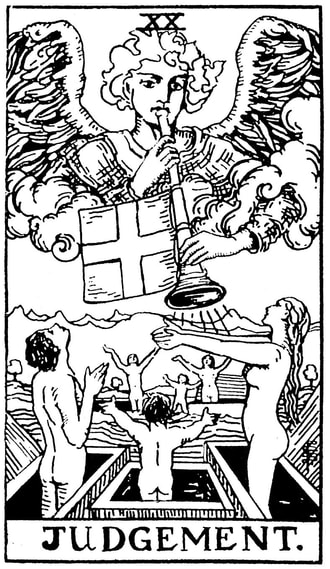
The picture draws on Last Judgment and resurrection imagery. In A. E. Waite’s account, the transformation is also answered inwardly. That gives the card room for spiritual awakening as well as everyday reflection.
- The angel and trumpet
- A summons, a realisation or something asking for your attention.
- The rising figures
- Renewal and a response to what has been heard—not simply punishment.
- The open tombs
- A way to explore what has felt finished, buried or ready to be reconsidered.
- The banner and cross
- Part of the scene’s religious symbolism; they need not be reduced to a single personal message.
- The water
- You might associate it with feeling or memory. That is a reflective interpretation, not a required meaning.
- The mountains
- A possible prompt to step back and see a longer chapter rather than one difficult moment.
These associations are reading possibilities. Your deck may alter the scene entirely. Compare the image and its guidebook before carrying a meaning from one deck into another. The Golden Dawn’s Book T gives Judgement the Shin and Fire correspondence; later planetary overlays are a separate layer of interpretation.
Upright and reversed: review without condemning yourself
Upright: recognise and respond
Upright Judgement can describe recognising that a conversation, apology or change deserves attention. You may feel a calling toward a more truthful way of living. It can be a relief to name something you have avoided, even when you do not yet know the whole answer.
Ask: “What have I learned, and what response fits the person I want to be now?”
Reversed: listen more gently
Reversed Judgement can turn the review inward. Are you dismissing a genuine wish, replaying an old mistake, or being asked to decide without enough information? Sometimes the helpful reading is “not yet,” with a clear next check rather than indefinite delay.
Ask: “Do I need courage, more information, or a kinder standard?”
The reversed card is the same image turned upside down; the figures do not literally change their actions. In an advice position, explore how you might respond. In a challenge position, consider self-criticism or avoidance. In an outcome position, renewal is a possible theme—not proof that facing an issue will automatically resolve it.
Judgement comes just before The World in the usual Major Arcana order. In the teaching story of the Fool’s Journey, this can be the review before a cycle closes. It is not a timetable you have to follow.
Love: what would a fresh start need?
For a couple, Judgement can bring attention to a conversation that keeps circling: commitment, a changed need, or an old hurt that has not been addressed. A second chance is one possible theme, but a meaningful restart needs consent, accountability and changed behaviour—not just the hope that the past will disappear.
If you are single or thinking about an ex, ask what the old relationship taught you and what boundaries you would keep now. The card does not establish whether someone misses you, is faithful or plans to return. You do not owe anyone renewed contact or forgiveness because a card appears.
If there is fear, control or threats, seek support rather than confronting someone because of a reading. In the US, the National Domestic Violence Hotline is available at 1-800-799-7233 or by texting START to 88788. In immediate danger, contact 911 or your local emergency service.
Career and money: turn the review into a question
At work, Judgement may frame an appraisal, a project review or a growing wish for more meaningful work. Try separating the calling from the plan: “I want to teach” is a different statement from “I can afford this course and know what qualification it provides.” Ask about the real requirements before committing.
With money, the theme can be facing statements, costs and commitments so you can make a plan. It does not establish that a loan, promotion or investment will succeed. Use actual figures and qualified advice for significant commitments. For a practical way to compare paths, try our five-card choice spread or the wider hard-decisions guide.
A three-card review for a new chapter
Place Judgement face up as a theme card. Shuffle the rest of the deck and draw three cards. This is an optional reflective exercise; there is no correct result to produce.
-
1. Review
What part of the story deserves an honest look?
-
2. Respond
What response is within my control?
-
3. Renew
What could support a more workable next chapter?
Example: returning to study
You might read the Eight of Pentacles as a wish to develop a skill, the Queen of Swords as a need for clear information, and Temperance as a prompt to pace the workload. A practical next step could be asking the course provider about entry requirements and study hours—not assuming the cards have approved enrolment or predicted a career.
Five ways to put the reading to work
- Name the call. Finish “Something asking for my attention is…” You do not have to pretend you already know the answer.
- Review fairly. Note what helped and what you would change. Balance responsibility with recognition of what was outside your control.
- Set a checkpoint. Decide what information you need and when you can reasonably revisit the question. Respect real deadlines.
- Clarify once, if useful. Draw a card for what would help you respond, then write your interpretation rather than drawing until reassured.
- Practise compassion. Write what you would say to a friend in the same position. Forgiving yourself can coexist with making amends.
If the exercise turns into distress or relentless self-criticism, put the deck aside and reach out to someone supportive. In the US, you can call or text 988 for emotional or crisis support.
Possible card pairings
These are ways to combine themes, not claims that these cards occur together more frequently.
- Judgement + Death
- An ending followed by a response to change. Ask what is ending and what you can begin doing differently.
- Judgement + The World
- Review and completion. Consider what would make a chapter feel genuinely complete rather than merely over.
- Judgement + Six of Cups
- A past memory, reunion theme or familiar pattern. Ask what belongs in the present and what can remain a memory.
- Judgement + Eight of Cups
- Recognition that something no longer fits. Check what leaving would require instead of treating it as an instruction to walk away.
- Judgement + Ace of Wands
- Renewal meeting a new spark. Choose a small, testable beginning rather than committing everything at once.
Keep exploring
For uncertainty and perspective, compare The Moon; for pacing and integration, read Temperance. If you are still building a practice, start with tarot for beginners.
Frequently asked questions
1. What does the Judgement tarot card mean?
Judgement commonly represents awakening, honest review, a calling and renewal. It invites you to look at a chapter of your life, recognise what you have learned and choose how to respond. Its spiritual meaning need not be a harsh verdict on your worth.
2. Is Judgement a good card to pull?
It can be encouraging when you are ready for clarity or a fresh start. It may also bring up uncomfortable questions about responsibility or unfinished business. Read it with the question and surrounding cards rather than assuming it guarantees a positive result.
3. What does Judgement mean reversed?
Common interpretations include self-doubt, harsh self-criticism, avoidance or a review that is not finished. It can suggest an inner process rather than an outward change. Ask what information, support or time you need instead of treating the reversal as failure.
4. What does Judgement mean in a love reading?
It can suggest reviewing a relationship honestly, addressing an old pattern or considering a fresh start. A second chance needs willing participation and meaningful change. The card does not establish another person’s feelings, faithfulness or intentions.
5. Does Judgement mean someone from my past will return?
Reunion is one possible symbolic theme, not a promise that someone will contact you. A more useful question is what would need to change for renewed contact to be welcome. Respect the other person’s choices and your own boundaries.
6. What does Judgement mean for career and money?
At work it can frame a review, a change of direction or a desire for meaningful work. With money it can prompt you to face the figures and plan. Check actual terms and costs; a card is not evidence that a promotion, loan or investment will succeed.
7. Is Judgement a yes or no card?
Some readers lean toward yes for a considered fresh start, or not yet when reversed. This is a reading convention, not a fixed answer. Keep the reasons, conditions and practical checks that a simple yes or no would leave out.
8. What is the difference between Judgement and Justice?
In the Rider–Waite–Smith sequence, Justice XI emphasises fairness, balance and accountability. Judgement XX emphasises a wider review, awakening and a response to a calling. Their themes can overlap; neither card predicts a court decision.
9. Which astrological sign goes with Judgement?
In the Golden Dawn correspondence system, Judgement is linked to Shin and Fire rather than a zodiac sign. Some modern tarot systems add Pluto. These are different symbolic frameworks, so follow the system used by your deck rather than treating one association as universal.
10. Why do the figures on Judgement look grey in many decks?
In many Rider–Waite–Smith colourings, the muted figures belong to the resurrection scene: people rising from tombs. Readers may explore renewal or a past chapter through that image. A particular skin colour does not have one compulsory interpretation, and other decks redraw the scene.
11. Where does Judgement sit in the Fool’s Journey?
Judgement is numbered XX, or 20, and comes immediately before The World XXI in the usual sequence. With The Fool numbered 0, it is the twenty-first card if you count from The Fool. The Fool’s Journey is a teaching story used to explore that sequence.
12. Does Judgement predict a court case or legal result?
Do not treat it as evidence of a verdict, deadline or legal outcome. You can use its review theme to organise questions and documents, but take the actual legal issue to a qualified legal professional and check official notices.
13. How does its spread position change the reading?
As advice, it may invite review or a considered response. In a challenge position, explore self-criticism or avoidance. In an outcome position, read renewal as a possible theme to work toward, not a guaranteed event or proof that all difficulties will resolve.
14. What if I keep pulling Judgement?
Record the question, context and what the card brings to mind before drawing again. Look for a useful recurring concern rather than assuming you are being commanded or punished. If repeated readings increase distress, take a break and return to ordinary sources of support.
15. What is a simple spread to use with Judgement?
Place Judgement face up as a theme card, then draw three cards: what to review, what response is within your control, and what could support renewal. Write one practical next step. The spread is an optional exercise, not a test you can pass or fail.
“The integration of symbolic elements associated with transformation within this discussion enriches our understanding further.” Each symbol—the trumpet-blowing angel or rising figures—conveys profound messages regarding self-realization and cleansing processes necessary for rebirths we experience throughout life cycles; these are especially relevant during moments when one feels overwhelmed by regret or guilt from past actions.
This reaffirms my belief that tarot can serve not just as divination tools but also as catalysts for meaningful conversations about mental health and wellness.
“Judgement” indeed serves as a pivotal reminder about the importance of self-forgiveness and liberation from past burdens across various domains—be it love, career, or finances. The text eloquently captures how confronting one’s history allows for genuine renewal; this concept is vital in today’s society where people often carry emotional baggage without recognizing its weight. Moreover, embracing change through introspection can lead individuals towards more fulfilling lives while instilling a sense of purpose as they navigate new paths forged by previous experiences.
The discussion surrounding financial readings in relation to the Judgement card presents a refreshing perspective on financial responsibility intertwined with personal development. The call for informed decision-making rather than impulsive spending resonates strongly with current economic realities where many face financial uncertainty. By advocating for a ‘clean slate’ approach, this interpretation encourages readers not only to assess their financial habits critically but also promotes long-term planning aligned with personal values—a vital lesson given today’s fast-paced consumer culture.
I find the symbolism presented in the Judgement card particularly thought-provoking. The imagery of rising figures and an angelic presence invokes powerful themes of awakening and accountability. It suggests that we are all called to confront our past decisions and their impact on our present circumstances. This card seems to resonate deeply during periods of significant life transitions, making it relevant for those at crossroads in their lives. It invites individuals not only to seek forgiveness from themselves but also to embrace opportunities for growth that come from introspection.
The exploration of the Judgement tarot card is quite enlightening, particularly in its relation to personal transformation. It is intriguing how this card encapsulates the idea of resurrection and self-awareness, emphasizing that every individual has the capacity for renewal. The connection to Pluto as a symbol of deep transformation adds a layer of complexity to its interpretation. I appreciate the notion that past mistakes should not be viewed with shame but rather as stepping stones toward personal growth. It encourages an honest reflection on one’s life choices, which is a critical aspect of evolving as individuals.
I appreciate the detailed examination of how the Judgement card functions within relationship dynamics. It highlights an essential truth about self-awareness in partnerships—understanding oneself is crucial before seeking harmony with others. This notion can often be overlooked in discussions about love and relationships; however, it emphasizes that genuine connection requires both individuals to confront their pasts together and foster an environment conducive to growth. Such insights can undoubtedly guide readers toward healthier relational patterns.
“This article succinctly articulates how integral self-awareness is when interpreting tarot cards like Judgement in different contexts.” I particularly resonate with your analysis regarding career transitions prompted by this card’s appearance—it underscores that our professional journeys should align closely with our core values and aspirations rather than merely serving economic ends. The encouragement to pursue vocations that resonate deeply reinforces an essential ethos: work should ideally be an extension of one’s identity rather than just a means to an end.
The insights provided on how to interpret the Judgement card across different contexts—past, present, and future—are commendable. This nuanced approach allows for a more comprehensive understanding of its implications in various aspects of life, whether personal or professional. The emphasis on viewing challenges as opportunities for learning aligns well with contemporary psychological perspectives on resilience and growth mindset. It’s fascinating how the lessons from tarot can parallel psychological principles, encouraging individuals to move beyond guilt towards proactive change.