

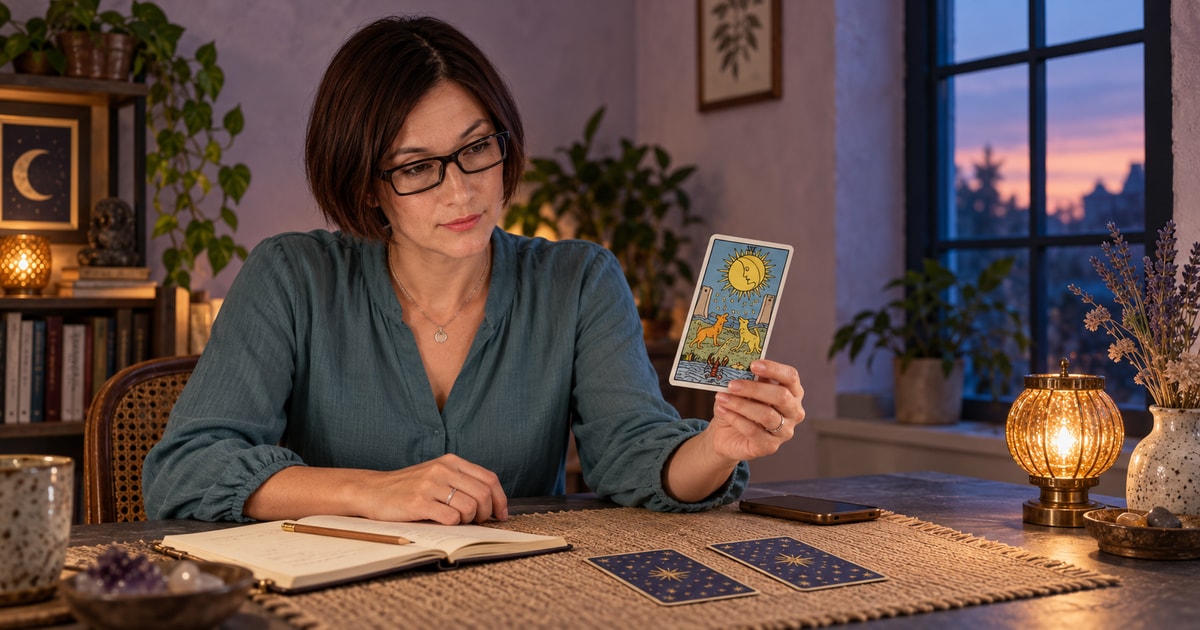
The Moon is the card of a half-lit question. You may feel something strongly without being able to see the whole situation. In a tarot reading, its invitation is to listen carefully—to your intuition, your imagination and the information in front of you—without rushing to make them say the same thing.
This guide follows the Rider–Waite–Smith Moon: the dog and wolf, the crayfish, and the path between two towers. Other decks may tell the story differently. Start with the image in your own hands.
- Number and family
- XVIII (18), Major Arcana; no suit
- Upright themes
- Uncertainty, intuition, imagination, dreams and fear
- Reversed possibilities
- Confusion easing, a concern named, or uncertainty still unresolved
- Astrological tradition
- Pisces in the Golden Dawn system; a water-sign association
- Yes/no approach
- Unclear: identify what is missing before choosing
- Useful question
- What do I know, what do I sense, and what can I check?
Read the picture before the keywords
The Moon’s scene gives you four useful places to begin. Move from what you can actually see on the card to a possible meaning, then to a question about your own situation. The illustration below locates the features; the descriptions that follow explain how to work with them. Reflect, then check what you know.
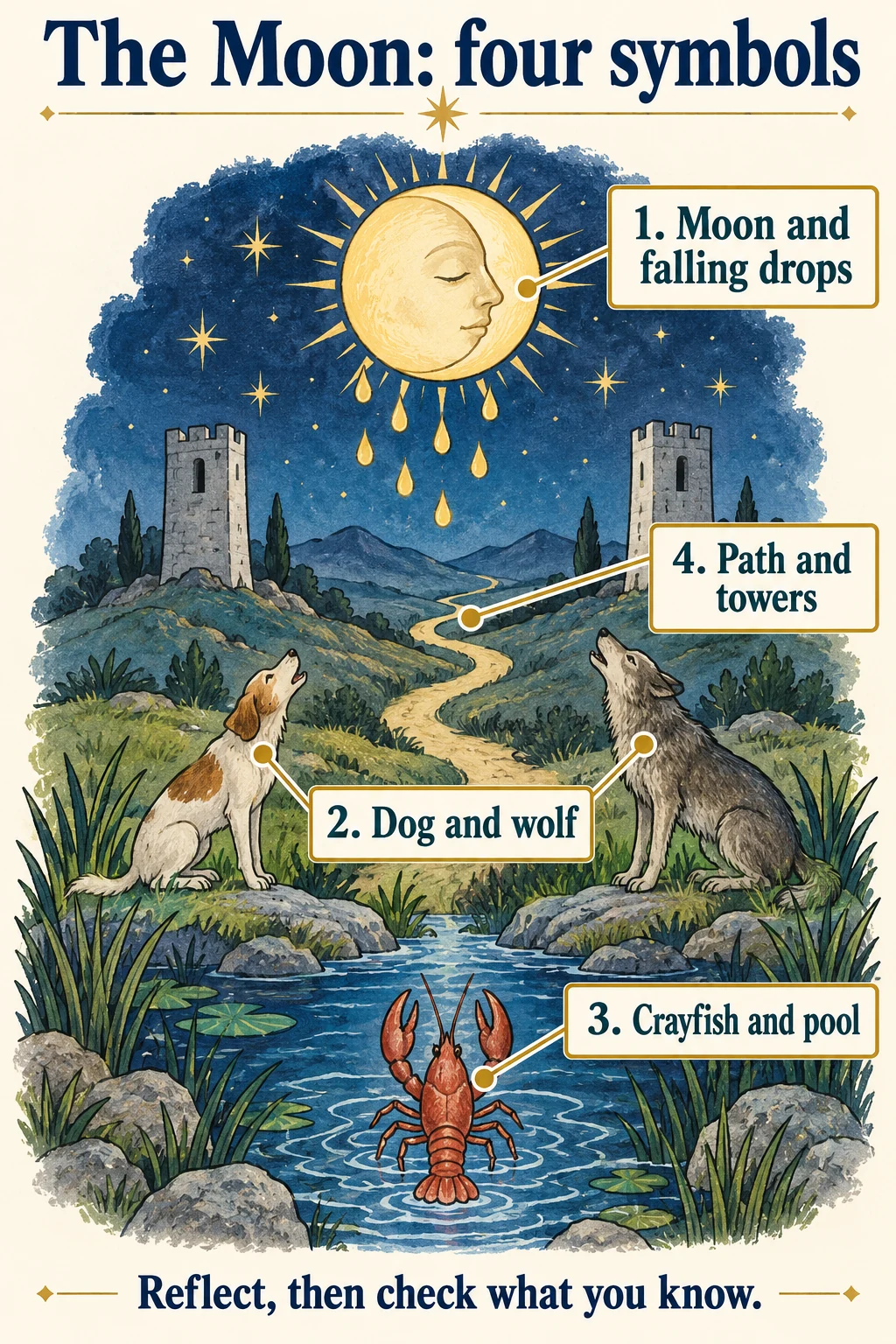
1. Moon and falling drops
A face looks down from the moon above the landscape; small drops fall beneath it. Waite called these the “dew of thought.” Reflected light offers an image for insight that is meaningful but incomplete.
Ask: What am I noticing, and what might I be adding to the picture?
2. Dog and wolf
A domestic dog and a wild wolf both turn toward the moon. One way to read them is as familiar, trained responses beside instinctive reactions. Neither animal needs to be treated as the enemy.
Ask: Which response feels familiar, and which feels raw or unexpected?
3. Crayfish and pool
A crayfish emerges from water at the foot of the card. Readers may connect it with a feeling, memory or instinct coming into awareness. This is a symbolic lens, not a claim that a card has recovered a hidden memory.
Ask: What feeling can I name without deciding its cause yet?
4. Path and towers
A winding path passes between two towers toward distant hills. The scene suggests a passage into the unknown, not an instruction to walk into danger or ignore a clear warning.
Ask: What is one small next step I can take with enough information?
Upright and reversed: two ways into the question
Upright: stay with the question
The Moon can describe waiting for news, feeling unsure after a conversation, or having a powerful impression that is difficult to explain. In a spiritual reading, you might work with it as an invitation to listen inwardly, notice symbols and allow an answer to develop. You do not have to turn every impression into an immediate conclusion.
Its creative side matters too. A dream, sketch, poem or remembered image can give shape to something you have not found words for. Record it as an experience that matters to you; leave room for more than one interpretation.
In a past–present–future spread, read the position as a lens: an earlier uncertain period, the ambiguity you are sitting with now, or a possible area needing clarification. A future position is not a fixed event or a deadline.
Reversed: ask what has actually changed
Some contemporary readers interpret the reversed Moon as confusion easing: a worry becomes speakable, an assumption is corrected, or information arrives. Others read it as uncertainty turned inward, a concern being avoided, or difficulty trusting your own perception. Neither direction automatically means everything is now fine.
Try the question: “What is clearer than it was, and what remains unconfirmed?” If nothing has changed outside the reading, keep the answer open. Do not manufacture a revelation just because the card is upside down.
If you do not read reversals, the upright card can hold these different shades. Use the spread position, the surrounding images and your deck’s guidebook to choose a meaning you can explain.
Meanings have changed across guidebooks. Waite’s early divinatory list uses darker language, including deception and error, and does not simply define the reversal as clarity. Those old keywords are part of tarot’s history, not evidence that someone has betrayed you.
The Pisces association belongs to a particular esoteric system: the Golden Dawn-related attribution table in Liber LXXVIII pairs this trump with Pisces. In the same table, the High Priestess is associated with the celestial Moon. A card’s title and its astrological correspondence are not always identical.
Love: turn mixed signals into a useful question
In a relationship reading, the Moon can give you language for vulnerability, attraction, uncertainty or a feeling you have been setting aside. For someone dating, it might open the question of what is known about the person and what is still an appealing possibility. In an established relationship, it might point you toward an expectation that has never been discussed.
Try: “What do I need to understand about my part in this connection?” Follow with something you can ask or decide: “Are we making plans together?” or “What level of communication works for me?” Your intuition can be part of that reflection without becoming a claim about someone else’s thoughts.
Reversed, you could explore a conversation becoming possible or a doubt you have stopped dismissing. Check whether the person’s words and actions actually provide clarity. The card does not confirm love, cheating, a reunion or a secret bond. For broader questions, see tarot questions for love readings.
Where there are threats, control or fear, prioritise support and safety over interpreting the card. In the US, the National Domestic Violence Hotline can be reached at 1-800-799-7233 or by texting START to 88788. Use a safer device if yours may be monitored. Call 911 in immediate danger.
Career and money: identify the missing detail
A vague job description, shifting project brief or unexplained delay offers a practical Moon question: “Which missing detail would change my decision?” You might need the salary range, reporting line, review date or written scope—not another guess about a colleague’s intentions.
Upright, explore the uncertainty itself. Reversed, ask whether new information has arrived or whether you are simply more willing to name what remains unclear. A useful next step could be a written question: “Could you confirm the hours and responsibilities before I respond?” Respect real deadlines; waiting indefinitely is not the only way to be careful.
For money, treat the card as a prompt to examine an offer’s terms, costs and obligations, not as a sign that it is either fraudulent or safe. Base important choices on the actual documents and appropriate qualified advice. The Moon does not forecast an investment return.
A five-step Moon exercise
You can use this with the Moon alone; there is no need to keep drawing clarifiers. Take a few minutes with a notebook, then leave with one question you can act on.
- Record the question and the impression Write the date, your question and one sentence about the card’s strongest image. If you experience the impression as intuitive or spiritual, you can name it that way without treating it as verified information.
- Separate observation from interpretation Make three headings: Known, Felt or imagined, and Check next. Put messages, dates and spoken agreements under Known. Put fears, hopes, dreams and intuitive impressions in the middle column. Neither list has to cancel the other.
- Name the feeling gently Notice whether the card brings up a familiar fear or a new concern. You do not need to decide where a feeling began. If useful, keep a one-line dream record for a week, adding your own associations rather than using a fixed dream dictionary.
- Look for another explanation Ask what would count against your first interpretation. A delayed reply could reflect busyness, uncertainty or disinterest; the card does not select one for you. Avoid collecting only the details that support your favourite answer.
- Choose a check and a stopping point Decide on one proportionate action and when to review it: ask a question, read an agreement, or wait until an agreed date. Close the reading. If repeated pulls are making you more unsettled, take a break rather than searching for a reassuring card.
An unanswered message: a worked example
This is an imagined journal entry, not a reading of another person. It shows how a meaningful card impression and an unanswered practical question can coexist.
Known
We planned to arrange a weekend visit. I sent a message yesterday and have not received a reply.
Felt or imagined
I feel uneasy and read the Moon as a prompt to notice my fear of being forgotten. That feeling does not tell me why the reply is late.
Check next
If it feels safe and appropriate, send one clear question about the plan, then give the conversation space. Decide what boundary I need if plans remain uncertain.
If you want a steadier pace for the exercise, the Temperance card offers a useful companion for thinking about balance. For dream-led work, try interpreting dreams with tarot cards, keeping your personal associations separate from claims about future events.
If worry is persistent or affecting sleep and daily life, speak with a health professional; a tarot interpretation cannot diagnose the cause. NIMH’s anxiety information explains the difference between occasional worry and ongoing difficulties. In the US, call or text 988 for emotional or crisis support.
Four combinations to explore
These are possible reading prompts, not a fixed translation of two cards. Start with the question and the positions before combining their themes.
Moon + Sun
A useful contrast between uncertainty and visibility. Ask what would make the situation clearer; do not promise that a secret will be exposed or that the outcome will be happy.
Moon + Seven of Cups
Explore the difference between possibilities and commitments. Write down which choices are actually available and which are appealing imagined versions.
Moon + Nine of Swords
The images can open a conversation about worry and night-time thoughts. They do not diagnose anxiety or establish its cause. Ask what support or practical change would help outside the reading.
Moon + High Priestess
Both can invite inward attention. You might read the High Priestess as quiet listening and the Moon as the confusing territory around what is sensed. The pair does not prove psychic accuracy.
Compare the High Priestess’s imagery with the Moon, or place it in the wider Fool’s Journey through the Major Arcana. Neither comparison requires you to treat the cards as a timetable.
15 questions about the Moon
1. What does the Moon card mean in tarot?
The Moon is often read as uncertainty, imagination, dreams, intuition and fear. It invites you to explore what you sense while noticing what is still unknown. It is not proof of a hidden event.
2. What number is the Moon card?
The Moon is XVIII, or 18, in the Major Arcana. In Rider–Waite–Smith order it comes after the Star, XVII, and before the Sun, XIX. The Fool is numbered 0.
3. What do the dog and the wolf mean?
They can be read as familiar, domesticated responses beside wilder instincts, both reacting to the same moonlight. Treat that as an interpretive possibility rather than a universal code for every deck.
4. What is the crayfish on the Moon card?
It is the small creature emerging from the pool at the bottom of the Rider–Waite–Smith scene. Readers may use it as an image of a feeling or instinct entering awareness, not as evidence of a recovered memory.
5. What does the Moon mean reversed?
Some readers see uncertainty easing; others see confusion persisting inwardly or a concern being avoided. Ask what has actually become clearer and use the spread position and your deck’s guidebook. Reversed does not automatically mean resolved.
6. Is the Moon a yes or no card?
There is no universal yes/no rule. A useful convention is to read it as unclear or needing more information. If you use fixed yes/no meanings, choose them before the reading rather than changing them to obtain a preferred answer.
7. What does the Moon mean in a love reading?
It can invite reflection on mixed signals, vulnerability, attraction or uncertainty about a relationship. Focus the question on your needs, communication and boundaries. A card cannot verify another person’s private feelings.
8. Does the Moon mean someone is lying or cheating?
No. Deception appears in older keyword lists, but drawing the Moon is not evidence of infidelity or a lie. Do not make an accusation from a card; consider the actual behaviour and whether a direct conversation is safe.
9. Which zodiac sign is linked to the Moon card?
In the Golden Dawn correspondence system, the Moon tarot card is assigned to Pisces, a water sign. The High Priestess is assigned to the Moon as a celestial body in that system. These are symbolic associations, not descriptions of everyone born under a sign.
10. What does the Moon mean in a career reading?
It can be used to explore unclear expectations, a changing role or a decision with missing details. Ask what needs confirming in writing. The card does not establish a colleague’s motives or predict the result of an interview.
11. Is the Moon a bad card to pull?
No card fixes a bad outcome. The Moon can be uncomfortable because it leaves room for uncertainty, but it also offers imagery for creativity and inward listening. Choose a question that helps you respond rather than searching for a threat.
12. What does the Moon mean as a daily card?
Try noticing one assumption, writing down one dream or image, and choosing one thing to clarify. A daily Moon card does not mean every interaction is deceptive or that you must put your whole day on hold.
13. Does the Moon predict something at the next full moon?
It does not establish a date. You can choose a lunar phase as a personal journaling reminder, but that is your practice rather than a prediction confirmed by the card. Check real deadlines and agreements separately.
14. How can I work with dreams after drawing the Moon?
Record the dream, the feeling it left and your own associations with its images. You may explore spiritual meaning without assuming the dream reports another person’s actions or predicts an event. You do not need to force a single explanation.
15. How is the Moon different from the High Priestess?
One useful contrast is quiet inner listening with the High Priestess and uncertainty around perception with the Moon. Decks and readers differ. Look at the actual images and the question rather than ranking one card as more intuitive or more accurate.
Leave room for the answer to develop
The Moon does not ask you to distrust everything—or to accept every impression as a fact. Let the symbols help you name the question, then choose one clear check, conversation or boundary. You can honour a spiritual practice and keep your judgment in the reading.
New to the deck? Begin with tarot cards for beginners. If the image feels alarming, revisit reading difficult cards without turning them into threats.