

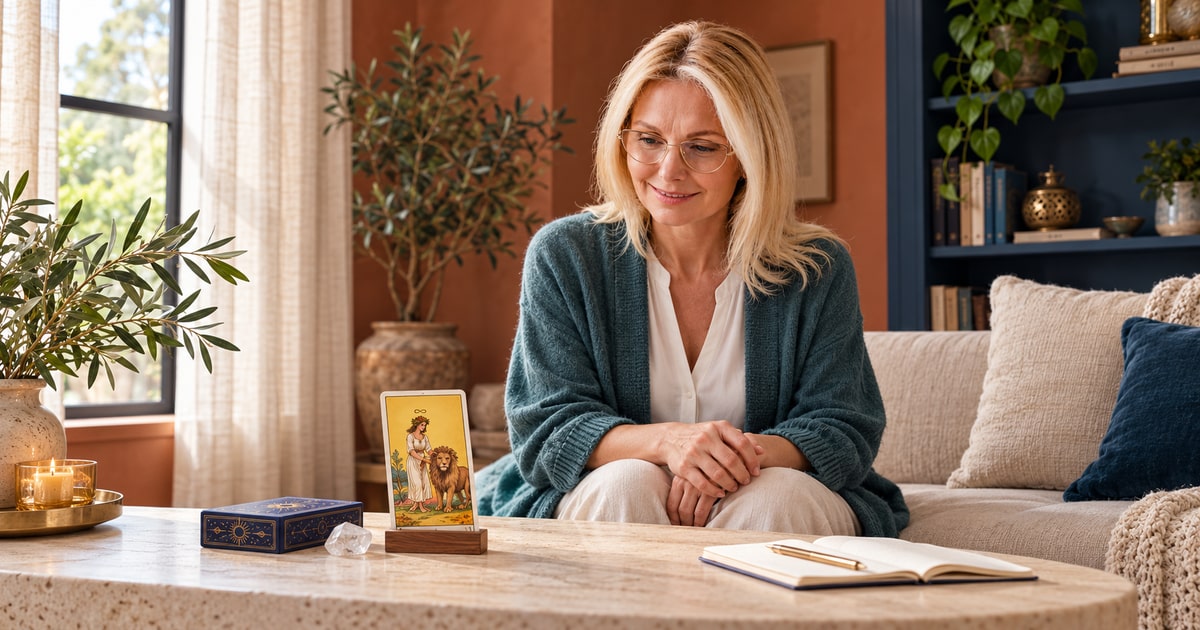
Tarot meditation gives one image your attention for a short time. Instead of asking what will happen next, you choose a card and explore a quality you want to practise: patience, care or courage.
You can approach this as a spiritual pause, a quiet conversation with a symbol, or a simple attention exercise. Five minutes is a manageable starting point, not a promise that you will feel different by the end.
Choose an image you can stay with
Select a card deliberately for this exercise. You do not need to shuffle, predict an outcome or choose the card that feels most impressive. Pick an image that invites curiosity without making you feel pressured.
Strength: gentle resolve
In the Rider-Waite-Smith image, a woman tends a lion beneath an infinity symbol. Use it to consider a firm response that does not depend on force.
The Empress: everyday care
Her wheat-filled landscape can invite a question about nourishment: what small act of care have you been putting off?
The Hermit: one clear step
The lantern offers a useful focus when you want to slow down. You do not have to see the whole road to identify the next step.
These are suggested reflections, not the only meanings of the cards. Art and associations differ between decks. Our Major Arcana guide can help you choose another image; your own deck’s guidebook can explain details particular to that artwork.
A five-minute card meditation
Set the card where you can see it without leaning forward. Sit in a comfortable chair with support if you need it. A timer is optional; the five parts below are a loose structure, not a test.
- Minute one: arrive. Notice the chair supporting you and your feet resting on the floor. Let your breathing find its ordinary rhythm. There is no need to hold your breath or make it especially deep.
- Minute two: look closely. Choose three visible details: perhaps a hand, a colour and something in the background. Describe what is actually pictured before deciding what it means.
- Minute three: return. Rest your attention on one of those details. When a thought interrupts, notice it and look back at the card. You can keep your eyes open throughout. If you enjoy imagining the picture with your eyes closed, try that briefly and reopen them whenever you wish.
- Minute four: ask one small question. Try, “What would patience look like in my next conversation?” Let a word or sentence arise without forcing an answer. You do not need to receive a message.
- Minute five: finish. Look around the room, then write the date, card and one possible action. Put the card away and return to an ordinary activity. Ending on time is part of the practice.
From a symbol to a real choice
Imagine you have chosen Strength before a difficult conversation. You notice the woman’s gentle hands and the lion’s size. Your reflection might be: “Being calm does not mean agreeing to everything.”
A useful next step could be writing one clear boundary before the conversation: “I can help for twenty minutes, but I cannot take this on today.” That is a choice you can make, not a prediction about how the other person will respond.
Keep observations separate from interpretations in your notes. “I saw a lantern” describes the card. “I want more time to decide” describes your response. Neither requires you to treat a sudden impression as an instruction.
Make the practice fit you
If pictures do not form in your mind: keep looking at the physical card, or write three words about it. Mental visualisation is optional. A larger print or an accessible description may suit you better than a small card.
If your attention wanders: shorten the exercise to one minute. Notice one detail, ask one question and stop. Returning once is enough to practise the action of returning; a completely quiet mind is not the entry requirement.
If the image feels unsettling: put it down and choose something ordinary in the room to look at. You can change cards, pause or skip meditation. Distress is not a sign that you must push through a spiritual lesson.
The NCCIH overview of meditation explains that research findings vary and some people report difficult experiences. Research on meditation in general does not establish the effects of this particular tarot exercise. If practice repeatedly leaves you more anxious or unsettled, stop and discuss it with a qualified health professional rather than extending the sessions. Keep any existing care in place.
If you are in emotional crisis in the United States, you can call or text 988 for support. A card exercise is not the support to rely on in a crisis.
Let repetition stay flexible
You might use the same card for a week and record one line after each session. Notice whether different details catch your attention, and whether the action you chose was realistic. There is no streak to protect and no need to make up missed sessions.
At the end of the week, keep the card, choose another, or take a break. Judge the routine by whether it feels useful and manageable, not by whether you have become a stronger person on a schedule.
Keep the next step small
One image, one question and one everyday action are plenty. For more ways to combine reflection and notes, explore tarot and mental wellness. If you would like more context for decks and interpretation, start with how tarot readings work.