

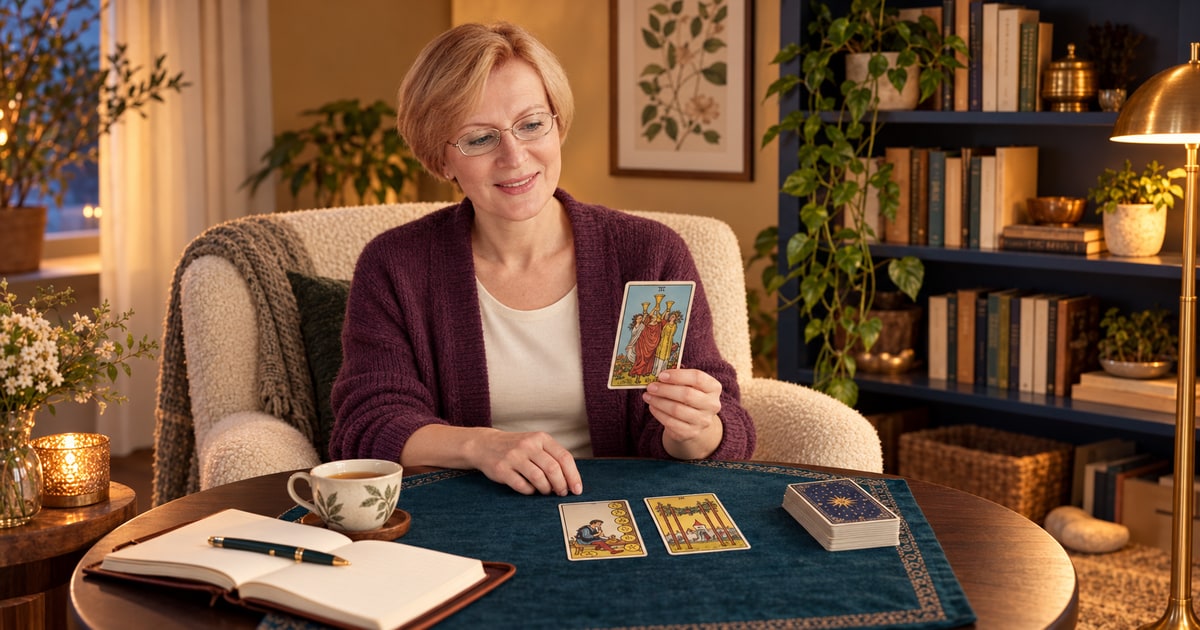
Tarot can give a weekly check-in a shape: a quiet moment, three images and a few honest lines about how life has felt. You may approach that ritual spiritually, as a conversation with your intuition, or simply enjoy the space it creates for reflection.
The useful part is what happens next. Notice what nourished you, name what was difficult and choose one manageable act of care. A card is not a health assessment, and a difficult week is not a failed reading.
The Sunday review draw
Choose a time that suits you; it need not be Sunday. Set aside about ten minutes, with a deck and somewhere to write. Ask, “What would help me care for myself this coming week?” Shuffle in your usual way, then lay three cards from left to right. If you are new to this, our beginner’s tarot guide explains how to start.
1. What nourished me?
Recall a real moment from the past week that felt supportive, enjoyable or meaningful. Use an image on the card to help you remember, rather than assuming its usual meaning must describe your week.
2. What drained me?
Name a demand, worry or missing resource. Keep the language specific and kind: “Three late nights left me tired” is more useful than “I am bad at looking after myself.”
3. What can I try?
Choose a small response within your control. It might involve rest, company, asking for help or changing a boundary. You do not have to solve everything before the next check-in.
Write one or two sentences beneath each position. If a card does not resonate, note that honestly, use the position’s question on its own or stop. There is no need to keep drawing until you get a reassuring answer.
A worked example: company, work and something to anticipate
Three of Cups in the first position: the shared celebration in the Rider–Waite–Smith image reminds you of dinner with a friend. You almost cancelled, but the conversation was a welcome break.
Eight of Pentacles in the second: the figure absorbed in a task brings to mind repeated unpaid overtime. The card can represent worthwhile practice too; it is your experience that tells you which association fits.
Four of Wands in the third: the welcoming scene suggests making space for something pleasant. Your practical choice is to arrange a short catch-up and protect one evening from extra work.
These are possible readings, not instructions the cards impose. Another person could draw the same three cards and write a different, equally personal account.
Five cards to use as wellbeing prompts
The associations below draw on common Rider–Waite–Smith interpretations. Treat them as starting points for your notes, not measurements of your health or predictions about recovery.
Nine of Pentacles: enjoying what supports you
Comfort and independence can prompt you to notice a resource already available: a peaceful corner, a skill or a little time of your own. Ask, “What did I do for myself that I would like to repeat?” Enjoyment does not have to involve spending money.
Three of Cups: connection
Friendship and shared celebration invite you to ask, “Who did I feel at ease with, and who have I missed?” A realistic response might be a message, a call or a short visit, while respecting everyone’s availability and boundaries.
Four of Swords: making room for rest
Its quiet imagery can raise a practical question: “What interrupted rest this week?” Look at your actual schedule and circumstances. The card cannot tell you why you are tired or determine whether a sleep problem needs medical attention.
Eight of Pentacles: effort and limits
Practice and steady work may feel satisfying, draining or both. Ask, “Which tasks felt worthwhile, and where did effort exceed what I could give?” Consider changing a deadline, requesting help or setting a clearer stopping point.
Temperance: a more workable balance
The blending of cups can suggest adjustment rather than perfection. Ask, “Where would a small change make the week more sustainable?” Balance need not mean giving equal time to everything; your needs and responsibilities may differ from someone else’s.
Turn a reflection into one doable action
Wellbeing involves more than a reading. The NHS wellbeing guide highlights connection, physical activity, learning, helping others and attention to the present. Let the check-in point you back towards daily life, not replace it.
- Make it concrete. Replace “Be more balanced” with “Ask someone to share one task” or “Arrange a call with a friend.” Choose something suited to your energy, access and circumstances.
- Decide when. Put a small next step in your diary, or attach it to an existing routine. Leaving room to change the plan is part of making it workable.
- Review without scoring yourself. Next week, note what happened and what got in the way. An unfinished plan may need to be smaller or better supported, not accompanied by another judgment about yourself.
After several check-ins, reread your notes for recurring needs. Look at the events you recorded, not just which cards appeared. A run of late nights may suggest a scheduling problem even when the cards look cheerful.
Keep the practice gentle, especially in a hard week
A frightening image or reversed card does not diagnose illness, announce a crisis or mean you have attracted harm. Describe what you see, consider a less alarming interpretation and return to the position’s question. It is fine to put that card away.
On a low-energy day, use one question instead of a spread: “What is one kind, realistic thing I can do next?” Answer without cards if that feels easier. Skip the ritual if it increases worry or turns into repeated checking. A comforting practice should not become another obligation.
When reflection is not enough
If low mood, poor sleep or loss of interest is persistent, distressing or affecting daily life, talk with a healthcare professional rather than relying on another draw. NIMH’s guidance on caring for your mental health explains self-care and when to seek help. You can bring your notes to a conversation if they help you describe what has been happening.
In the United States, call or text 988 for crisis support, including thoughts of suicide. If there is immediate danger, contact emergency services. Outside the US, use your local crisis or emergency service.
Build a routine that leaves room for real life
For a broader discussion of reflection, journaling and the limits of readings, explore tarot and mental wellness. Keep what genuinely supports you and leave room to change the practice.