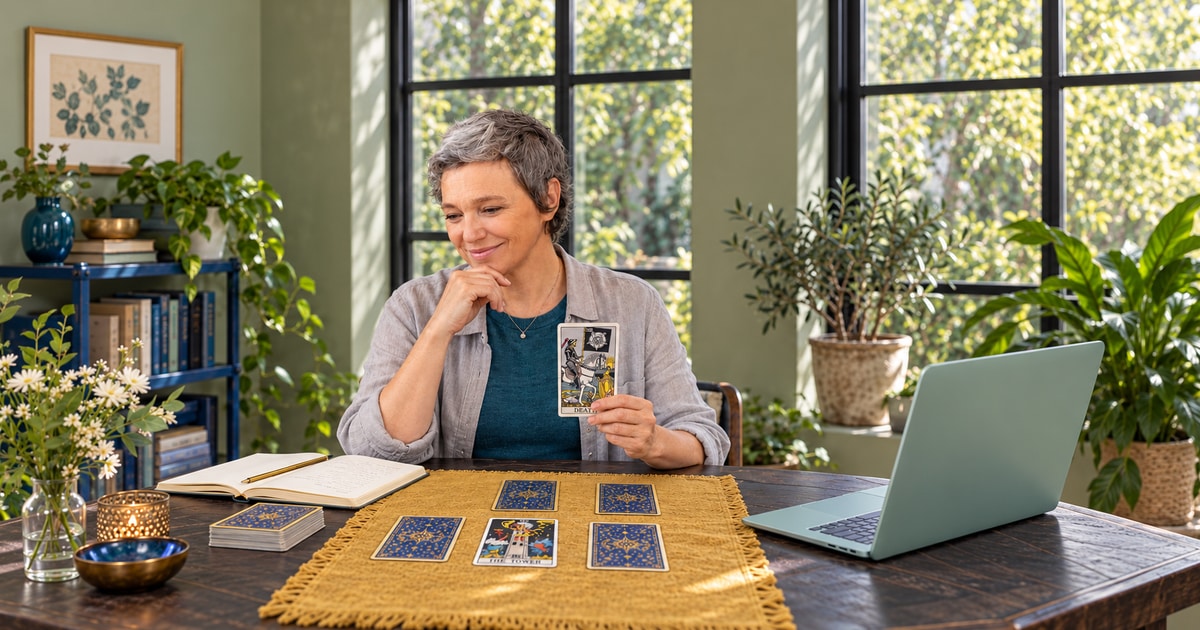
An intense image is an invitation to slow down
Death, the Tower, the Devil and some of the Swords cards can make a reading feel suddenly heavier. You may respect the deck, feel a strong intuitive response and still wish you had drawn something gentler. That reaction does not mean you have done anything wrong.
A meaningful interpretation need not turn an image into a literal forecast. These six cards can help you explore endings, upheaval, attachment, pain or a need for support. A single draw does not establish that someone will die, a partner will leave or a loss is on its way.
You do not have to make every difficult card positive
A calmer reading is not the same as insisting that everything is secretly wonderful. If you are grieving, stretched thin or facing a difficult change, a card may give you language for that experience. It does not require you to welcome the pain or find its lesson immediately.
The examples below use familiar Rider-Waite-Smith imagery and modern reflective questions. Decks and readers differ. Older books can sound much harsher: Waite’s divinatory lists are not simply a set of reassuring modern keywords. Treat these as ways to explore the cards, not the one universally agreed “traditional” meaning.
Six cards, read with room for context
1. Death
A common fear: “Does this mean someone will die?”
- Image cue
- In the Rider-Waite-Smith image, a skeletal rider moves on a white horse beneath a black banner with a white rose.
- A theme to explore
- Endings, transition and the experience of letting a chapter close. You may connect it with spiritual renewal, but an ending can also involve grief or uncertainty rather than immediate relief.
- A question to try
- What is changing, and what do I need in order to meet that change?
- One grounded response
- Name one ending or transition you already recognise. Decide what needs a goodbye, a boundary or practical support. The draw alone cannot establish that a person will die.
2. The Tower
A common fear: “Is a disaster about to happen?”
- Image cue
- Lightning strikes a tower; figures fall from the building.
- A theme to explore
- Disruption, an overturned assumption or the feeling that a structure no longer holds. This need not mean a literal building, and it does not make every shock necessary, deserved or secretly beneficial.
- A question to try
- What has actually changed, and what is still steady enough to rely on?
- One grounded response
- Check a fact before making a major decision. If a routine or plan has been interrupted, identify the next safe, practical step rather than deliberately creating upheaval to match the card.
3. The Devil
A common fear: “Am I cursed, trapped or a bad person?”
- Image cue
- Two human figures are chained beneath a horned figure.
- A theme to explore
- Attachment, pressure, compulsion or a bargain that costs more than it gives. This is a way to explore a pattern, not a moral judgement or evidence of a supernatural threat.
- A question to try
- Where do I feel less free, and what kind of support would make a difference?
- One grounded response
- Notice one boundary or source of help you could explore. Do not assume that dependency, coercion or an unsafe relationship can be solved simply by trying harder or deciding to leave; support and circumstances matter.
4. Ten of Swords
A common fear: “Does this promise betrayal or ruin?”
- Image cue
- A figure lies beneath ten swords, with a lighter band of sky at the horizon.
- A theme to explore
- Pain, exhaustion, a difficult ending or the sense that you have reached a limit. Some readers notice the horizon as a hopeful detail, but that does not guarantee the worst is over or that recovery will be immediate.
- A question to try
- What am I no longer able to carry in the same way?
- One grounded response
- Choose a manageable form of rest, help or closure. You can acknowledge a painful situation without forcing a fresh start or assuming the image predicts a violent event.
5. Three of Swords
A common fear: “Is heartbreak or cheating certain?”
- Image cue
- Three swords pierce a heart against rain and cloud.
- A theme to explore
- Sorrow, disappointment, separation or a truth that hurts. It may give language to a feeling you already have, but it does not establish why someone acted as they did.
- A question to try
- What hurt needs to be named without inventing an explanation for it?
- One grounded response
- Separate what happened from what you fear it means. If a conversation is appropriate and safe, ask about the actual issue instead of accusing someone on the basis of a card.
6. Five of Pentacles
A common fear: “Will I become ill or lose everything?”
- Image cue
- Two people pass a lighted window in the snow.
- A theme to explore
- Hardship, exclusion, insecurity or feeling outside the circle of support. The window can invite a question about help, but it is not proof that help is available or that a difficulty is easily solved.
- A question to try
- What support is genuinely available, and what would make it easier to ask?
- One grounded response
- Look for a concrete resource or person you can contact. Let actual symptoms, circumstances and qualified advice guide health or money decisions. Hardship is not a failure of faith or positive thinking.
The Ten of Swords is a useful example of why dramatic artwork needs careful language. Waite’s entry describes pain and distress without making it especially a card of violent death. Equally, it does not promise that all difficulty has already ended. Let the situation and spread position matter.
For more detail on these cards and the Moon, continue with interpreting difficult tarot cards.
What to do after an unsettling draw
Leave the card where it is for a moment. You can take a breath, look away from the picture or put the deck aside. If you want to continue, try this short routine:
- Return to the question and position A card in “what needs attention” has a different role from one in “what supports me.” Do not discard the position because an image feels alarming.
- Name what you recognise Ask where, if anywhere, the theme already appears in your life. “I feel worn out” is an observation; “this proves I will be betrayed” is a claim the card has not established.
- Leave the unknowns unknown Consider what you can check, what you control and where another person needs to speak for themselves. You do not have to invent an event to make the card fit.
- Choose one proportionate response Record a small step, or decide that no action is needed yet. If another draw is only an attempt to make the fear go away, pause the reading rather than replacing cards until one feels comforting.
If the card is reversed, turning it upside down does not automatically cancel its difficult themes or make them worse. Use the method you chose before the draw; understanding a reversed tarot card gives examples of different approaches.
A worked Tower example: uncertainty at work
Imagine you draw the Tower after learning that a work project is changing. Instead of treating the card as a job-loss prediction, you could record:
- Question and position
- How can I respond to changes at work? Position: what needs attention.
- Card and possible theme
- The Tower: an assumption about the usual routine may need revisiting.
- What I know, and what I do not
- The team’s project has changed. I do not yet know whether my responsibilities or working hours will change.
- A next step
- Ask my manager for clarification and write down the answer. Do not treat the card as a reason to resign or as a promise that a better role is waiting.
This imagined example keeps the spiritual association available without letting it outrun the information you have. The question is what deserves attention, not how to make your life resemble the picture.
Ask your reader for an explanation, not a frightening verdict
A reader may use intuition, a guidebook or a particular tradition. You are allowed to ask how they reached an interpretation and to say when the wording leaves you more confused or alarmed. Useful questions include:
- How does that interpretation connect to the question and this spread position?
- What other reading of this image could fit the information I have given you?
- Is there a practical question I can explore without treating this as a fixed prediction?
A frightening card is not evidence that you need an urgent paid curse removal or protection service. Pause if fear is being used to pressure you into spending more. The FTC’s scam guidance identifies demands for immediate action and particular payment methods as warning signs; taking time to think and talking to someone you trust are sensible responses.
If you notice yourself turning each image into confirmation of an existing fear, explore why tarot cards get misread. You can also use better alternatives to unhelpful tarot questions to move from “What terrible thing is coming?” toward a question about your choices.
On your next reading, keep one useful question
You do not need to avoid these six cards or prove that you are brave enough to keep reading. Choose a small spread, keep the position labels clear and notice what the image brings up before deciding what it means. If the reading stops feeling useful, end it for now.
A card can be important to your spiritual practice without becoming the authority on someone else’s intentions, your health or your future. Use information, conversations and appropriate support alongside what you take from the deck.
A difficult card can hold a question, not a sentence
Make room for what feels uncomfortable without assuming the worst or forcing a cheerful interpretation. Name what you recognise, leave space for uncertainty and choose a response that fits your actual life. Sometimes the most useful next step is a conversation; sometimes it is simply a pause.