
If 222 keeps catching your eye, you can explore its symbolism without needing to prove that every sighting is a message. Some readers approach repeating numbers through an angel-number practice; others enjoy them as reminders to pause and reflect. A meaningful association is personal, not a reliable forecast.
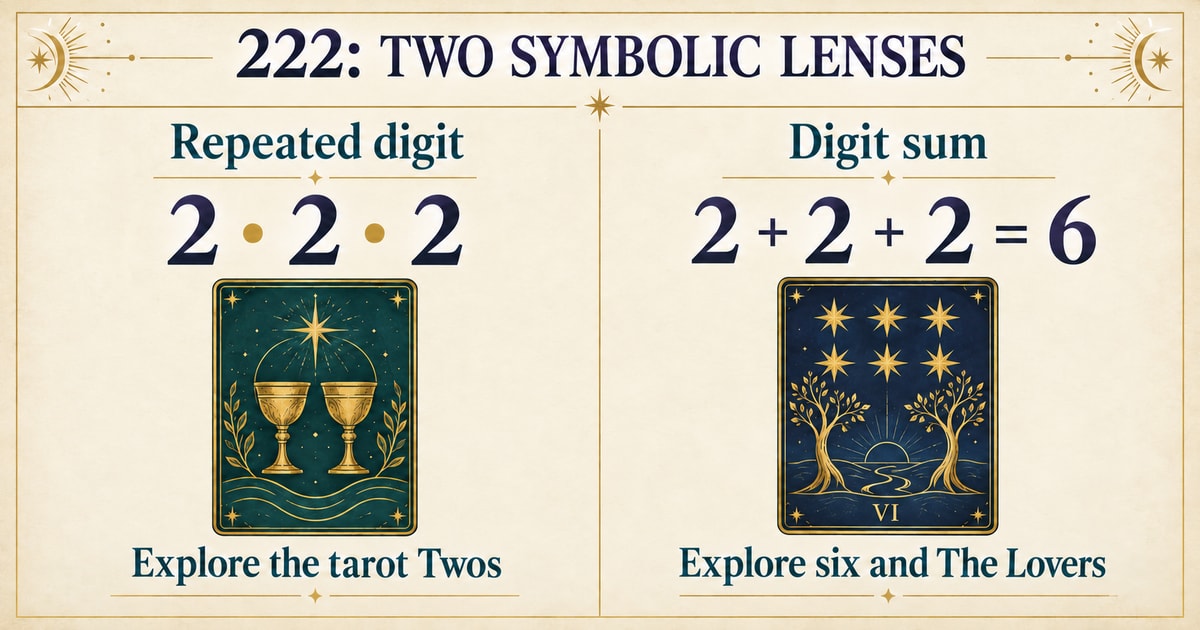
For a tarot-based approach, start with the Twos: pairs, competing needs, relationship and choice. There is also a different numerical route: adding 2 + 2 + 2 gives 6. Keeping those approaches separate makes a reading clearer than treating every connection as the same meaning.
Does 222 point to two or six?
That depends on the method you choose. Neither method turns a number on a receipt or clock into a tarot card you have actually drawn.
- Read the repeated digit. You might explore the symbolism of two through the four suit Twos and the High Priestess, numbered II. In this approach, the repetition is your starting theme.
- Add the digits. 2 + 2 + 2 = 6. A digit-sum approach can lead you to the Sixes or the Lovers, numbered VI. That is a different exercise, not a correction to the repeated-digit approach.
Judgement needs its own explanation: XX means 20, not two. Adding its digits gives 2 + 0 = 2, which is why a reader using number reduction might connect it with the High Priestess. They remain different cards with different imagery. You can check those Major Arcana numbers in A. E. Waite’s account of the cards.
There is no standard card numbered 222. Choose an approach before interpreting, and say which one you used. For the wider number framework, see Understanding Tarot Card Numerology.
Six cards to explore through the theme of two
These are possible reflective themes, not one compulsory meaning for every deck. The suit-card prompts draw on familiar Rider–Waite–Smith imagery; your guidebook may emphasise something else. The High Priestess is directly numbered two, while Judgement joins this exercise only through the reduction explained above.
1. The High Priestess (II): leave room for the unknown
Her partly concealed scroll can invite attention to what is understood, sensed or still unstated. Listening inwardly does not mean assuming every feeling is a fact.
Notebook prompt: what have I noticed, and what do I still need to learn before reaching a conclusion?
2. Judgement (XX): review before responding
The call in this card can be explored as reflection, reassessment or responding to something important. Its connection to two is numerical reduction, not an instruction to judge yourself harshly.
Notebook prompt: what can I review fairly now, and what response would reflect what I have learned?
3. Two of Cups: consider reciprocity
The pair with raised cups offers a starting point for mutual respect and exchange. That could concern friendship, collaboration or romance; it does not confirm a soulmate or another person’s feelings.
Notebook prompt: where could I ask for, offer or acknowledge more balanced give and take?
4. Two of Wands: bring a plan into focus
The figure looking outward with a globe can prompt thoughts about possibility, planning and perspective. The image can help you explore an option without promising that it will succeed.
Notebook prompt: what is one concrete step for the plan I keep circling, and what information would help me assess it?
5. Two of Swords: name the missing information
The blindfold and balanced swords can suggest a pause, tension or a decision not yet made. Do not assume that hesitation always means avoidance; sometimes more information really is needed.
Notebook prompt: what decision is waiting, and which fact, conversation or boundary would help me approach it?
6. Two of Pentacles: check what is sustainable
The two linked coins and moving figure can invite reflection on changing demands and juggling priorities. Balance need not mean giving every commitment equal time.
Notebook prompt: which commitment is losing out, and what could I adjust, postpone or ask for help with?
Turn a sighting into a short reflection
You can select a card deliberately for this exercise; you do not need to shuffle until a Two appears.
- Record the moment. Note where you saw 222 and what was on your mind. Keep the observation separate from your interpretation.
- Choose a lens. Use the repeated twos or the digit sum of six. For the prompts above, stay with the theme of two.
- Choose one prompt. Write a few lines that fit the actual situation. If none fits, leave it there rather than inventing a connection.
- Name a next step. Choose a conversation, practical check or manageable action. Keep later observations separate from the original note.
Imagined example: you notice 2:22 while worrying about two commitments. You deliberately choose the Two of Pentacles prompt and realise both events were entered for the same evening. Your useful next step is checking the calendar and discussing an alternative—not assuming the number guarantees everything will work out.
If personal readings tend to become repeated checking, our guide to reading your own tarot without forcing the answer offers practical boundaries.
Why noticing 222 is not the same as establishing a message
Once a number matters to you, memorable sightings may stand out more than all the ordinary numbers you pass. A related reasoning pitfall is giving extra weight to observations that fit an existing belief, discussed in Raymond Nickerson’s review of confirmation bias. That does not diagnose why you noticed a particular clock, or settle your spiritual beliefs.
You can hold a personal interpretation lightly while checking decisions against conversation and relevant facts. Seeing 222 does not establish that someone loves you, that money is arriving or that a deadline is safe to ignore.
If you seek a paid interpretation, agree to the price and scope voluntarily. Be cautious of claims that 222 proves a curse or urgent danger that only an escalating payment can remove. You can decline that claim and end the conversation; a number does not create an obligation to buy anything.