

The Chariot, card VII of the Major Arcana, is often read as direction, determination and the challenge of steering competing priorities. Upright, it can invite focused action. Reversed, it can invite you to examine scattered effort, excessive control or a goal that no longer fits. Neither orientation guarantees success or failure.
Its message also depends on the position you assigned before drawing it. A Chariot in an obstacle position is not the same invitation as a Chariot in an advice position. Start with the role of the card, then explore its symbols in relation to your question.
Upright and reversed: two ways to explore direction
Upright: choose a course
Consider commitment, self-discipline and purposeful movement. Where would one clear priority help? Focus does not require controlling other people or ignoring limits.
Reversed: examine the steering
Consider a stalled plan, divided attention or pushing too hard. Is a smaller step, a pause or a different destination more appropriate? Reversed does not automatically mean defeat.
These are reflective readings, not universal definitions. Follow the guidebook and approach of your own deck. If you do not read reversals, you can explore both the helpful and difficult sides of the upright image without turning the card over.
The Chariot in six common reading roles
The six labels below are alternatives, not six numbered slots in one fixed spread. Past–present–future is one familiar three-card arrangement; advice, obstacle and outcome appear in other layouts. Celtic Cross labels and order vary. Decide what each position means before dealing, or use the guide to choosing a tarot spread.
1. Past
- Upright
- Reflect on an earlier commitment, sustained effort or a decision that shaped your present situation.
- Reversed
- Reflect on a previous detour, competing demands or a push that became difficult to sustain.
Ask: What actually happened, and what do I want to learn from it?
2. Present
- Upright
- Explore where a clear priority and deliberate action could help you now.
- Reversed
- Explore where attention is divided, control is too tight or someone else’s pace is replacing your own.
Ask: Which part of this situation can I genuinely influence?
3. Future
- Upright
- Consider a possible path of continued commitment, including the effort and support it would require.
- Reversed
- Consider what might need adjustment if the same conflicts or overcommitments continue.
Ask: What could I change now? This position is not evidence that a particular event will occur.
4. Advice
- Upright
- Choose one manageable aim and identify an action within your control.
- Reversed
- Review the destination and demands before adding more effort. A pause can be a considered choice.
Ask: What is one proportionate next step—not a test of how hard I can push?
5. Obstacle
- Upright
- Examine whether determination has become rigidity, haste or a need to win at any cost.
- Reversed
- Examine unclear priorities, depleted capacity or commitments pulling against one another.
Ask: Is the difficulty a lack of direction, a lack of resources or too much pressure?
6. Outcome
- Upright
- Explore what progress or a sense of agency would mean to you, rather than assuming a guaranteed victory.
- Reversed
- Explore a changed approach, an unfinished goal or choosing not to continue on the same terms.
Ask: How will I recognize the actual result? Effort alone cannot control every circumstance.
Use the picture without forcing a message
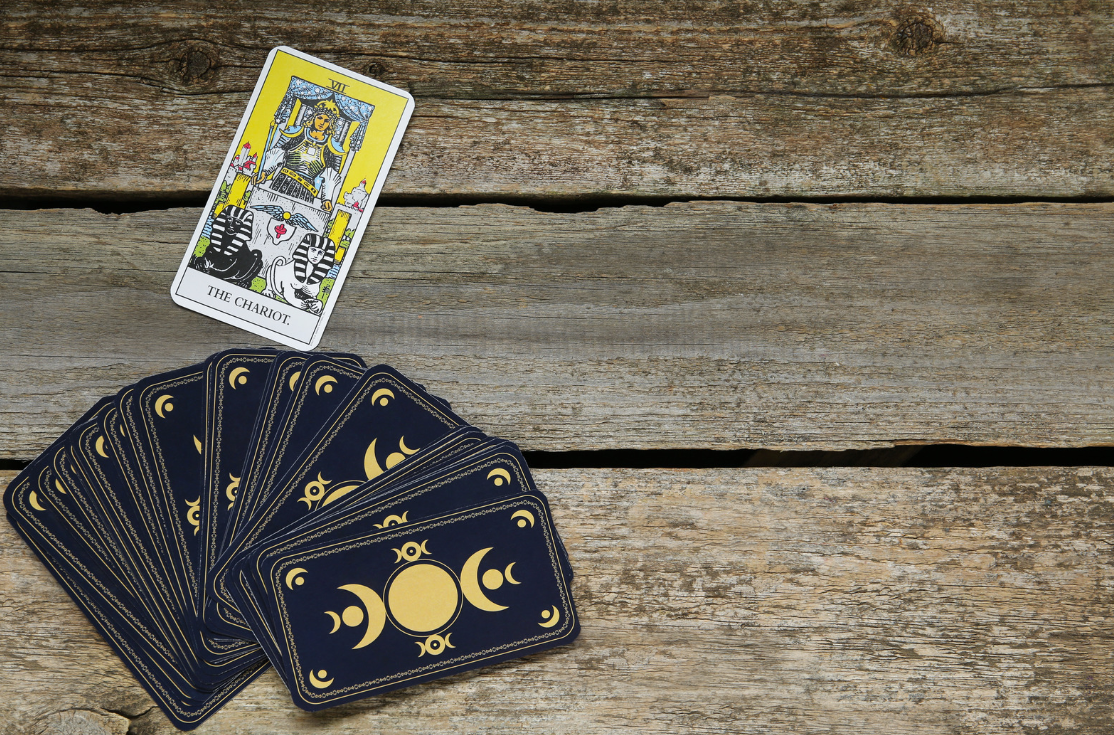
- The contrasting sphinxes: a prompt to name two competing wants or responsibilities—not to label people as good or bad.
- The armoured figure: a prompt to consider readiness and protection, including whether defensiveness is getting in the way.
- No visible reins: an invitation to reflect on direction and self-command, not a claim that willpower can override other people or real-world limits.
In his original Chariot commentary, A. E. Waite emphasizes conquest and triumph. The questions here use the image as a reflective practice; they are not a promise that a reading can deliver those results.
Read nearby cards as a conversation
A pairing is not a fixed code. These possibilities can help you form a question; the spread position still comes first.
Chariot and Strength
Explore the relationship between determination and gentleness. Could you hold a boundary without making the situation a contest?
Chariot and Eight of Wands
Explore pace and coordination. If many things need attention, what needs a response and what can wait? The cards do not establish a deadline.
Chariot and Two of Swords
Explore movement alongside hesitation. Is there a decision to make or information to gather before taking action?
If your question concerns a trip or move, the chariot image may suggest movement as a theme. Check the practical arrangements directly. It cannot confirm a booking, transport safety or how a journey will turn out.
Try a short Chariot reading
- Name the position. Write the question and the card’s role, such as advice about one project.
- Choose one interpretation. Link one visible detail or keyword to your situation. Keep what you know separate from what you imagine.
- Write an action and a check. Name a step you can choose, then record what actually happens rather than treating the card as proof.
Example: advice about a portfolio project
You want to finish a portfolio but keep starting new pieces. The upright Chariot in an advice position might prompt: “I’ll choose one existing piece to finish before adding another.” Reversed, it might prompt: “I’ll review what I can realistically take on before setting another target.”
Both readings concern your choices. Neither tells you whether an employer will hire you. If the real issue is choosing between paths, use the tarot guide for hard decisions to separate reflection from the practical decision.
Want the fuller Chariot guide?
The complete Chariot card guide explores its symbolism and upright, reversed, love and career readings. Keep this shorter page as a position-by-position reference while you read.