

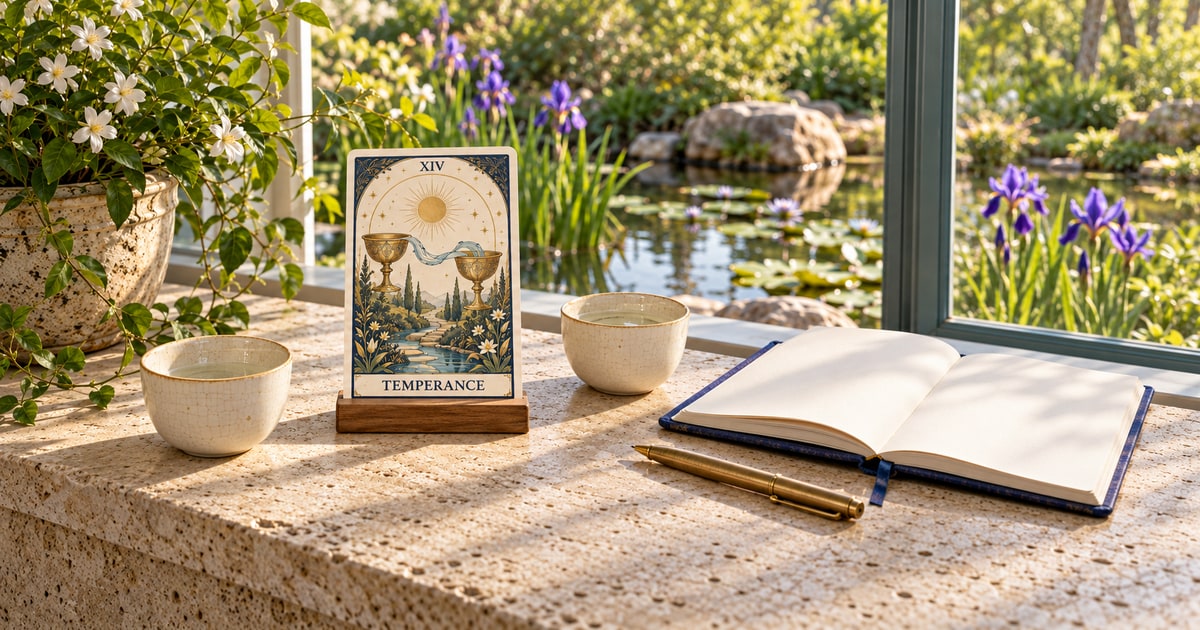
Temperance asks what would help different parts of your life work together. Card XIV is commonly associated with patience, proportion and integration. It can suggest a steady adjustment rather than a dramatic answer: less rushing, a clearer boundary or a way to combine two useful skills.
There is no single interpretation that overrides the question, deck or spread position. This short guide focuses on putting the card’s balance theme into practice; the full Temperance guide covers its meanings and symbols in more detail.
What the two cups suggest
In the Rider-Waite-Smith image, a winged figure transfers liquid between two cups, with one foot on land and one in water. A. E. Waite’s account describes a spiritual harmony between psychic and material life. That is his esoteric interpretation, not a finding about how the future works.
For a present-day reflection, the exchange between the cups offers a useful question: what needs a different proportion? Balance need not mean equal amounts. Rest and effort may need different amounts on different days. Sometimes the adjustment is to stop a commitment, not squeeze more into an already full schedule.
1. Upright: find a workable rhythm
A common reading emphasizes patience, cooperation and gradual integration. Look for something you can sustain: a realistic pace, an agreed division of work or a small change you can review. Calmness is a possibility to explore, not proof that everything is already harmonious.
2. Reversed: notice the strain
Reversed Temperance can be read as an uneven exchange, overcorrection or difficulty finding a rhythm. It is not a judgment that you have failed. Ask where the strain appears and what support or boundary is missing. If you do not use reversals, the question and neighboring cards can still bring those themes into view.
Bring the meaning back to the question
- Love and friendship
- Upright may suggest cooperation between different temperaments; reversed may draw attention to one-sided effort. Ask what each person can actually agree to. Balance never requires tolerating threats or giving up a necessary boundary.
- Work and study
- Upright can suggest combining skills or pacing a project; reversed can highlight an overloaded timetable or rushed choice. Ask which task needs more time and which commitment can be reduced or renegotiated.
- Money
- Use the card to reflect on competing priorities, not to forecast an investment or promise that a budget will hold. Compare the actual amounts, dates and obligations before making a financial decision.
- Daily habits
- Consider where your routine feels workable and where it has become rigid or exhausting. Choose a small, observable adjustment. A card does not diagnose a condition, treat dependence or tell you to change prescribed care.
Is Temperance a yes or a no?
Some readers use it as a conditional yes: proceed with patience or make an adjustment first. Others do not assign fixed yes/no answers. Decide on the method before drawing, and do not turn “be patient” into a guaranteed date. A useful follow-up is “What condition can I work on?” rather than “How long until the promised result?”
Name the two cups
Try this brief journaling exercise with one real situation. It turns an appealing word such as “balance” into something you can notice and review.
- Name the two needs. Write a specific pair, such as study and rest, earning and family time, or listening and speaking.
- Choose one adjustment. Describe what you will change this week in plain terms: one task moved, one conversation arranged or one protected break.
- Set a review point. Record what felt more workable and what still needs attention. Adjust the plan using what happened, not only what you hoped the card meant.
For example: a person taking an evening course might move one optional task away from class night and reserve a short preparation period. The aim is not a perfect timetable. It is a manageable change they can check after the next class.
Let nearby cards refine the question
These are possible combinations, not fixed formulas or claims about how often cards appear together.
- With the Devil: explore where choice feels narrowed or a pattern feels difficult to leave. Name the support needed; do not read the pair as a diagnosis or proof that moderation alone is the answer.
- With the Two of Cups: consider how two people communicate and share effort. Mutual agreement matters more than the appealing idea of a perfect match.
- With the Five of Wands: ask whether clearer roles, a slower discussion or a different process would help a disagreement. Keeping the peace is not the same as solving the issue.
When Temperance describes a person, it may point to a mediator or someone skilled at bringing different approaches together. That does not oblige them to stay neutral about harm or carry everyone else’s emotional work. The card’s most useful question may be simple: what would make this situation more workable without asking one person to absorb all the strain?