

Quick guide
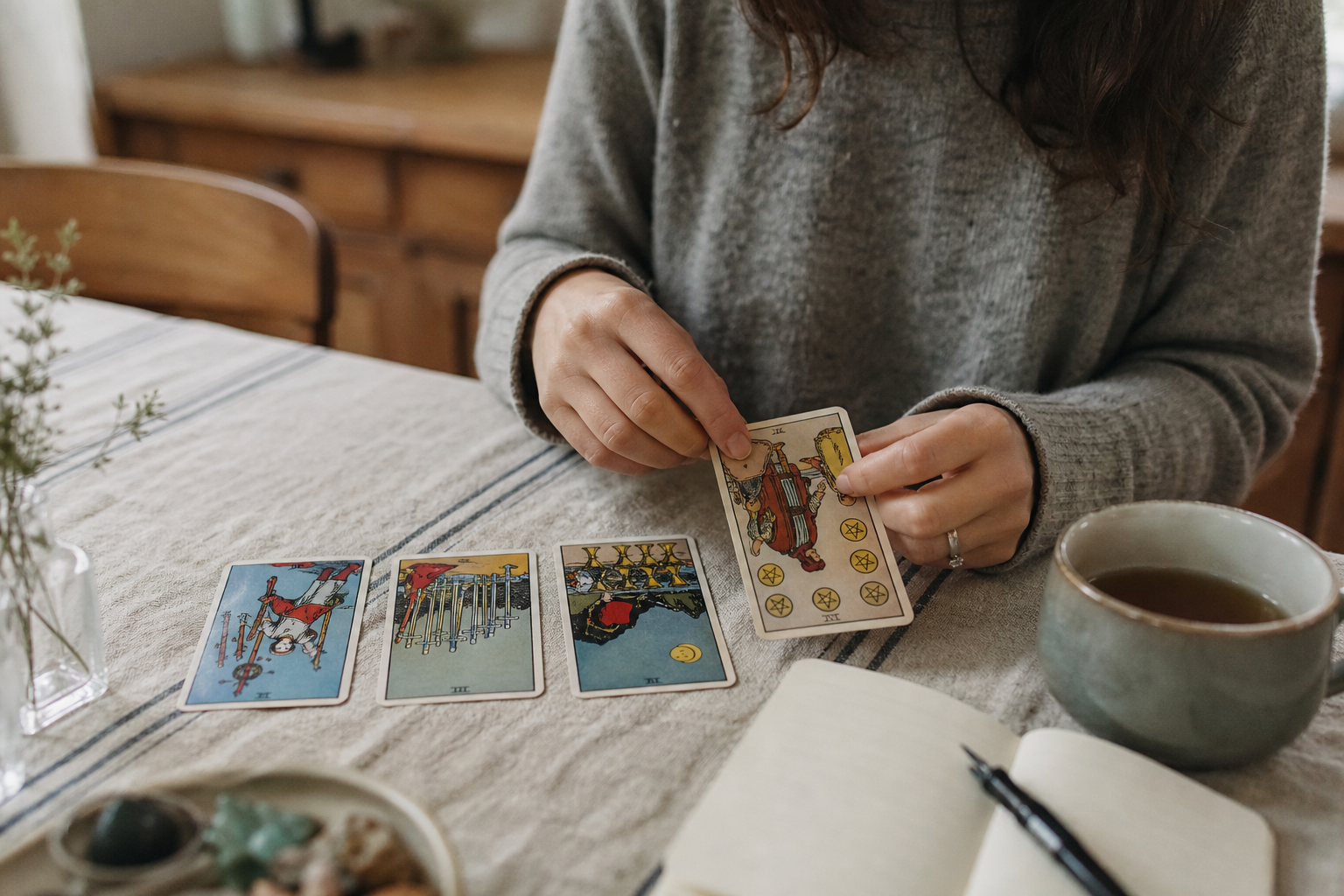
A reversed tarot card is a card that lands upside down when you turn it over. In the Rider-Waite-Smith tradition, readers treat a reversal as a change in the upright meaning rather than a brand-new one: the energy is blocked, turned inward, flipped to its opposite, or arriving late and too strongly. None of these methods is the “correct” one; they are conventions, and plenty of skilled readers never use reversals at all. A reversed card cannot predict an event, reveal what another person is thinking, or turn a reading into a warning about your future. What it can do is sharpen the question you bring to the cards. This guide explains the four common reading methods, how to decide whether reversals suit you, how to shuffle so they appear naturally, and walks through worked examples with named cards.
Turn over a card and find the Sun standing on its head, and most beginners feel a small jolt. Is the good news cancelled? Has the reading turned dark? The short answer is no. Reversals are one of the oldest layers of tarot reading, and once you understand how readers actually use them, they stop being alarming and start being useful. This page is the hub for everything reversal-related on tarotreading.co. It covers what a reversal is, the four methods readers rely on, whether you should use them at all, how to shuffle for them, and what some well-known cards tend to say when they land upside down.
What a reversed card actually is
Physically, a reversal is nothing more than orientation. A standard deck has 78 cards: 22 Major Arcana and 56 Minor Arcana across the suits of Wands, Cups, Swords and Pentacles. When a reader allows reversals, each card can arrive in one of two positions, which gives 156 possible positions. It does not give 156 unrelated meanings. The reversed Eight of Pentacles is still about skill and steady work; it is the same card viewed from a different angle.
Reversals have been part of guidebook tradition for a long time. Reversed meanings appear in European cartomancy manuals from the late eighteenth century, and A. E. Waite’s 1910 companion to the Rider-Waite-Smith deck lists a reversed meaning for every card. That said, the cards themselves are older than any of this. Tarot began as a trick-taking card game in northern Italy in the 1430s, and the fortune-telling use of the deck came along centuries later, as Britannica’s overview of tarot explains. Reversed meanings, like upright meanings, are interpretive conventions that authors attached to the images. They are not laws, and no two guidebooks agree on every card.
It helps to hold one idea in mind throughout: a reversal changes how you look at a card, not what the future holds. The Three of Swords reversed does not promise that heartbreak is over any more than the upright card promises heartbreak is coming. Both are prompts for a conversation with yourself about what is happening now.
How to read any reversed card
Four steps for a reversed card
- Say the upright meaning firstName what the card means the right way up, in one plain sentence. Reversals only make sense against that baseline.
- Check the positionA reversal in the “what is blocking me” slot of a spread reads very differently from one in the “advice” slot. Let the position shape the method.
- Choose one methodPick blocked, internalised, opposite, or delayed and excessive. Stick with the one you chose before the reading rather than switching to whichever sounds nicest.
- Turn it into a questionFinish with something you can act on: “What is getting in the way of the rest I need?” rather than “Will I ever rest again?”
A reversed card is a nudge to look again, not a verdict.
The four common reading methods
Most readers use one of four approaches, and it pays to know all of them even if you settle on one. The table below runs each method past the same card, the Eight of Pentacles, which upright shows a craftsman carefully engraving a row of coins: steady effort, practice, and skill built over time.
| Method | What the reversal suggests | Eight of Pentacles reversed, read this way |
|---|---|---|
| Blocked or stuck | The upright energy is present but cannot flow freely | You want to improve a skill, but practice keeps getting interrupted by other demands |
| Internalised | The energy is happening inside you rather than out in the world | You are quietly learning, but nobody has seen the work yet, including you |
| Opposite | The upright meaning flips to its reverse | Rushed, careless or repetitive work; going through the motions |
| Delayed or excessive | The upright meaning arrives late, or shows up too strongly | Perfectionism that stops you finishing, or a project that drags on far past its deadline |
| Release | The card asks you to put down what it shows | Stop polishing and let the piece go out into the world |
| Softened | The same meaning with the volume turned down | A hobby rather than a craft; pleasant practice with no pressure attached |
Notice that the six readings in the table are different, and several contradict each other. That is why experienced readers decide on a method before they shuffle. If you let yourself choose the interpretation after seeing the card, you will tend to pick the one that confirms what you already believed, a habit psychologists call confirmation bias. Choosing in advance keeps the reading honest.
The “blocked” and “internalised” methods are the most popular among modern readers because they keep the card’s character intact and lead naturally to a question. The “opposite” method is the oldest and the simplest, but it produces blunt results: the Sun reversed becomes gloom, the Devil reversed becomes freedom, and the subtlety of the image gets lost. The “delayed or excessive” method rewards readers who like nuance, but it takes practice to tell “too much” from “not yet” in the same card.
Should you use reversals at all?
Here is something many beginners are relieved to hear: reversals are optional. Marseille-style readers often ignore them. Some Thoth deck readers use the astrological dignities of neighbouring cards instead. Many professional readers who work with the Rider-Waite-Smith deck read every card upright and let the surrounding cards supply the shade. There is no quality mark attached to using reversals, and no reading is more “advanced” because the cards are upside down.
- Use reversals if you already know the 78 upright meanings well enough to say them without a book.
- Use reversals if your readings often feel one-note and you want more shades of meaning without adding cards.
- Use reversals if you prefer a clear visual signal for “something is stuck here” rather than inferring it from context.
- Use reversals if you like yes-or-no questions and want a simple rule, with upright leaning yes and reversed leaning no, while remembering that the rule is a convention rather than a forecast.
- Skip reversals if you are still learning upright meanings; doubling the vocabulary too early slows most people down.
- Skip reversals if they make you anxious, so that a reading full of upside-down cards feels like a bad omen instead of a conversation.
- Skip reversals if your deck has a reversible back design that makes it hard to tell orientation, or if the art is symmetrical.
- Skip reversals if you read mostly with large spreads such as the Celtic Cross, where ten cards already give plenty of texture.
If you decide against reversals, be consistent about it. Turn any upside-down card the right way as you lay it out, and do not sneak a reversed meaning in when the upright one feels uncomfortable. If you decide for them, keep them in every reading for a month before judging whether they help you.
How to shuffle so reversals appear naturally
Cards do not reverse themselves. If you only overhand-shuffle a deck that started fully upright, it will stay upright forever. Readers who want reversals build a rotation into their shuffle, and they do it the same way every time so the mix is fair rather than staged.
- Decide before you touch the deck. State to yourself whether this reading uses reversals and which method applies. This single habit removes most of the confusion reversals cause.
- Rotate half the deck. Cut the deck into two roughly equal piles, turn one pile end over end, then riffle or overhand-shuffle the piles back together. Repeat two or three times so the orientation is well mixed.
- Try the spread-and-swirl method. Spread the whole deck face down on the table and swirl the cards with both hands for thirty seconds, then gather them. This is the gentlest option for large or delicate decks and produces a natural mix of orientations.
- Cut with a turn. After shuffling, cut into three piles and rotate the middle pile before restacking. Some readers do this as a ritual signal that the reading has begun.
- Flip cards sideways, not top to bottom. When you turn a card over to reveal it, flip it like the page of a book, left to right. Flipping from the top edge reverses every card as you reveal it and scrambles your result.
- Note your method in your journal. Write “reversals on, blocked method” at the top of the entry. When you look back in six months you will know exactly how you read that spread.
Worked examples with named cards
The fastest way to get comfortable with reversals is to watch them in action. Each example below uses the “blocked or internalised” family of methods unless stated otherwise, because that is the approach most guidebooks published since the 1970s favour.
The Sun reversed. Upright, the Sun shows a child on a white horse under a bright sky: joy, clarity, warmth, success that is visible to everyone. Reversed, the warmth is still there but something is dimming it. Perhaps you have achieved what you wanted and feel oddly flat, or you are hiding good news because you worry about how others will take it. A useful question: “What is stopping me from enjoying what is already going well?” Note that the Sun reversed is still one of the gentlest cards in the deck. It never means disaster.
Eight of Swords reversed. Upright, a bound and blindfolded figure stands among eight swords, hemmed in by a story she tells herself. Reversed, the binding loosens. Many readers treat this as a release card: the restriction was mostly mental, and you are starting to see the gaps between the swords. Question: “Which belief have I already started to doubt?”
Three of Cups reversed. Upright, three friends raise their cups in celebration. Reversed, the party is either cancelled or overdone. Using the delayed-or-excessive method, it can point to a celebration that keeps being postponed, or to a social life that has become exhausting. Using the internalised method, it suggests you are craving company but not asking for it. Question: “Who have I not called in a while, and why?”
Knight of Wands reversed. Upright, the Knight charges ahead on a rearing horse: enthusiasm, bold moves, travel, a project launched at speed. Reversed, the horse is going nowhere, or going everywhere at once. This often reads as energy without a direction, or a plan abandoned halfway. Question: “Which of my five new ideas actually deserves the next two weeks?”
The Hanged Man reversed. Upright, a figure hangs calmly by one foot, choosing to pause and see the world differently. Reversed, the pause is being refused or has gone on too long. It can mean stalling, resisting a necessary wait, or finally being ready to come down from the tree. Question: “Is this a pause I chose, or one I am hiding in?”
Ten of Swords reversed. Upright, this is one of the most dramatic images in the deck: a figure face down with ten swords in his back under a black sky, while dawn breaks on the horizon. Reversed, most readers soften it: the worst has already happened and recovery is beginning, slowly. Some use the opposite method and read it as refusing to admit something has ended. Question: “What ending am I still carrying around as if it were news?”
The Tower reversed. Upright, lightning strikes a crown from a tower and two figures fall: sudden change, a structure that could not hold. Reversed, the change is resisted, delayed, or arrives in smaller shocks instead of one big one. It can also mean you are the one holding the walls up by force. Question: “What am I propping up that would be easier to let fall?”
Queen of Pentacles reversed. Upright, the Queen sits in a garden with a rabbit at her feet, caring for her home and body with easy generosity. Reversed, that care is missing, usually for herself. Readers often see burnout, skipped meals, or a home that has become a workplace. Question: “What would I tell a friend who was living the way I am living this week?”
Across all eight examples, notice the pattern. The reversal never introduces a stranger. It takes a card you already know and asks what happens when its energy is stuck, hidden, overdone, or ready to be released. That is why learning upright meanings first is the best investment a new reader can make, and why the reversed vocabulary comes quickly once those foundations are in place.
Reversals and the so-called bad cards
Beginners often worry about the opposite case: what if a frightening card lands reversed? Does the Devil reversed mean a worse Devil? In almost every tradition, the answer is the reverse. Death reversed is read as change resisted or delayed; the Devil reversed as a habit loosening its grip; the Three of Swords reversed as the first stage of healing after a hurt. The upright versions are not sentences either, as the hub on difficult cards explains, but reversals of these cards tend to be among the gentler readings in the deck. If a reading full of reversed Swords frightens you, close the deck, write down the question that prompted the reading, and come back when you can read calmly. A reading should never feel like a threat.
A short practice to build confidence
Try this for two weeks. Each morning, shuffle with reversals on and draw one card. Say its upright meaning aloud. If it is reversed, apply the blocked method and write one question in your journal. Do not try to predict the day. In the evening, write two lines about whether the question was useful. After fourteen days, read the entries back. Most people find that about half the reversed questions pointed at something real and the other half did not, which is a healthy result. The cards are prompting reflection, not forecasting events, and a journal is the honest way to see that.
Key takeaways
- A reversed card is the same card viewed from a different angle, not a new or darker card.
- The four main methods are blocked, internalised, opposite, and delayed or excessive; choose one before you shuffle.
- Reversals are optional, and many excellent readers never use them.
- Build rotation into your shuffle and flip cards sideways so reversals appear fairly.
- Reversals of difficult cards such as Death, the Tower and the Ten of Swords usually read gentler than their upright versions.
Related reading
- Understanding a Reversed Tarot Card
- When the Six of Cups Is Reversed
- Interpreting the Difficult Tarot Cards
- Tarot Cards for Beginners
- How to Shuffle Tarot Cards
- How Accurate Are Tarot Card Readings?
- Introduction to Tarot Cards and How They Work
Frequently asked questions
1. What does a reversed tarot card mean?
A reversed card is one that lands upside down. In the Rider-Waite-Smith tradition, readers treat it as a shift in the upright meaning: the energy is blocked, turned inward, flipped, delayed or overdone. It is a convention for reflection, not a prediction.
2. Do I have to read reversed cards?
No. Reversals are optional, and many experienced readers read every card upright. If you prefer not to use them, turn any upside-down card the right way as you lay it out and be consistent about it.
3. Are reversed cards always negative?
No. A reversal often softens a card. The Ten of Swords reversed is usually read as the beginning of recovery, and the Devil reversed as a habit losing its grip. Reversals change the angle, not the mood of the whole reading.
4. What are the four main methods for reading reversals?
Blocked (the energy is present but stuck), internalised (it is happening inside you), opposite (the meaning flips), and delayed or excessive (it arrives late or too strongly). Most readers choose one method and keep it for the whole reading.
5. Which reversal method is best for beginners?
The blocked method is the simplest to apply because it keeps the card’s upright character and leads straight to a question: what is getting in the way of this. Add the other methods once you are comfortable.
6. How do I shuffle tarot cards so some come out reversed?
Cut the deck into two piles, rotate one pile end over end, then shuffle them back together. Repeat two or three times. Alternatively, spread the cards face down and swirl them with both hands before gathering.
7. Why do none of my cards ever come out reversed?
Because cards do not rotate on their own. If you only overhand-shuffle a deck that started upright, it stays upright. Build a rotation into your shuffle and flip cards sideways, like a book page, when revealing them.
8. What does the Sun reversed mean?
The Sun is one of the gentlest cards in the deck, and reversed it still is. Readers usually see joy or success that is being dimmed, hidden or not fully enjoyed. A good question is what stops you from enjoying what already goes well.
9. What does the Tower reversed mean?
Most readers see change that is resisted, delayed, or arriving in smaller shocks rather than one dramatic event. It can also suggest you are holding up a structure by force. It does not forecast a disaster.
10. What does Death reversed mean?
Death upright is about transformation and endings, not physical death. Reversed, it is usually read as change being resisted or delayed, or an ending you have not accepted yet.
11. Does a reversed card mean “no” in a yes-or-no reading?
Many readers use upright for yes and reversed for no as a simple convention. It is a rule for structuring the reading, not a forecast, and it works best with questions you can act on rather than questions about other people or fixed outcomes.
12. Can a reversed card predict the future?
No. Tarot has not been shown to predict events or read minds, and a reversal does not change that. Its value is in prompting a clearer question about a situation you are already in.
13. Should I use reversals with a Marseille or Thoth deck?
You can, but it is less traditional. Many Marseille readers ignore reversals, and Thoth readers often use the surrounding cards for shading instead. Reversals are most closely tied to Rider-Waite-Smith guidebooks.
14. What if most of the cards in my spread are reversed?
Check your shuffle first; it may simply be well mixed. If the pattern is real, readers often take a mostly reversed spread as a sign that the question itself needs rephrasing, or that the situation is one you are not ready to act on yet.
15. Can I decide the method after I see the card?
You can, but it invites confirmation bias, where you pick the reading you already wanted. Choosing the method before you shuffle keeps the reading honest and makes your journal entries comparable over time.
16. Do reversals apply to the Major Arcana and Minor Arcana equally?
Yes. The same methods work for both. Some readers weight Major Arcana reversals more heavily because those cards describe larger themes, but that is a personal convention rather than a rule.
17. How long does it take to learn reversed meanings?
If you already know the upright meanings, most people are comfortable with reversals after a few weeks of daily one-card draws, because a reversal is a shift in a meaning you know rather than a new one to memorise.
18. What should I do if a reversed reading frightens me?
Close the deck, write down the question that prompted the reading, and return when you feel calm. No card is a sentence. If low mood or fear is persistent, talk to a professional; in the US you can call or text 988 at any time.
Evidence note: The card meanings on this page, upright and reversed, are traditions attached to the Rider-Waite-Smith deck (1909) and the guidebooks that followed it, including A. E. Waite’s 1910 companion volume, which lists reversed meanings for every card. They are interpretive conventions, not findings. Tarot has not been shown to predict events or to read another person’s mind, and the Rider-Waite-Smith card images are not evidence of anything about your situation. Historical points about tarot’s origin as a card game in 1430s Italy are drawn from Britannica, and the note on confirmation bias from Britannica’s science reference. If a reading leaves you with persistent low mood or thoughts of self-harm, call or text 988 in the US.