
An ordinary 52-card deck can support a tarot-style reading. You do not have to buy a tarot deck to try a small reflective spread. Choose a suit correspondence, decide how to handle the court cards and keep that method consistent for the session.
This guide borrows tarot associations for playing cards. It is one approach to cartomancy, not the only playing-card tradition. Other systems give the same card different meanings. You can use the exercise for spiritual reflection without treating a draw as proof of a future event or someone else’s private feelings.
Choose a suit mapping
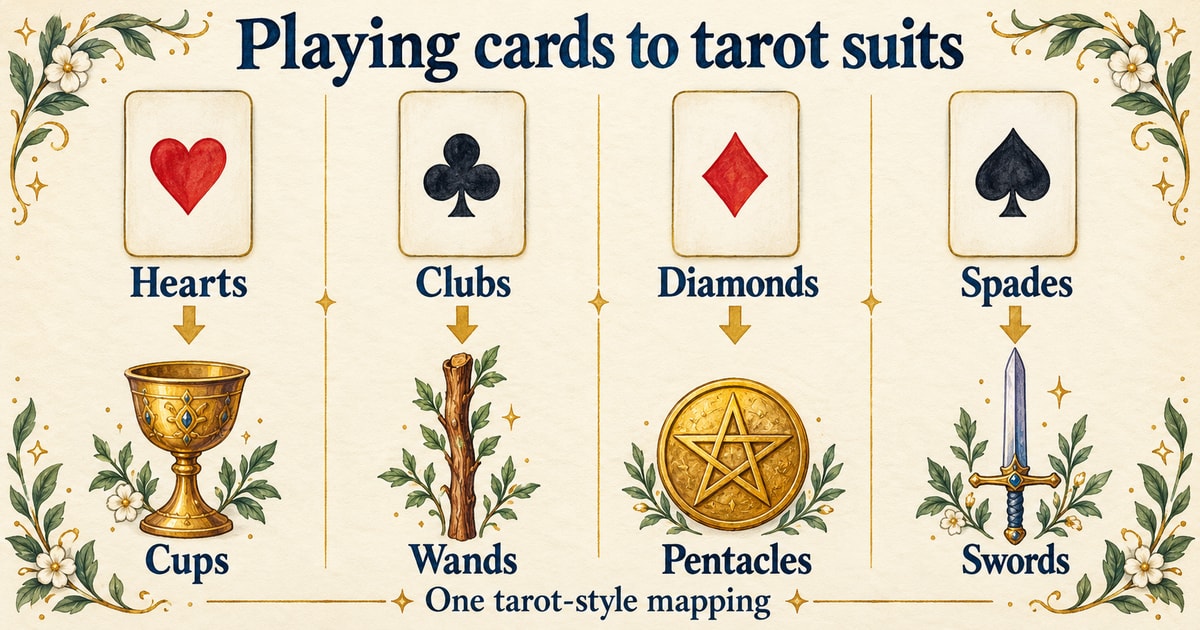
For this exercise, use the four correspondences below. The elemental themes are interpretive associations, not a rule that every cartomancy tradition follows.
- Hearts → Cups
- Water themes: feelings, relationships, care and connection. Begin by asking what the situation brings up emotionally, rather than assuming a Heart must predict romance.
- Clubs → Wands
- Fire themes: initiative, energy, creativity and effort. Ask what is being started, defended or sustained; a Club does not automatically mean a job offer.
- Diamonds → Pentacles
- Earth themes: practical resources, home, money and everyday responsibilities. Look at what needs attention in concrete terms, not a promised financial gain.
- Spades → Swords
- Air themes: thinking, communication, decisions and conflict. Consider the question and card value; a Spade is not automatically a bad omen.
Aces can provide an entry point of beginnings or potential, Fives of friction or change, and Tens of culmination or the end of a phase. These are starting themes, not a complete meaning for every card. Combine the value with its suit and spread position. For fuller playing-card interpretations, use Understanding Cartomancy.
What happens to Pages, Knights and the Major Arcana?
In the method used here, Jack corresponds to Page, Queen to Queen and King to King. A standard playing-card suit has three court cards, while a standard tarot suit has four. That leaves no separate Knight in this mapping.
Some readers instead give the Jack a combined Page-and-Knight role. That is a different choice, not an extra card hiding in the pack. Pick one approach before shuffling so that the meaning does not change just because you prefer another answer. Courts can suggest a role, quality or approach; they need not identify a person of a particular age or gender.
Compared with a standard 78-card tarot deck, your 52-card pack has no separate 22-card Major Arcana and, with the Jack-as-Page choice, no four Knights. Remove the Jokers for this exercise. You do not need to turn one into the Fool. If a spread specifically depends on Major Arcana cards, choose another layout or use a tarot deck.
Prepare a small reading
- Write an answerable question. Try “What could help me approach this week’s responsibilities?” rather than asking for a guaranteed result.
- Choose positions before dealing. Use situation, challenge and advice. Shuffle comfortably, deal three cards and leave them in that order. The spread guide explains how positions shape a reading.
- Record the interpretation and one action. Note the cards, your mapping and what does or does not fit. Finish with a modest step you can take, then review it later.
A worked three-card example
Suppose the question is “What should I pay attention to this week?” and the cards are Seven of Clubs, Three of Spades and Queen of Diamonds. This is an imagined practice example, not a reading about you.
1. Situation: Seven of Clubs
Using the Seven of Wands association, explore defending a position or deciding which demands deserve your effort. Ask: “Where am I feeling pressured, and what is worth standing up for?” Do not assume that a hidden opponent exists.
2. Challenge: Three of Spades
Using the Three of Swords association, consider disappointment, difficult words or a painful realization. Ask what you actually know and what you are adding to the story. The card does not establish betrayal or prove that someone meant to hurt you.
3. Advice: Queen of Diamonds
Using the Queen of Pentacles association, consider practical care and resourcefulness. Ask which ordinary need or responsibility would benefit from attention. This could mean preparing for a task or organizing your space, not a command to spend money or care for everyone else.
Bring the three together: “I may need to hold a reasonable boundary, check a hurtful assumption and choose a practical next step.” For instance, write down the point you want to discuss before a conversation. Keep the response grounded in the actual situation; the cards have not confirmed the story.
Related history, different reading systems
Tarot and playing cards have a connected history, but that does not make today’s correspondence tables universal. The Metropolitan Museum’s history of tarot describes tarot’s development as a card game in fifteenth-century northern Italy. The tarot-style mapping above is a reading method, not evidence that the four modern playing-card suits always carried these spiritual meanings.