

Quick answer
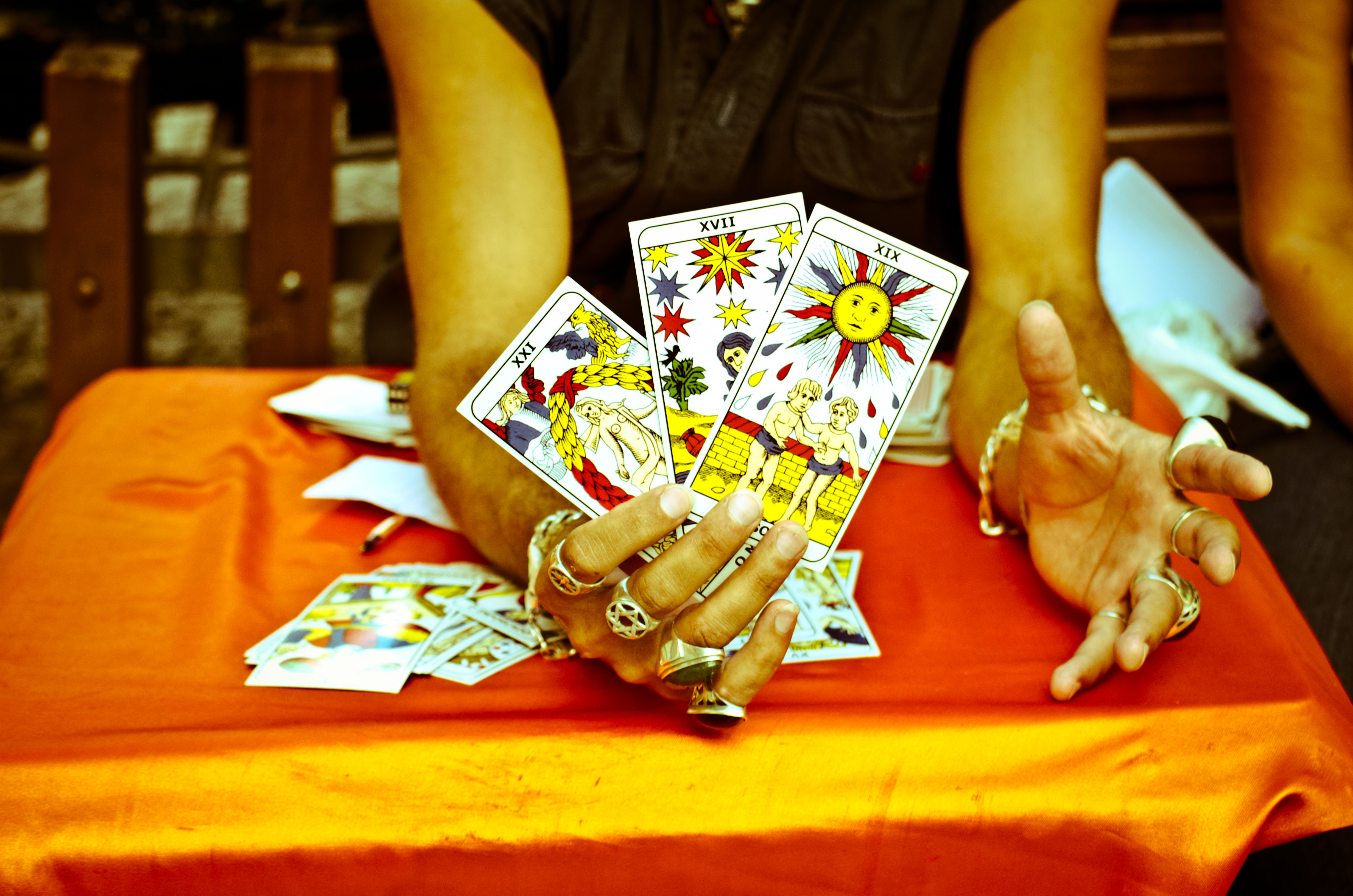
A tarot reader works from the cards: a question, a spread and the traditional meanings of the 78 Rider-Waite-Smith images, which you can see on the table and follow for yourself. A psychic reading, by contrast, rests on the reader’s own stated impressions, with or without a deck in front of them. Some readers do both, using the cards as a framework for what they say. Neither kind of reading has been shown to predict events or know another person’s thoughts, so the practical choice comes down to what you want from the hour: a structured conversation you can check and take notes on, or an open-ended one that depends on how much you trust the person speaking.
Tarot reader or psychic: what actually differs
The clearest difference is what is on the table. In a tarot reading, the cards are the shared evidence. If the Hermit lands in the “advice” position, you can see it, look up its meaning afterward and judge whether the reader’s interpretation was a fair stretch or a leap. In a psychic reading there is nothing to look at, so the whole session rests on the reader’s claims, and broad statements that fit most people can feel uncannily specific; psychologists call this the Barnum effect. That is not an accusation against any reader, only a reason to notice what in a session was specific to you. Readers who describe themselves as mediums, claiming contact with people who have died, are a separate category covered in what are psychic mediums. Whichever you choose, the same rules apply: agree a price and length first, bring a question you can act on, and walk away from anyone who mentions curses, blocks or fees to remove negative energy.
| What to compare | Tarot reader | Psychic (self-described) |
|---|---|---|
| What the reading rests on | A spread of cards and their traditional meanings | The reader’s stated impressions |
| What you can see | Every card and its position, on the table | Nothing; you hear the reader’s account |
| How to check it afterward | Look up the cards; reread your notes | Compare specific claims against what you know |
| Learnable for yourself | Yes, with a deck and practice | Presented as a gift, not a method |
| Typical strength | Structure for thinking through a question | Open conversation with no fixed format |
| Typical risk | Reading predictions into a prompt | Vague statements that fit anyone |
Keep in mind: Tarot meanings are conventions attached to the Rider-Waite-Smith deck of 1909, and no reading, with cards or without, predicts an outcome, reads a mind or confirms what another person feels. Use either kind of session as a way to reflect, and take health, legal, money and safety questions to a qualified professional.
Read the full guide
The introduction hub explains where tarot came from, how the deck is organised and how a reading actually works.