

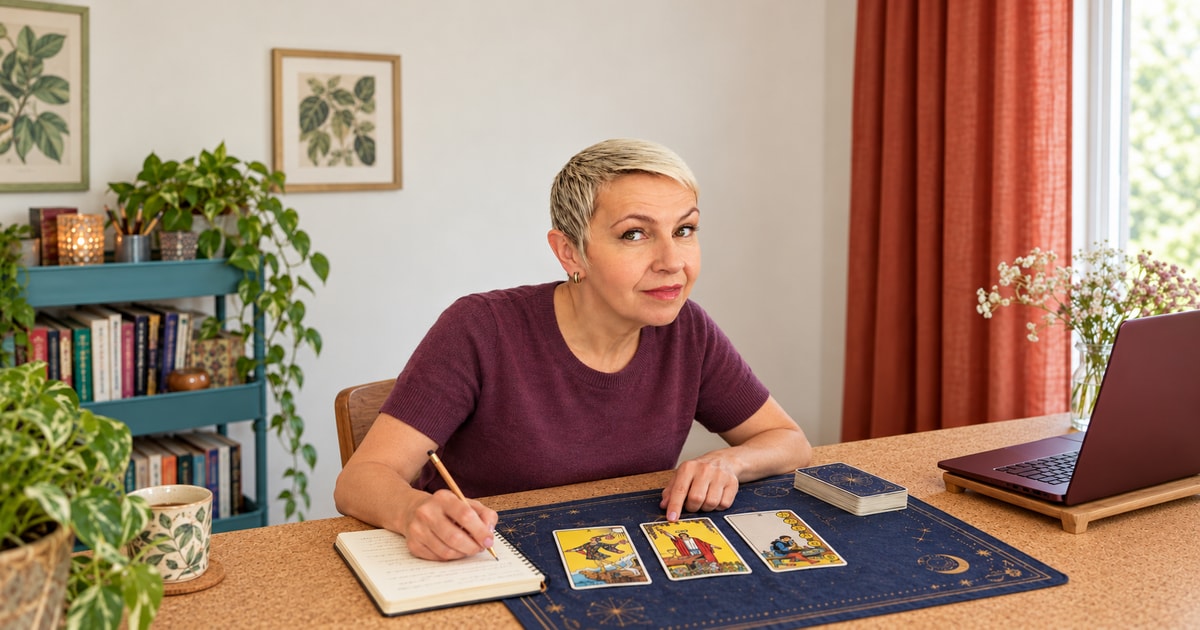
Start with a small, memorable study set
You do not have to memorise all 78 tarot cards in one sitting. These ten offer a manageable introduction to beginnings, choices, change, hope, feelings, work and belonging. Learn an image, a starting theme and one useful question for each.
This is a chosen learning selection, not a universal “best ten” or the deck’s numerical order. Setting these cards aside for study is different from shuffling and drawing from your full deck for a reading.
The image cues follow the Rider–Waite–Smith tradition, illustrated in Arthur Edward Waite’s card guide. Other decks may change the scenes or emphasis. Treat these meanings as starting points for interpretation: your question, deck and personal associations also matter.
Six Major Arcana: recognise the larger themes
These cards offer distinct scenes that are easy to compare. Notice the difference between the Fool’s beginning, the Magician’s purposeful action and the Lovers’ attention to values. Death and the Tower need not be avoided; meeting their imagery calmly can make them less intimidating.
1. The Fool (0)
- Look for
- A traveller pauses near a cliff edge, carrying a small bundle, with a dog beside them.
- Starting theme
- Beginnings, openness and learning through experience.
- Ask
- What would a small first step look like, and what should I notice before taking it?
The invitation is to explore, not to ignore risks. Let curiosity and attention travel together.
2. The Magician (I)
- Look for
- A figure stands at a table bearing a wand, cup, sword and pentacle, with one hand raised.
- Starting theme
- Intention, resourcefulness and putting an idea into action.
- Ask
- Which tools or skills can I use now, and what support is still missing?
You do not have to possess every resource already. Naming a gap can be part of using your power wisely.
3. The Lovers (VI)
- Look for
- Two figures stand beneath an angel; the surrounding landscape includes two trees.
- Starting theme
- Connection, values and choices that ask for alignment.
- Ask
- Does this choice fit the kind of relationship or life I want to build?
Romance is one context, not the only one. The card can invite an honest conversation about what matters.
4. Death (XIII)
- Look for
- An armoured skeleton rides a white horse; a rising sun appears between distant towers.
- Starting theme
- An ending, transition and making room for a different chapter.
- Ask
- What has reached its natural stopping point, and what needs time to change?
Do not use this card to predict someone dying. In a reflective reading, explore the transition actually relevant to the question.
5. The Tower (XVI)
- Look for
- Lightning strikes a crowned tower, with flames and falling figures in the scene.
- Starting theme
- Disruption, a challenged assumption or something that can no longer stay as it was.
- Ask
- What has changed, and which practical support would help me respond?
A difficult event is not proof that you built your life wrongly. Read the card without blaming yourself or anyone else for suffering.
6. The Star (XVII)
- Look for
- A figure pours water onto land and into a pool beneath one large star and seven smaller stars.
- Starting theme
- Hope, replenishment and a gentler relationship with the future.
- Ask
- What restores a little trust or steadiness for me today?
Hope can be quiet and gradual. This card does not set a recovery deadline or guarantee the outcome you want.
If an unsettling card dominates your attention, the guide to interpreting difficult tarot cards offers ways to read the whole situation without treating one image as a sentence.
Four Minor Arcana: bring the ideas into daily life
These examples introduce Cups, Swords and Pentacles. They do not cover every suit: Wands is a useful next addition. For now, compare how a new feeling, a painful thought, steady practice and a sense of belonging each ask a different question.
7. Ace of Cups
- Look for
- A hand emerges from a cloud holding an overflowing cup above water and lilies.
- Starting theme
- An opening for feeling, affection, inspiration or spiritual connection.
- Ask
- What feeling or creative interest would I like to welcome and care for?
Think of an opening rather than a finished promise. A warm exchange does not establish what another person feels.
8. Three of Swords
- Look for
- Three swords pierce a heart against clouds and rain.
- Starting theme
- Hurt, disappointment and the clarity of naming something painful.
- Ask
- What hurts, what do I actually know, and what support would be kind?
The image is intense, but it is not evidence of betrayal. Separate a feeling from an unconfirmed explanation.
9. Eight of Pentacles
- Look for
- A seated craftsperson works on pentacles, with completed pieces arranged nearby.
- Starting theme
- Practice, attention and skill developed through repeated work.
- Ask
- Which small part of this skill can I practise, then review?
This is a useful learning card: one careful repetition can teach more than rushing through the whole deck.
10. Ten of Cups
- Look for
- Two adults raise their arms beneath a rainbow of ten cups, with children and a home nearby.
- Starting theme
- Belonging, emotional fulfilment and a shared sense of enough.
- Ask
- What does a supportive home or circle of belonging mean to me?
Your version may involve chosen family, friends or a different household. The card is not a promise of marriage or a prescribed family shape.
A three-pass practice for each card
Spend a day on each card if that pace suits you, or stay with one for longer. Keep the task small enough that you can return with curiosity.
-
Look before looking up
Choose one of the ten cards deliberately. Describe three things you can see without interpreting them: a gesture, an object and part of the setting. If your deck has different artwork, start with its actual image and guidebook.
-
Name one starting theme
Read the card’s starting theme and put it into your own words. Add one personal or spiritual association if it feels meaningful, while keeping it separate from a fact you can verify. You can begin with upright cards; reversals can wait.
-
Ask, write and return
Use the prompt to write two or three sentences about an ordinary situation. Finish with one possible action or an open question. Return later to see what still fits; you are learning a symbolic language, not grading psychic accuracy.
A helpful notebook entry is: “I can see… / This suggests… / My question is…” You may experience an intuitive impression alongside the image. Write it down as an impression, rather than using it to declare someone else’s thoughts or an inevitable event.
Try a pairing without forcing a story
After learning single cards, deliberately place two together and notice how their themes interact. These imagined examples show the method; they are not accounts of readings or outcomes.
Fool → Eight of Pentacles
You are thinking about a pottery class. The Fool suggests trying something unfamiliar; the Eight of Pentacles brings your attention to the practice that follows. A useful journal line is: “I can ask about a beginner session, then decide whether regular practice suits me.” This is a study pairing, not a prediction of success.
Three of Swords → Star
You feel disappointed after an unanswered invitation. The first card helps you name the hurt; the second asks what might restore some steadiness. “I feel left out, but I do not yet know why they have not replied. I can make another plan and check in once.” Neither card proves someone’s motives.
If you want to practise a three-card spread, choose whether you are studying a selected combination or drawing from the shuffled full deck. Give the positions clear jobs, such as “what I notice / what I need / a possible next step.” Do not quietly switch between the two methods.
What to learn after these ten
- Fill in the Major Arcana. Follow the Fool’s Journey through the Major Arcana to connect individual scenes with a larger learning story.
- Add one suit at a time. Include Wands, then compare the Aces and the numbered cards across all four suits. Keep the court cards as a separate, manageable study session if that helps.
- Return to the complete deck. Use its guidebook when an unfamiliar card appears. Looking something up is part of learning, not a failed reading.
Progress means recognising more of the imagery and asking more thoughtful questions. You do not need a fixed timetable, a dramatic spiritual experience or perfect recall to keep going.
Build a practice you can return to
Choose one card, notice its details and write one honest sentence. When you want the deck’s structure, first spreads and a wider learning route, continue with Tarot Cards for Beginners.