

A tarot reading may suit you when you want time to explore a question, connect with a meaningful spiritual practice or notice a different perspective. You do not need complete certainty about what you believe. You do need room to question an interpretation, decline a topic and make your own decisions.
The useful starting point is not “Will tarot work for everyone?” but “What am I hoping this particular reading will give me?” If the answer is guaranteed certainty, permission to ignore important facts or relief that lasts only until the next booking, it may be worth pausing.
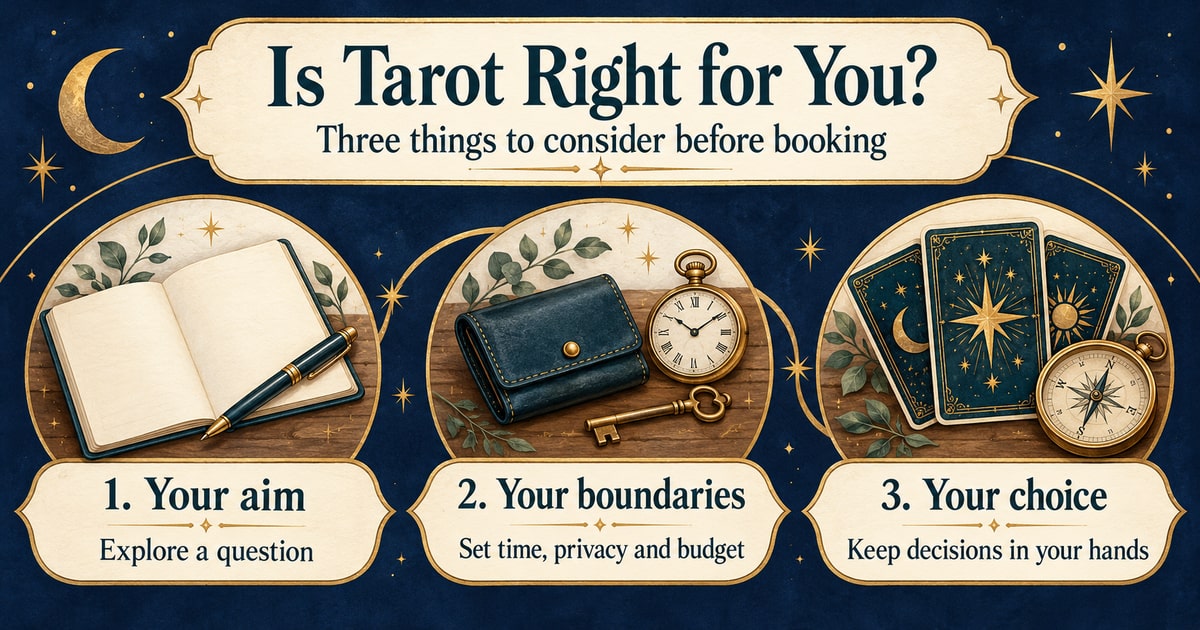
Three things to consider before booking
1. Your aim
Explore a question. Name something you want to understand better, such as a recurring argument, a creative block or your feelings about a change.
2. Your boundaries
Set time, privacy and budget. Decide what you are comfortable discussing and spending. Ask about the session length and recording arrangements before agreeing.
3. Your choice
Keep decisions in your hands. A reading can offer interpretations to consider. You can disagree, leave a suggestion unused or choose not to have another session.
Is a reading a good fit for you right now?
Read these as considerations, not a test you must pass. You can be curious about tarot and still decide that today is not the day.
Your purpose
A reading may be worth considering if you want a new angle on a situation. Be cautious if you want the cards to select the only “correct” answer. You will still need to compare options and live with the choice.
Your response to difficult imagery
Cards such as the Tower or the Devil can invite discussion of change, attachment or habits; they are not proof of disaster. If those images would leave you frightened, ask how the reader handles them, request a gentler approach or skip the session.
Sharing context
Some readers welcome conversation; others begin with fewer details. Ask about the style. You may keep personal information private, and you do not have to disclose painful experiences to prove that you are open to a reading.
How often you want reassurance
One session followed by time to reflect is different from booking repeatedly until an answer feels safe. If the urge to ask again keeps returning, consider a break and a conversation with someone supportive instead of another purchase.
The kind of answer you need
Tarot may help you explore feelings about work, relationships or creativity. It cannot establish a diagnosis, determine your legal position, calculate an affordable debt plan or verify another person’s intentions. Use the appropriate practical or professional help for those questions.
A worked example: thinking about a job change
“Will this job be mine?” asks for certainty that a spread cannot verify. “What do I need to consider before applying?” leaves room for reflection and useful follow-up.
Two of Pentacles: the juggling imagery might prompt you to examine competing demands. What would the commute, caring responsibilities and working hours actually involve?
The Hermit: a traditional association with reflection might suggest making time to identify your own priorities, rather than adopting someone else’s idea of a good career.
Eight of Wands: imagery often linked with movement might raise a question about pace. Is there a real deadline, or do you merely feel pushed to decide immediately?
The next step could be to read the job details carefully and ask the employer about the schedule. That action follows from your question; it is not evidence that the cards know whether you will be hired. Spiritual or intuitive meaning can remain part of the experience without replacing facts.
Choose a format and reader you feel comfortable with
You might prefer a conversational phone or video session, an in-person reading or a written interpretation you can revisit. Ask whether follow-up questions are included and what happens if you want to stop. Confirm the total cost and any cancellation terms; do not assume a free introduction covers the whole session.
Ask the reader how they approach future-oriented questions and uncertainty. A prediction is an interpretation, not verified knowledge of an event or someone else’s thoughts. Promises of guaranteed reconciliation, threats about curses or pressure to pay extra to prevent harm are reasons to step away.
If the process itself feels unfamiliar, our step-by-step guide to a tarot session explains questions, spreads and the closing conversation. You can also try a small self-reading or journal exercise before deciding whether to pay someone.
When waiting is the kinder choice
You are allowed to wait because the timing, price, imagery or approach does not feel right. You do not need to book to prove your intuition, spirituality or willingness to grow.
If you are distressed or low mood is affecting daily life, put support ahead of seeking the perfect reading. The NIMH guide to caring for your mental health explains self-care and when to seek professional help. A spiritual practice can sit alongside care; it need not carry the whole burden.
In the United States, if you have thoughts of harming yourself or need immediate emotional support, call or text 988. Reaching a person matters more than drawing another card for reassurance.
If you decide to try a reading
Take one clear question and your own boundaries with you. Our guide to getting a great tarot reading covers choosing a reader, preparing questions and using what you hear afterwards. The choice to book—or not book—remains yours.