
A tarot affirmation is a short, personal reminder inspired by a card. It might help you return to a quality you want to practise: patience, courage, rest or a clearer boundary. The most useful sentence is not necessarily the most positive one. It is one you can believe enough to use.
You may treat the card as a spiritual symbol, an intuitive prompt or a picture to reflect on. Repeating its message does not guarantee an outcome or control another person. Give the words a small action to accompany them, rather than asking them to carry the whole situation.
Write an affirmation you can stand behind
Begin with a situation, not a demand to feel differently. You can choose a card deliberately; you do not have to draw randomly or accept a card that feels upsetting.
1. Name the moment
Be specific: “I rush to agree when someone asks a favour” is easier to work with than “I am bad at everything.” Notice the feeling without making it your whole identity.
2. Look for a quality
Choose an image that suggests what you need. Strength might suggest calm firmness; Four of Swords might invite a pause. Ask what that quality would look like in this situation.
3. Make the words believable
Try “I can ask for time to think” instead of “I am always confident.” If “I can” feels too strong, try “I am willing to practise.” Keep your actual circumstances in view.
4. Add a small action
For the favour example, your action might be to say, “Let me check and get back to you.” The sentence is a cue; the practical response gives you something to try.
Six tarot cards, six possible reminders
These examples draw on familiar Rider–Waite–Smith imagery. They are starting points, not fixed instructions from the cards. Your deck may show the themes differently, and you can change any sentence to suit you.
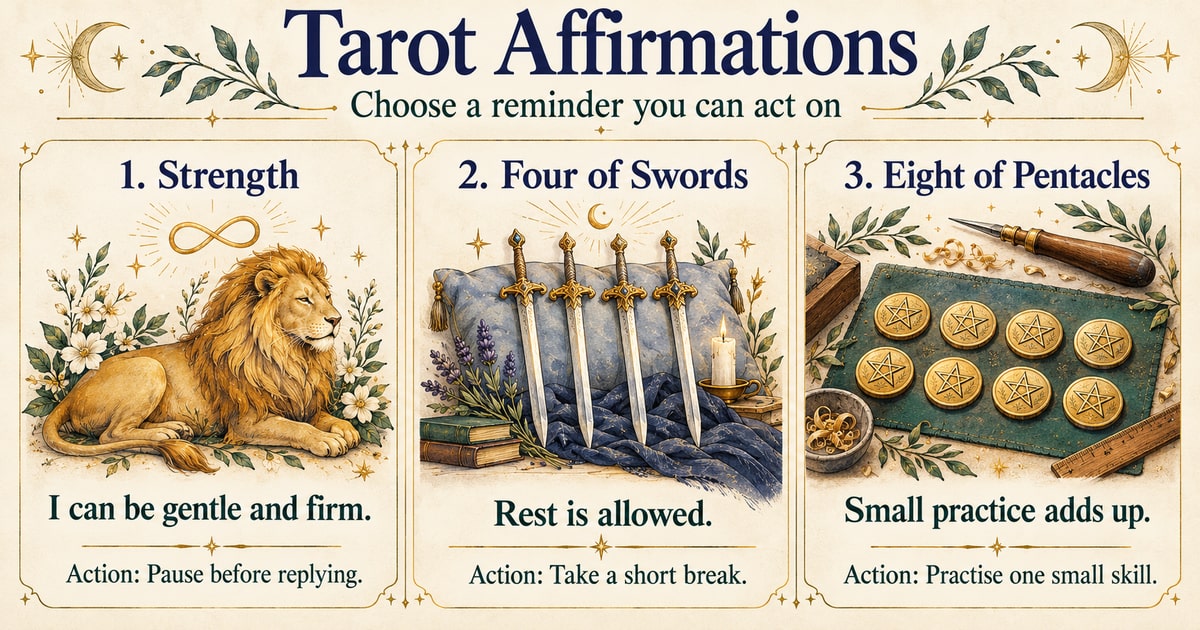
Strength
A calm figure with a lion can suggest courage without force.
“I can be gentle and firm.”
Try it: Pause before replying to a difficult message. State one boundary without adding an apology for having it.
Four of Swords
The resting figure can prompt a deliberate break rather than constant effort.
“Rest is allowed.”
Try it: Take a short break if you can. If you have caring or work responsibilities, identify a realistic pause or ask someone for help.
Eight of Pentacles
The craftsperson working on pentacles suggests attention and repeated practice.
“Small practice adds up.”
Try it: Practise one small skill for a few minutes. Record what you attempted, not just whether you got it right.
Two of Wands
The figure surveying a wider view can suggest planning before committing.
“I can choose my next step.”
Try it: List two realistic options and one piece of information you need. You do not have to decide your whole future today.
The Star
The water and open sky are often associated with hope and renewal.
“I can make room for a little hope.”
Try it: Choose one sustaining activity or contact someone supportive. Hope need not mean pretending that a loss or difficulty has ended.
Queen of Swords
The upright sword can suggest clarity and discernment.
“I am allowed to say what I mean.”
Try it: Write one clear request before a conversation. Being direct can still leave space to listen and to revise your view.
A short routine, without a repetition target
Place one card beside your notebook. Read your sentence, notice your response and choose the action that goes with it. Later, write a line about what happened: “I asked for time,” “I forgot, then tried again,” or “This wording did not help.”
Keep the card somewhere private if you prefer. There is no required number of repetitions, perfect time of day or streak to protect. Missing a day does not cancel anything. For a slower approach, try our single-card meditation practice.
If the affirmation feels false or makes you feel worse
Do not force yourself to agree. “Everything is fine” may clash with a genuinely hard day. “This is difficult, and I can ask for support” leaves room for both the difficulty and a choice.
Positive statements are not helpful for everyone. In two experiments reported in 2009, participants with low self-esteem felt worse after repeating a strongly positive self-statement than in comparison conditions. That study did not test tarot; it is a reason to avoid assuming that a brighter slogan must be better.
Try a neutral observation, a question or no affirmation at all. “What would help me with the next ten minutes?” may be more useful today. The NHS guide to reframing unhelpful thoughts offers a separate, evidence-checking approach. Tarot symbolism can be personally meaningful without being evidence that a thought is true.
Support matters more than finding perfect words
An affirmation should not become another test you feel you are failing. If low mood, anxiety or distress is persistent or affecting daily life, speak with a qualified health professional. You can keep a spiritual practice alongside care, but you do not need to solve your symptoms with a sentence.
If you are in the United States and have thoughts of harming yourself or need immediate emotional support, call or text 988. Put reaching a person ahead of another card draw or repetition.
Keep the practice kind and practical
Our tarot and mental wellness guide brings together journaling, reflection and support. Start with one believable reminder and one manageable action; leave the rest for another day.