

Quick guide
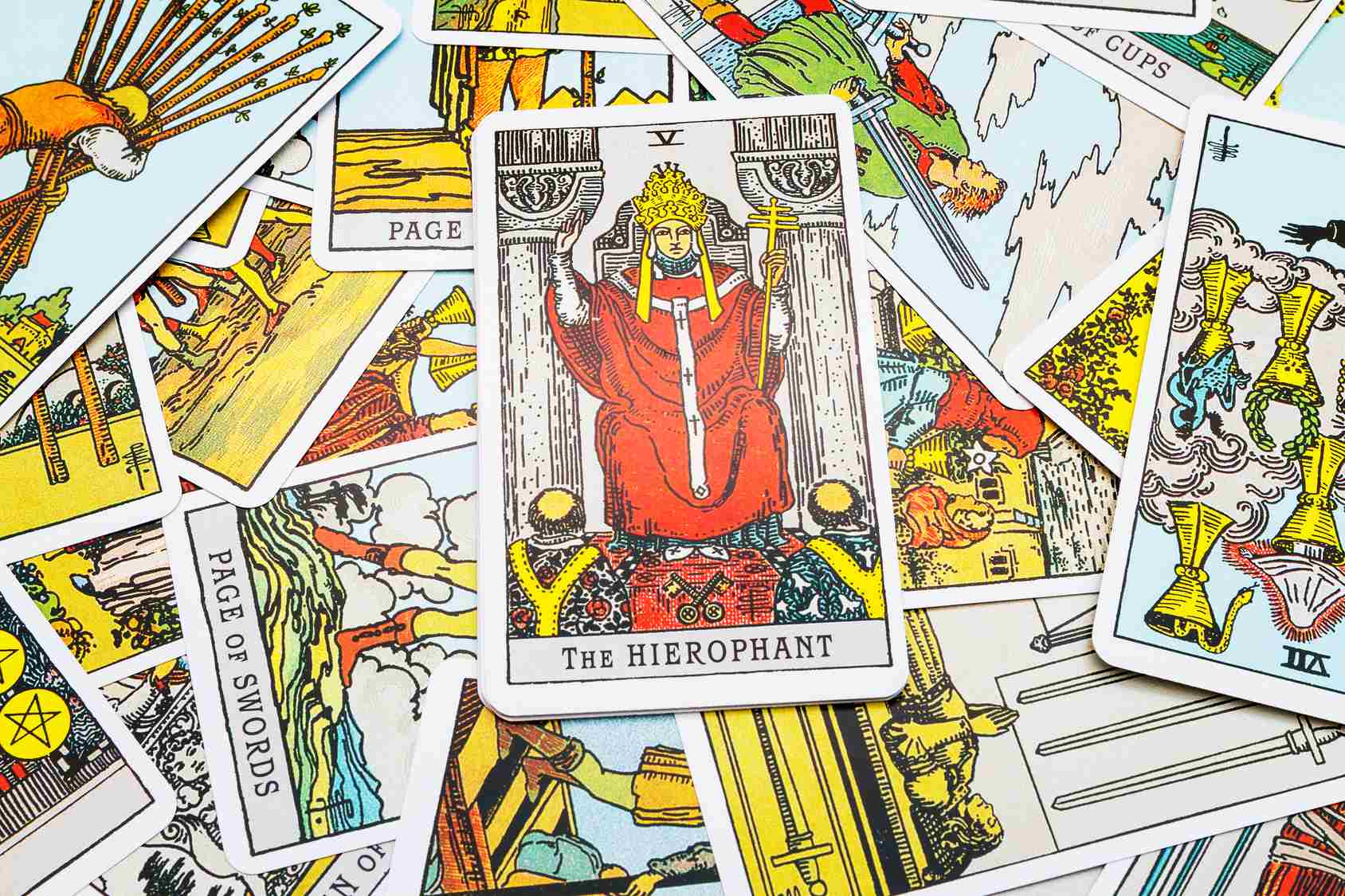
The Hierophant is card V of the Major Arcana. In the Rider-Waite-Smith deck a robed figure sits on a throne between two grey pillars, wearing a triple crown and raising one hand in blessing while the other holds a staff topped with a triple cross. Two crossed keys lie at his feet and two acolytes kneel before him, one in a robe of roses and one in a robe of lilies. Upright, his traditional keywords are tradition, teaching, institutions, shared belief and doing things the established way. Reversed, readers speak of rigid rules, questioning authority or finding your own path. The one question he usually raises is this: in this situation, does the tried and tested route serve you, or is it time to think for yourself?
| At a glance | |
|---|---|
| Arcana / number / suit | Major Arcana, number V |
| Upright keywords | Tradition, teaching, mentorship, institutions, shared values, ceremony |
| Reversed keywords | Rigid rules, dogma, rebellion, unconventional choices, questioning authority |
| Element / astrological association (tradition) | Earth; the sign Taurus (Golden Dawn correspondence) |
| Yes/no reading (convention) | Usually a yes when the question is about following an established or conventional route; otherwise read as neutral |
The image and its symbols
Pamela Colman Smith’s 1909 Hierophant is a picture of an institution. The figure sits squarely on a stone throne, framed by two grey pillars, dressed in a red robe with a white trim and a three-tiered crown. The right hand is raised with two fingers up and two folded down, the traditional gesture of blessing. The left hand holds a long staff that ends in a cross with three bars.
Everything in the picture comes in threes and twos. The triple crown and the triple cross are usually read as three levels of understanding, or as the mind, the heart and the body brought under one teaching. The two pillars, unlike the black and white pair on the High Priestess card, are the same colour: this is a figure who speaks for agreed rules rather than for the tension between opposites. At his feet lie two crossed keys, one gold and one silver, traditionally read as the keys to knowledge that a teacher can hand on to a student.
In front of him kneel two tonsured acolytes with their backs to us. One wears a robe patterned with red roses, the other with white lilies, the same flowers that grow around the Magician. They stand for the people who come to the institution to learn: passion and purity, both asking to be taught. The word hierophant comes from the Greek for someone who shows sacred things, and in the older Marseille pattern the card is simply Le Pape, the Pope. Modern decks keep the idea of a teacher who stands inside a tradition and passes it on.
Upright meaning
Upright, the Hierophant is traditionally the card of the established way. Readers take it to mean that a situation is governed by shared rules, a recognised path or a body of knowledge that already exists, and that the sensible move is to learn it before trying to improve on it. It covers formal learning, qualifications, mentors, ceremonies, religious or community life, and any moment when belonging to something larger than yourself matters.
Position shapes the reading. In a present position the card describes a situation where conventions carry weight: a wedding, a course, a hierarchy at work, a family expectation. In an advice position many readers summarise it as “ask someone who has done this before, and follow the usual steps.” In an obstacle position it can point to rules that no longer fit, or to a tendency to do things the accepted way when the accepted way is the problem. In a future position, readers see a formal step or a period of learning ahead, and treat that as something to prepare for rather than a forecast.
The Hierophant is often called the marriage card, and it is worth being clear about what that means. The card is linked to ceremony and commitment made in front of others, so it appears in readings about weddings, vows and formal partnerships. It does not predict that a wedding will happen. It raises the subject so you can think about what formal commitment would mean for you.
Reversed meaning
Reversed, the Hierophant usually describes rules that have hardened into dogma. Readers see it when a tradition is being followed for its own sake, when “that is how we have always done it” is the only argument left, or when an authority figure expects obedience rather than understanding. The prompt is to ask what the rule was originally for, and whether it still does that job.
The reversed card also has a hopeful reading. It can describe a person stepping outside an expected path: leaving a faith or joining one, choosing an unconventional relationship, starting a career nobody in the family understands, or learning a subject without a formal course. Readers treat this as a prompt to make the choice deliberately, with respect for what is being left behind, rather than as a judgement on whether the choice is right. A reversed card describes a tension you can work with, not a verdict.
In a love reading
Upright in a love question, the Hierophant is traditionally read as shared values and formal commitment. For a couple it raises questions about the next conventional step, meeting families, moving in, engagement or marriage, and about whether you both want the same shape of relationship. For someone single it suggests looking for a partner whose values match yours and meeting people through communities you already belong to, rather than through chance alone.
Reversed, readers often see a mismatch about tradition: one partner wants a formal commitment and the other does not, or family and community expectations are pressing on a relationship that would be happier on its own terms. The traditional advice is to have the conversation about what each of you means by commitment. No card can confirm how someone feels about you, whether a relationship will last or whether a wedding is coming, and tarot does not read another person’s mind. If a relationship involves control, fear or threats, speak to a person who can help: the National Domestic Violence Hotline is 1-800-799-7233, or text START to 88788.
In a career or money reading
At work, the upright Hierophant is the card of structure: a large organisation, a profession with qualifications, a trade with an apprenticeship, or a mentor who has walked the path before you. Readers take it as a prompt to learn the established methods, respect the hierarchy long enough to understand it, and seek out a teacher. It also appears in readings about teaching, training, counselling and religious or community roles.
In money questions the card traditionally favours conventional, well-understood choices over clever shortcuts: the boring savings plan, the standard contract, the adviser with proper credentials. Reversed, it can describe rules that are blocking a sensible change, or a reluctance to challenge an institution that is not serving you. The card is a reflection tool, not financial advice. For pensions, investments, contracts or debt, use the reading to clarify your questions and then put them to a qualified professional.
How to work with this card
- Name the tradition. Write down which rule, expectation or institution is shaping the situation, and where it came from.
- Find a teacher. Identify one person who has already done what you are trying to do, and ask them one specific question.
- Test the rule. Ask what the rule was designed to protect, and whether following it here achieves that.
- Choose on purpose. If you decide to leave the usual path, write one sentence explaining why, so the choice is yours rather than a reaction.
- Review later. After a month, note whether the conventional route or your own route served you better.
Cards that often appear with it
With the Lovers, the Hierophant is traditionally read as a relationship approaching a formal step, vows, engagement or a public commitment, and readers use the pair as a prompt to talk about what commitment means rather than as a prediction of a wedding. With the Fool, the pair sets rules against freedom: the established route on one side and the untried leap on the other, with the question being which the situation needs. With the Three of Pentacles, readers usually see learning a craft within a team or institution, an apprenticeship, a qualification or a mentor relationship that rewards patience.
Key takeaways
- The Hierophant is card V of the Major Arcana and the traditional card of tradition, teaching and shared belief.
- Its Rider-Waite-Smith symbols, the triple crown, crossed keys, raised hand and two acolytes, describe knowledge handed on inside an institution.
- Reversed, it points to rigid rules, dogma or a deliberate step away from the expected path.
- In love and work it raises the subject of formal commitment and established methods, but it cannot predict a marriage or a promotion.
- Use the card to name the tradition at work in your situation, find a teacher and test whether the rule still does its job.
Related reading
- The Fool’s Journey: the 22 Major Arcana cards in order
- The High Priestess tarot card meaning
- The Hermit tarot card meaning
- Tarot cards for beginners
- Love tarot readings: questions, spreads and limits
Frequently asked questions
1. What does the Hierophant card mean in tarot?
In the Rider-Waite-Smith tradition the Hierophant stands for tradition, teaching, institutions and shared values. It is a prompt to consider the established way of doing something, not a prediction that an event will happen.
2. Is the Hierophant a good card?
Most readers see it as steady and supportive, because it points to guidance, structure and people who have done this before. Whether that is welcome depends on the question, since structure helps in some situations and limits in others.
3. What does the Hierophant mean reversed?
Reversed, the Hierophant traditionally points to rigid rules, dogma or an authority that expects obedience, or to a deliberate choice to step outside the expected path. Readers decide which applies from the question and the surrounding cards.
4. Does the Hierophant mean marriage?
The Hierophant is linked to ceremony and formal commitment, so it often appears in readings about weddings and vows. It raises the subject of commitment for reflection; it does not predict that a marriage will take place.
5. What does the Hierophant mean in a love reading?
Upright, it suggests shared values, formal commitment and the next conventional step in a relationship. Reversed, it often points to a mismatch about tradition or outside pressure, which is a prompt for a conversation rather than proof about a partner.
6. What does the Hierophant mean for career and money?
It is the card of structured organisations, qualifications, mentors and established methods, and it advises learning the rules before trying to change them. In money questions it favours conventional, well-understood choices, and it is never a substitute for professional financial advice.
7. Does the Hierophant mean yes or no?
By convention the Hierophant is read as a yes when the question is about following an established or conventional route, and as neutral otherwise. Yes/no readings are a simplified use of the cards and carry no predictive power.
8. What do the two keys on the Hierophant card mean?
The crossed gold and silver keys at the Hierophant’s feet are traditionally read as the keys to knowledge that a teacher can pass to a student. Some readers also see them as the balance between outer practice and inner understanding.
9. Who are the two figures kneeling in front of the Hierophant?
They are two acolytes, one in a robe patterned with roses and one with lilies, traditionally read as students who have come to learn. The flowers match those around the Magician and stand for passion and purity.
10. What does the Hierophant card mean as a person?
As a person, the Hierophant describes a teacher, mentor, adviser or representative of an institution, or someone who values tradition and doing things properly. Reversed, it can describe someone rigid or someone who rejects convention.
11. Which zodiac sign is linked to the Hierophant?
The Golden Dawn system assigned the Hierophant to Taurus and to the element of Earth. This is a tradition used in astrological tarot, not a fact about people born under the sign.
12. What does the Hierophant mean in a future position?
In a future position readers usually see a period of formal learning, a ceremony or a decision about whether to follow an established path. They treat the card as something to prepare for and think about, not as a forecast of what will happen.
Evidence note: The meanings on this page are conventions attached to the Rider-Waite-Smith deck (1909) and the guidebooks that follow it, not findings about how the world works. Tarot began as a card game in Italy in the 1430s and divinatory use came centuries later (see Britannica on tarot). No reading predicts events, reads another person’s mind, confirms a marriage or sets a timeline. A card that feels like it describes you may do so because broad statements fit almost anyone, an effect psychologists call the Barnum effect. If your question is about health, legal matters or money, use the card to clarify your thinking and then take the question to a qualified professional. In the US, call or text 988 if you are struggling with low mood or thoughts of self-harm.