

A difficult email can land differently when you are rested than when you are running on very little sleep. That does not make the feeling imaginary. A body check adds context: what do you need, and what else about the situation deserves attention?
Some tarot readers use “energy” to describe atmosphere or intuition. Here, the practical focus is your everyday capacity and attention. Cards can prompt a pause, but they cannot measure your physical condition or decide whether an emotion is justified.
Six questions that leave room for the feeling
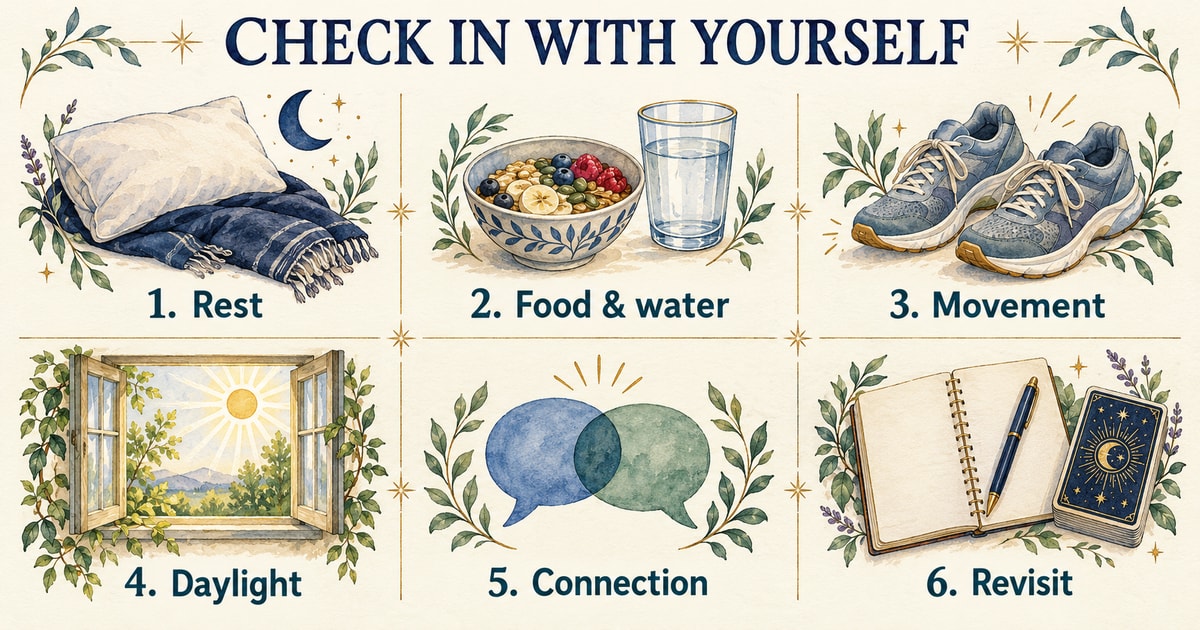
Use these as invitations, not a pass-or-fail checklist. You do not have to complete all six before taking a concern seriously. The NIMH’s self-care guidance includes sleep, regular meals, activity and connection, while recognising that helpful routines differ between people.
1. Rest: how rested do I feel?
Notice a short night, interrupted sleep or a demanding stretch of days. Sleep deficiency can affect managing emotions and making decisions, but there is no single six-hour threshold that explains everyone’s reaction.
Try: if a response can safely wait, give yourself a pause and plan another look. If you cannot wait, make the next step small and concrete rather than dismissing your feelings as tiredness.
2. Food and water: what have I had today?
A busy day can make basic needs easy to overlook. Check when you last ate or had something to drink without assuming hunger or dehydration explains the whole emotion.
Try: choose an available meal, snack or drink that fits your needs and any medical guidance you follow. This is care, not a test you must pass before you are allowed to feel upset.
3. Movement: would a change of pace help?
A little comfortable activity may offer a welcome break. A twenty-minute walk is not a universal mood reset, and walking is not possible or desirable for everyone.
Try: consider a short walk, gentle seated movement, stretching within your limits or simply changing position. Rest is also a valid choice. Notice the effect rather than demanding a particular result.
4. Daylight: would a different setting feel useful?
If you have been in one room for hours, consider whether you want a change of surroundings. Being indoors does not automatically cause low mood, and going outside is not a treatment plan.
Try: if safe and practical, take a brief outdoor break or sit somewhere comfortable near a window. Adapt to weather, accessibility and how you actually feel.
5. Connection: what kind of company do I want?
You might need a trusted listener, practical help or quiet time without demands. Sadness and anger do not have to be loneliness in disguise, and one conversation cannot establish their cause.
Try: ask specifically: “Could you listen for a few minutes?” or “Can you help me think through this?” Choose someone safe; connection need not mean contacting the person you are upset with.
6. Revisit: what still needs my attention?
After any small adjustment, name the feeling again. If it changes, that does not mean your original concern was false. If it stays, that does not prove there is only one cause.
Try: separate a body need from a situation need. You may need both a meal and a boundary, both rest and a difficult conversation, or support that a checklist cannot provide.
An optional two-card reflection
In this body-and-feeling spread, give each position a question rather than diagnostic authority. You can write answers without drawing any cards.
- Record what you know. Write one body observation, one feeling and one relevant fact about the situation. For example: “Slept poorly; hurt; received a short reply.” Keep a guess such as “they are angry” separate.
- Draw for the body. Ask “What support could I consider?” The Four of Swords may suggest rest or a pause; the Ten of Wands may invite reflection on your load. Check that suggestion against your actual circumstances.
- Draw for the feeling. Ask “What wants to be acknowledged?” The Three of Swords can offer an image of hurt without proving betrayal, exaggeration or another person’s intention.
- Choose one practical next step. Name what you will do, what can wait and whether you need someone’s help. You do not need a different card to make an unwelcome feeling acceptable.
If you want a structure for recording interpretations, see shuffling, laying out and journaling with tarot.
Rest and hurt can both be real
Imagined example: you slept badly and feel hurt by a brief email. Your body card is the Four of Swords and your feeling card is the Three of Swords. Instead of concluding “I am only exhausted,” you note both needs: a pause before replying and clarity about the message. Later, you ask the sender what they meant rather than letting the cards supply their motive.
That is the value of slowing down: more room for a considered response, not a reason to overrule yourself. Food, rest or a pleasant walk does not excuse mistreatment. A concern about safety or urgent care should not wait for the end of a reading.
When a check-in is not enough
If low mood, anxiety or exhaustion persists, feels severe or interferes with everyday life, speak with a healthcare professional. You do not have to prove you have perfected self-care before asking for help. A reading cannot establish why symptoms are happening.
In the United States, call or text the 988 Suicide & Crisis Lifeline for emotional distress or thoughts of suicide. If there is immediate danger, call emergency services.
Continue to Tarot and Mental Wellness for more ways to use reflection alongside everyday routines and appropriate support.