

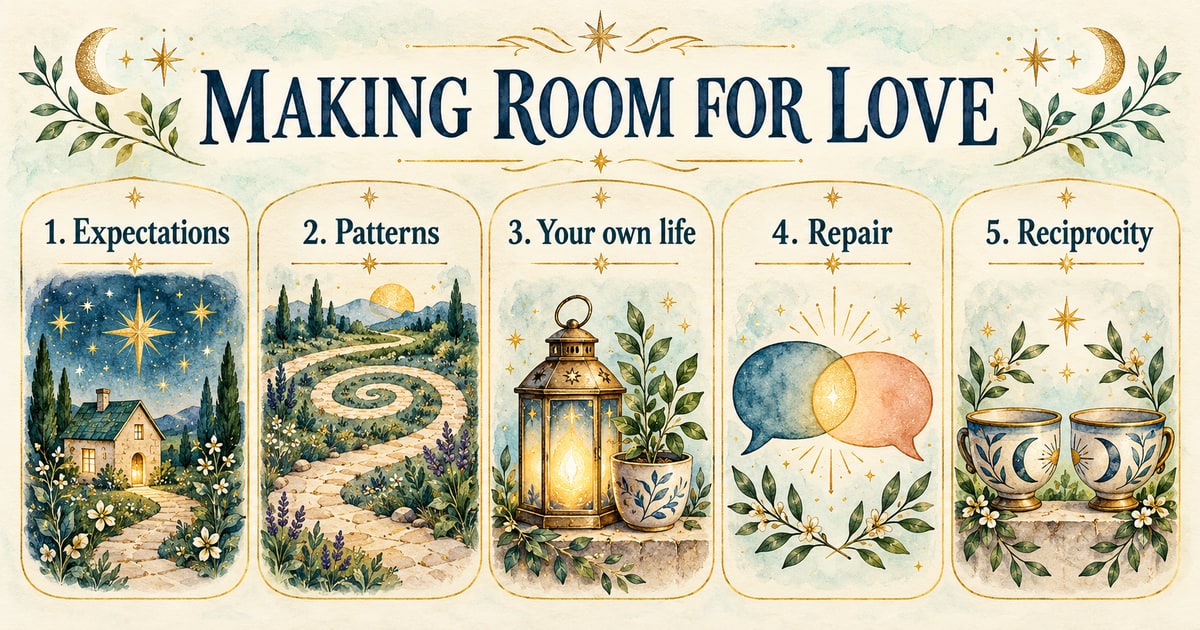
If “soulmate” is your word for a deeply meaningful bond, you can hold that hope without making your life a waiting room. A tarot practice can help you explore what you want to share, how you relate and what you will no longer accept.
There is no need to earn love by becoming perfectly healed or endlessly positive. These five prompts are invitations to reflect, not instructions for making a particular person arrive. A spiritual interpretation can be meaningful while another person’s interest, choices and consent remain their own.
Five things to explore before your next relationship
Choose whichever question feels useful today, or take one each week. You do not need a relationship history to begin. The card associations below draw on Rider–Waite–Smith-style reading traditions; your deck’s imagery and guidebook may offer another angle.
1. Expectations: what does love look like on an ordinary day?
Excitement and stability need not be opposites. Rather than deciding how attraction must change by a particular month, describe what matters beyond the rush: keeping plans, making time, affection or being able to disagree respectfully.
Single-card prompt: “What do I expect love to feel like?” The Ten of Pentacles can invite thought about a shared life and belonging. Ask what that means to you, not whether someone meets a traditional picture of family.
Journal line: “One sign of care I can actually observe is…”
2. Patterns: what would I like to do differently?
Look at a few past connections, if you have them, without turning their endings into evidence that you are the problem. Note specific events: rushing commitment, leaving needs unspoken or staying after a boundary was ignored. Someone else’s harmful behaviour is not something you attracted.
Single-card prompt: “Which pattern deserves my attention?” The Devil may bring up attachment or feeling stuck; the Five of Pentacles may bring up exclusion or support. Neither diagnoses you or predicts rejection.
Journal line: “Next time I notice this situation, I could…”
3. Your own life: what do you want to keep growing?
Enjoying your own company does not mean never feeling lonely. Think about friendships, interests, rest or plans you want to retain alongside a relationship. You are allowed to want partnership and still value the life you have now.
Single-card prompt: “What part of my life needs room?” The Hermit can suggest reflective time; the Nine of Pentacles can suggest autonomy or enjoyment. They do not instruct you to withdraw from everyone.
Journal line: “Something I want to keep making time for is…”
4. Repair: how do you respond when something goes wrong?
Recall a manageable disagreement. Could you listen, explain your need and acknowledge your part? An apology is more useful when it names the action and what will change, rather than promising never to disagree again.
Single-card prompt: “What would a fair repair look like?” Justice can prompt accountability; the Page of Cups can suggest an honest emotional opening. Taking responsibility is not the same as accepting all the blame.
Journal line: “I can own this part, and I still need…”
5. Reciprocity: what can you give and receive?
Picture an ordinary Tuesday rather than a grand romantic gesture. What attention, time or practical support can you realistically offer? What do you need in return? Generosity should leave room for your limits, not become an audition for love.
Single-card prompt: “What does mutual care ask of me?” The Six of Pentacles can raise questions about balance, the Queen of Cups about care with boundaries and the Knight of Pentacles about dependable effort.
Journal line: “A sustainable offer is…; a need I can express is…”
A one-card routine you can actually finish
- Choose one prompt. Write your own first response before shuffling. Draw one card, or simply use a card image you want to study.
- Separate image from assumption. Name one thing you see, one possible association and one fact from your life. Do not let a symbol supply another person’s feelings.
- Close with a small choice. Write a next step within your control and a date to revisit it. If the draw is confusing, record that and stop; you do not need to redraw until the answer feels reassuring.
A repeating card is a reason to revisit your notes, not a verdict about your worth or a deadline for meeting someone. If the reading becomes a cycle of checking, close the deck and return to something concrete.
Move from a hopeful idea to one real-world step
Imagined example: you draw the Nine of Pentacles for your own life. You notice that you enjoy a weekly class but have been skipping it while waiting for a date to confirm plans. Your next step is to keep the class and ask the date directly about availability. The card did not reveal a destined partner; it helped you name something you value.
Other steps might be accepting a low-pressure invitation, choosing a shared-interest activity or telling someone what pace feels comfortable. An unanswered message or a clear “no” is not a spiritual test to overcome. Leave space for mutual interest rather than trying to persuade a specific person to fulfil a reading.
When you do meet someone, compare the sense of connection with how you treat each other over time. See recognizing a meaningful bond and conversations about a shared life for more questions to explore together.
Keep your hope, boundaries and budget together
A strong connection does not require accepting control, humiliation or fear. Love is respect’s conflict guidance distinguishes ordinary disagreements from personal attacks and fear of retaliation. You do not have to become better at apologising to make mistreatment acceptable.
If you choose a paid reading, agree on the price and length first. Be cautious of guarantees that payment can make a particular person love you, or pressure to buy repeated rituals to remove a supposed blockage. A reader can discuss spiritual interpretations without controlling someone else’s choices.
If loneliness brings persistent low mood or makes everyday life difficult, consider speaking with a trusted person or healthcare professional. In the United States, you can call or text the 988 Suicide & Crisis Lifeline for emotional distress or thoughts of suicide. For immediate danger, contact emergency services.
For single-person and couple spreads, continue to the Love Tarot Readings guide. Let the reading support a life you are living, rather than postpone it until someone arrives.