

A tarot reading can feel meaningful without every statement being true. Perhaps a card helped you name a concern, notice an overlooked possibility or choose a useful next step. Those experiences deserve a careful description. They are different from showing that a reader can reliably predict events or know another person’s private thoughts.
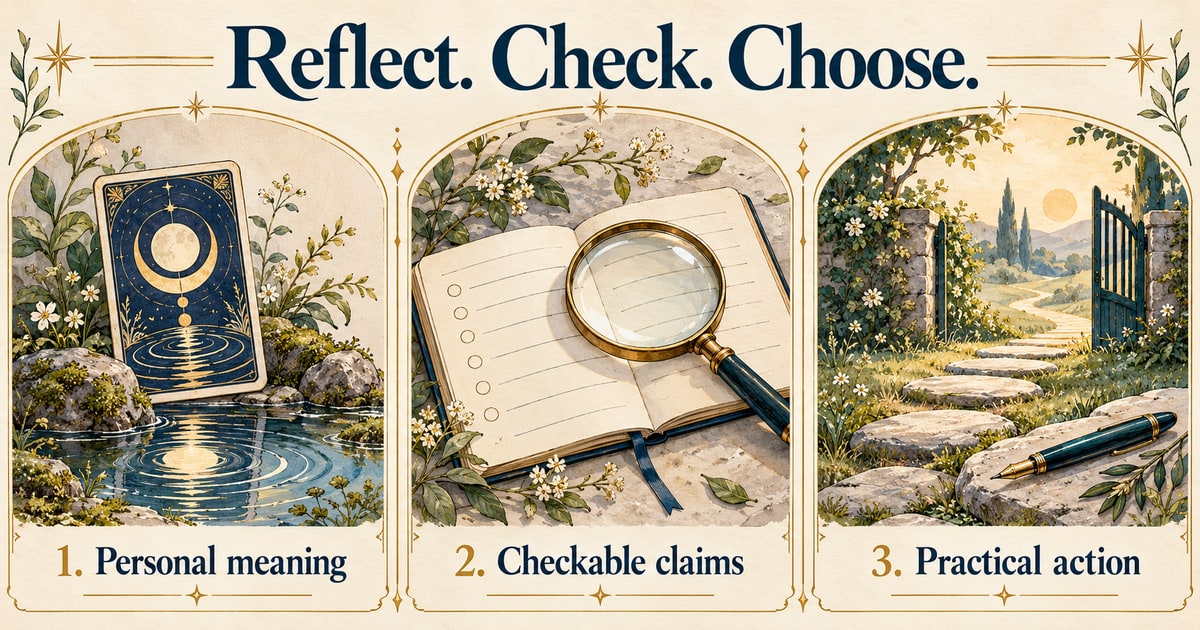
To judge a reading fairly, separate three questions: what resonated, what could be checked and what you chose to do. You can value the spiritual experience while keeping those distinctions clear.
What do you mean by “accurate”?
Tarot images offer a language for interpretation. Different decks and traditions use that language differently; a card’s meaning is not a measurement of your situation. Before rating a session, consider which of these experiences you are describing.
1. Personal meaning
“That image captured how I felt.” The Nine of Swords might prompt you to ask what has been keeping you awake. If the question fits, you can explore it. If it does not, you can say so. The card itself does not establish that you are anxious or hiding a problem.
Resonance is a personal response, not a test of a reader’s access to hidden facts.
2. Checkable claims
“The reader stated something that could be right or wrong.” Write down the actual words, how specific they were and what information you had already shared. “There is tension at work” leaves much more room for interpretation than a clearly defined claim.
A correct detail is worth recording, alongside incorrect details and uncertainty. One apparent hit does not establish reliable predictive ability.
3. Practical usefulness
“The conversation helped me decide what to do.” You might prepare a question for a colleague, ask for support or compare options more carefully. That can be valuable even when no new fact was revealed.
A helpful action and a successful prediction are different things. Keep the credit for the choices and effort you made afterward.
Five habits for a clearer reading
- Ask about your approach. “How can I organize my job search this month?” invites reflection on something you can influence. It does not require a promise about which employer will hire you.
- Notice the assumption in the question. “Does she feel the same way?” asks for private information about someone else. Try, “What would help me approach an honest conversation?”
- Allow a difficult theme without accepting a verdict. The Five of Pentacles can open a discussion about resources, belonging or support. It is not a decree that hardship is coming. A considerate reader can explore the image without frightening you or insisting it must fit.
- Leave timing uncertain. A “near future” position can suggest a theme to prepare for, not a confirmed date. For an actual deadline, appointment or decision, check the relevant source directly.
- Keep your decision-making role. Ask what options remain and what you need to learn. Disagreeing with an interpretation is allowed; it does not mean you failed to be open enough.
Our guide to getting clearer tarot answers offers more ways to shape a question.
Keep notes that include the misses
It is easy to notice details that support an expectation and give less attention to those that do not. The American Psychological Association describes this tendency as confirmation bias. A separate idea, the Barnum effect, describes accepting broad statements as particularly applicable to oneself. Neither concept requires dismissing every meaningful experience; both are reasons to examine what was actually said.
After a reading, make a short record before later events can reshape your memory. Use four headings:
- Words used: the statement or question, as closely as you can recall it.
- Information available: what you told the reader and what was already observable.
- Fit and mismatch: what applied, what did not and what remains unknown.
- Your action: what you chose to do and what happened afterward.
An imagined example: During a job-search reading, the Nine of Swords leads to a conversation about interview preparation. You decide to practice two answers with a friend. Later, you feel better prepared. Your notes can honestly say that the session prompted a useful action. They cannot establish that the card predicted a job offer.
Do not turn a few journal entries into an accuracy percentage. Vague statements, guesses, questions and specific predictions are not interchangeable, and selecting only the memorable successes would distort the picture. Keep your original wording when you review it, including anything unresolved.
What to look for in a reader
Look for someone who explains their approach, welcomes correction, distinguishes an interpretation from a factual claim and respects your budget and boundaries. Spiritual language can be part of the session without making every impression authoritative.
Be cautious if someone promises certainty, blames every mismatch on your resistance, claims exclusive access to a partner’s feelings or pressures you to buy repeated readings to prevent harm. You can pause or end a session. A difficult card is not a reason to pay for a threat to be removed.
When a question concerns health, a contract, money or immediate safety, use the reading to identify questions—not to settle the facts. Check the relevant information with an appropriately qualified person or service.
For the wider discussion of evidence, personal impressions and reading limits, continue to How Accurate Are Tarot Card Readings? You do not have to choose between enjoying tarot and asking careful questions about a session.